UPSC Engineering Services 2025 Mechanical Engineering Paper I PDF

Central Government Jobs Engineer 2025

  • Year 2025
  • Conducted By UPSC
  • Questions 8
  • Maximum Marks 300
  • Duration Three Hours
  • Languages English

Exam Details

Detail Information
Examination UPSC Engineering Services (Main) Examination
Year 2025
Conducting Body UPSC
Paper Mechanical Engineering Paper - I
Subject Mechanical Engineering
Duration Three Hours
Maximum Marks 300
Number of Questions 8
Question Type Mixed

This is the question paper for the UPSC Engineering Services (Main) Examination 2025, specifically for Mechanical Engineering Paper I. It contains 8 questions divided into two sections, with candidates required to attempt five in total, including compulsory questions 1 and 5. The paper is designed to assess the in-depth knowledge of Mechanical Engineering principles. Aspirants can use this paper to understand the exam structure, question types, and difficulty level, aiding their preparation for the competitive examination.

Major Topics Covered

  • Forced vortex
  • Pitot static tube
  • Ericsson cycle
  • Carnot cycle
  • Thermodynamics
  • Heat transfer
  • Convection (Free and Forced)
  • Black body
  • Gray body
  • IC engine
  • Volumetric efficiency
  • Equilibrium of submerged body
  • Fluid mechanics
  • Heat Transfer

Why This Paper is Important

  • Useful for Engineering Services (Main) Examination preparation
  • Helps understand the latest exam pattern
  • Useful for practice and self-assessment
  • Covers frequently asked General Studies topics
  • Helpful for analysing question trends

Related Resources

  • UPSC Engineering Services (Main) Examination 2024 Mechanical Engineering Paper I
  • UPSC Engineering Services (Main) Examination 2025 Mechanical Engineering Paper II
  • UPSC Engineering Services (Preliminary) Examination 2025 General Studies and Engineering Aptitude Paper
  • UPSC Engineering Services 2025 Mechanical Engineering Paper I Answer Key
  • UPSC Engineering Services Mechanical Engineering Syllabus
  • UPSC ESE Main Exam Syllabus
  • UPSC Engineering Services Exam Pattern
  • ESE Main Exam Pattern

Instructions

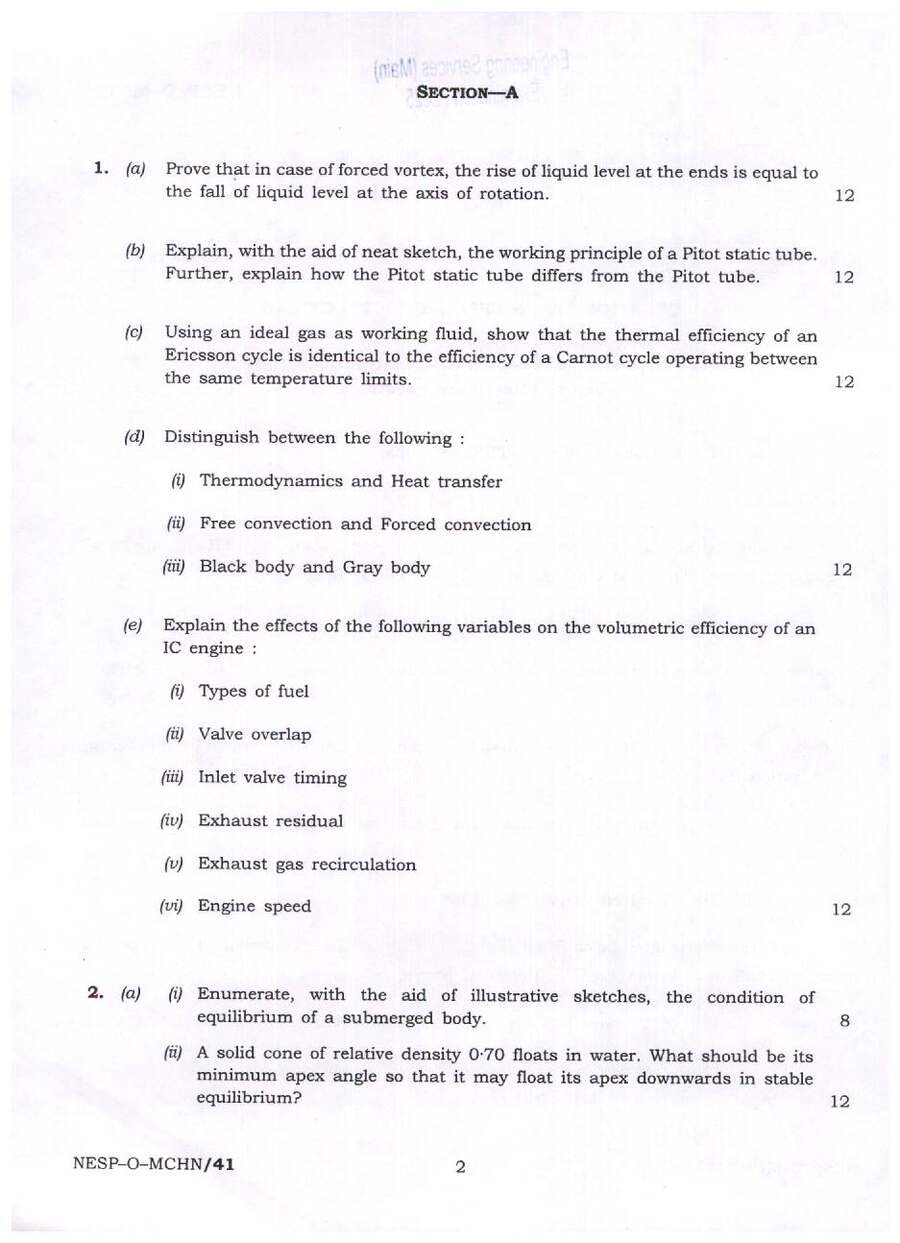
  • There are EIGHT questions divided in TWO Sections.
  • Candidate has to attempt FIVE questions in all.
  • Question Nos. 1 and 5 are compulsory and out of the remaining, any THREE are to be attempted choosing at least ONE question from each Section.
  • The number of marks carried by a question/part is indicated against it.
  • Wherever any assumptions are made for answering a question, they must be clearly indicated.
  • Diagrams/Figures, wherever required, shall be drawn in the space provided for answering the question itself.
  • Unless otherwise mentioned, symbols and notations carry their usual standard meanings.
  • Psychrometric Chart is given in Page No.
  • Attempts of questions shall be counted in sequential order.
  • Unless struck off, attempt of a question shall be counted even if attempted partly.
  • Any page or portion of the page left blank in the Question-cum-Answer Booklet must be clearly struck off.
  • Answers must be written in ENGLISH only.

Questions (page 2)

Section A

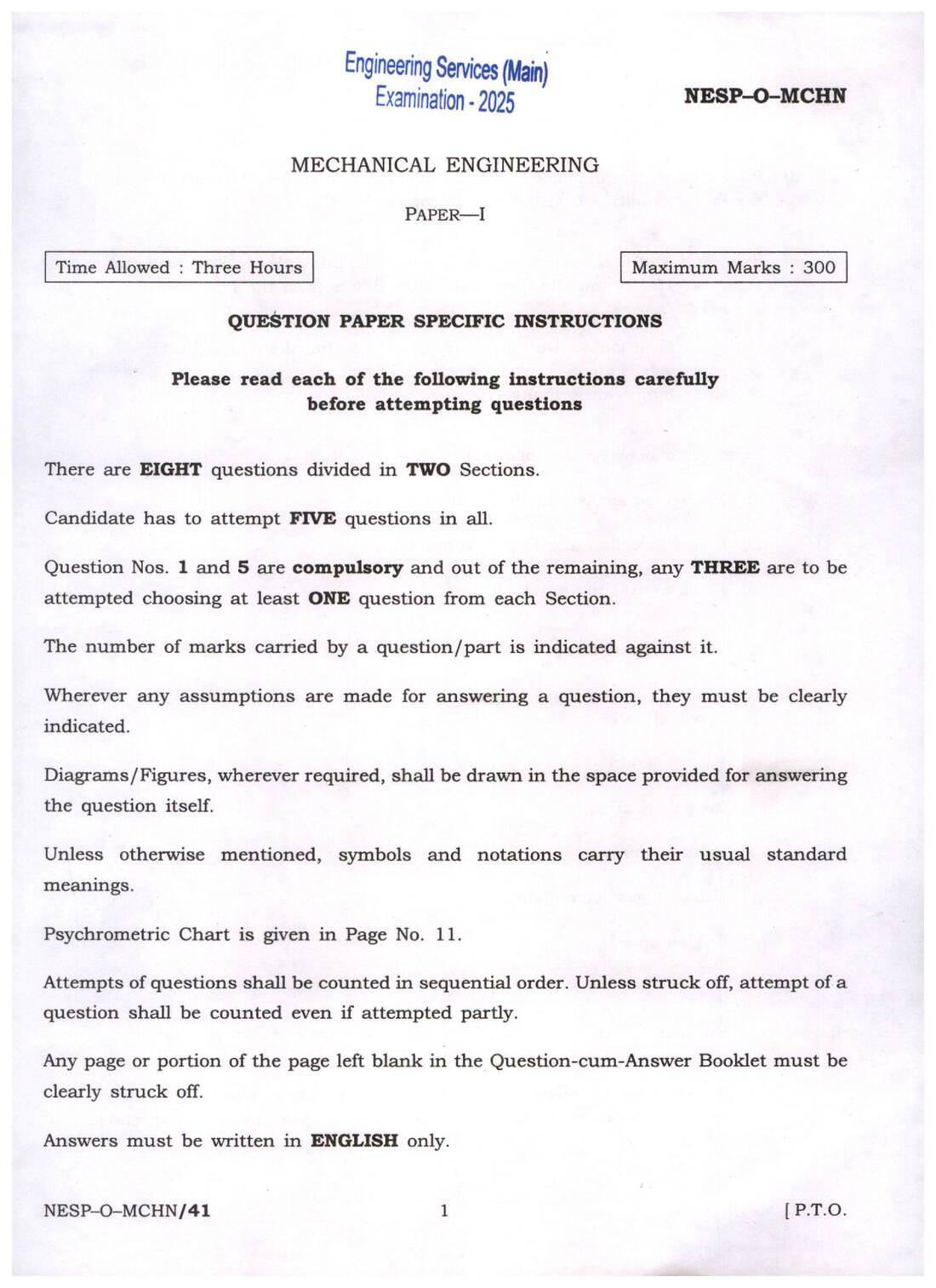
Q1. SECTION-A Prove that in case of forced vortex, the rise of liquid level at the ends is equal to the fall of liquid level at the axis of rotation. Explain, with the aid of neat sketch, the working principle of a Pitot static tube. Further, explain how the Pitot static tube differs from the Pitot tube. Using an ideal gas as working fluid, show that the thermal efficiency of an Ericsson cycle is identical to the efficiency of a Carnot cycle operating between the same temperature limits. Distinguish between the following : Explain the effects of the following variables on the volumetric efficiency of an IC engine :

(i) Thermodynamics and Heat transfer

(ii) Free convection and Forced convection

(iii) Black body and Gray body

(i) Types of fuel

(ii) Valve overlap

(iii) Inlet valve timing

(iv) Exhaust residual

(v) Exhaust gas recirculation

(vi) Engine speed

(a) the fall of liquid level at the axis of rotation. Explain, with the aid of neat sketch, the working principle of a Pitot static tube.

(b) Further, explain how the Pitot static tube differs from the Pitot tube. Using an ideal gas as working fluid, show that the thermal efficiency of an c) Ericsson cycle is identical to the efficiency of a Carnot cycle operating between the same temperature limits. Distinguish between the following :

(d) Thermodynamics and Heat transfer

(e) IC engine : Types of fuel
Section A

Q2. Enumerate, with the aid of illustrative sketches, the condition of equilibrium of a submerged body. A solid cone of relative density 0.70 floats in water. What should be its minimum apex angle so that it may float its apex downwards in stable equilibrium?

Question paper preview

Scanned pages 1–2 for reference. Download the official PDF for the full paper.

Page 1
UPSC Engineering Services 2025 Mechanical Engineering Paper I page 1 instructions scan PDF download. Official exam instructions for ESE Main 2025 Mechanical Engineering Paper I.
Page 2
UPSC Engineering Services 2025 Mechanical Engineering Paper I page 1 instructions scan PDF download. Official exam instructions for ESE Main 2025 Mechanical Engineering Paper I.

Free question paper download

Download question paper PDF

  • 5.2 MB
  • 7 pages
  • PDF format

Frequently asked questions

What is the exam name for this question paper?

The exam name is UPSC Engineering Services (Main) Examination.

What is the year of this question paper?

The year of this question paper is 2025.

Who is the conducting body for this examination?

The conducting body is UPSC (Union Public Service Commission).

What is the subject of this paper?

The subject is Mechanical Engineering.

What is the paper name and code?

The paper name is Mechanical Engineering Paper - I, and the paper code is NESP-O-MCHN/41.

How many questions are there in this paper?

There are 8 questions in total.

← Back to Engineer papers