Section A
Q1.
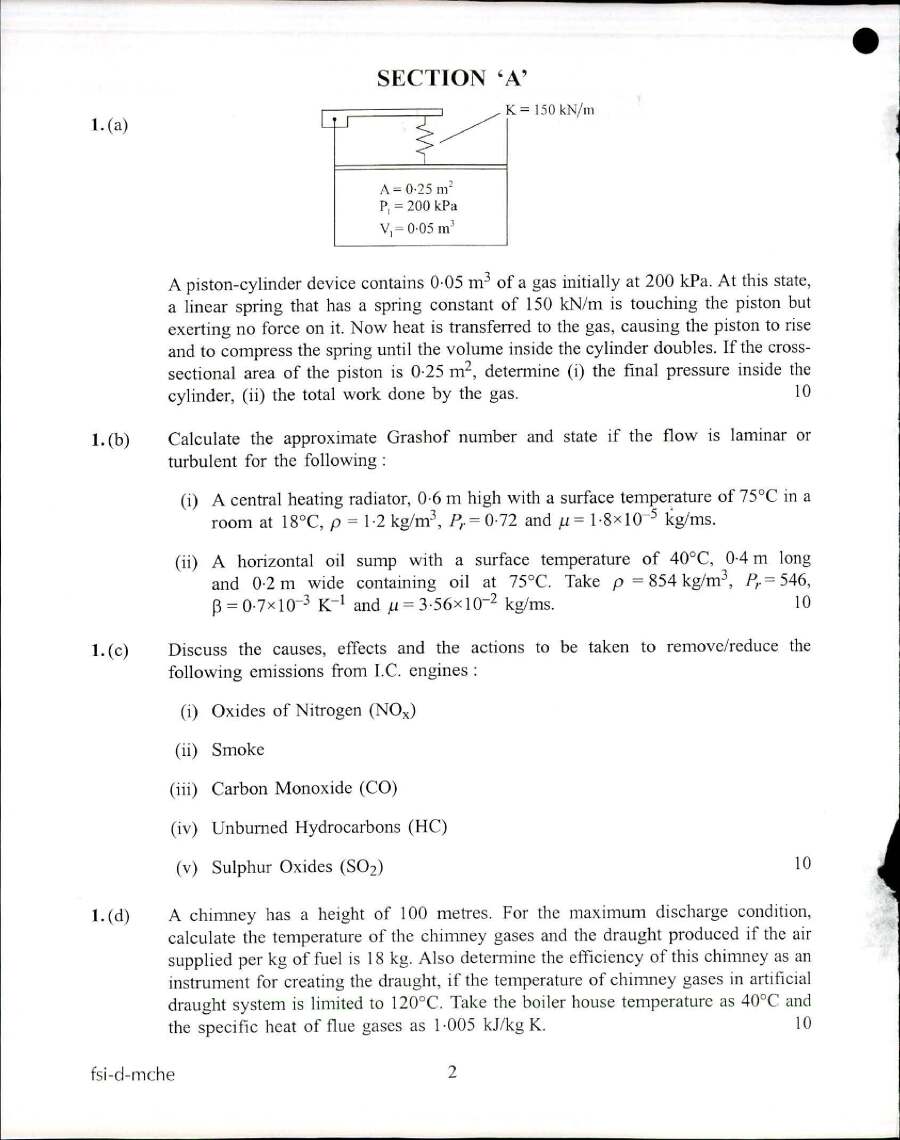
(a) A piston-cylinder device contains 0.05 \text m3 of a gas initially at 200 kPa. At this state, a linear spring that has a spring constant of 150 kN/m is touching the piston but exerting no force on it. Now heat is transferred to the gas, causing the piston to rise and to compress the spring until the volume inside the cylinder doubles. If the cross-sectional area of the piston is 0.25 \text m2, determine (i) the final pressure inside the cylinder, (ii) the total work done by the gas.
(b)
Calculate the approximate Grashof number and state if the flow is laminar or turbulent for the following:
(i) A central heating radiator, 0.6 m high with a surface temperature of 75\circC in a room at 18°C, \rho = 1.2 kg/m3, Pr = 0.72 and μ = 1.8 × 10⁻⁵ kg/ms.
(ii) A horizontal oil sump with a surface temperature of 40°C, 0.4 m long and 0.2 m wide containing oil at 75°C. Take \rho = 854 \text kg/m^3, Pr = 546, β = 0.7 × 10⁻³ \text K-1 and μ = 3.56 × 10⁻² \text kg/ms.
(c)
Discuss the causes, effects and the actions to be taken to remove/reduce the following emissions from I.C. engines :
(i) Oxides of Nitrogen (NOx)
(ii) Smoke
(iii) Carbon Monoxide (CO)
(iv) Unburned Hydrocarbons (HC)
(v) Sulphur Oxides (SO2)
(d) A chimney has a height of 100 metres. For the maximum discharge condition, calculate the temperature of the chimney gases and the draught produced if the air supplied per kg of fuel is 18 kg. Also determine the efficiency of this chimney as an instrument for creating the draught, if the temperature of chimney gases in artificial draught system is limited to 120°C. Take the boiler house temperature as 40°C and the specific heat of flue gases as 1.005 kJ/kg K.