Engineering Service 2019 Electronics & Telecommunication Paper-I PDF

Central Government Jobs Engineer 2019

  • Year 2019
  • Conducted By UPSC
  • Maximum Marks 300
  • Duration Three Hours
  • Languages English

Exam Details

Detail Information
Examination Engineering Service (Main) Examination
Year 2019
Conducting Body UPSC
Paper Electronics and Telecommunication Engineering Paper-I
Subject Electronics and Telecommunication Engineering
Duration Three Hours
Maximum Marks 300
Question Type Mixed

This is the official question paper for the UPSC Engineering Service (Main) Examination 2019, specifically for Electronics and Telecommunication Engineering Paper-I. The exam was conducted by UPSC and allowed candidates three hours to complete the paper, which carried a maximum of 300 marks. This paper is crucial for aspirants preparing for the ESE (Engineering Services Examination) as it provides insights into the types of questions asked and the difficulty level. Analyzing previous year papers like this one helps in strategizing preparation and identifying key topics for the Electronics and Telecommunication Engineering discipline.

Major Topics Covered

  • Semiconductor Devices
  • Diodes
  • Resistors
  • Crystal Defects
  • Measurement Instruments
  • Units and Systems of Units
  • Circuit Analysis
  • Small Signal Analysis

Why This Paper is Important

  • Useful for Engineering Service (Main) Examination preparation
  • Helps understand the latest exam pattern
  • Useful for practice and self-assessment
  • Covers frequently asked General Studies topics
  • Helpful for analysing question trends

Related Resources

  • ESE 2020 Electronics and Telecommunication Engineering Paper-I
  • ESE 2018 Electronics and Telecommunication Engineering Paper-I
  • ESE 2019 Electronics and Telecommunication Engineering Paper-II
  • ESE 2019 Electronics and Telecommunication Engineering Paper-I Answer Key
  • ESE Electronics and Telecommunication Engineering Syllabus
  • ESE Paper-I Syllabus
  • ESE Exam Pattern
  • ESE Main Exam Pattern

Instructions

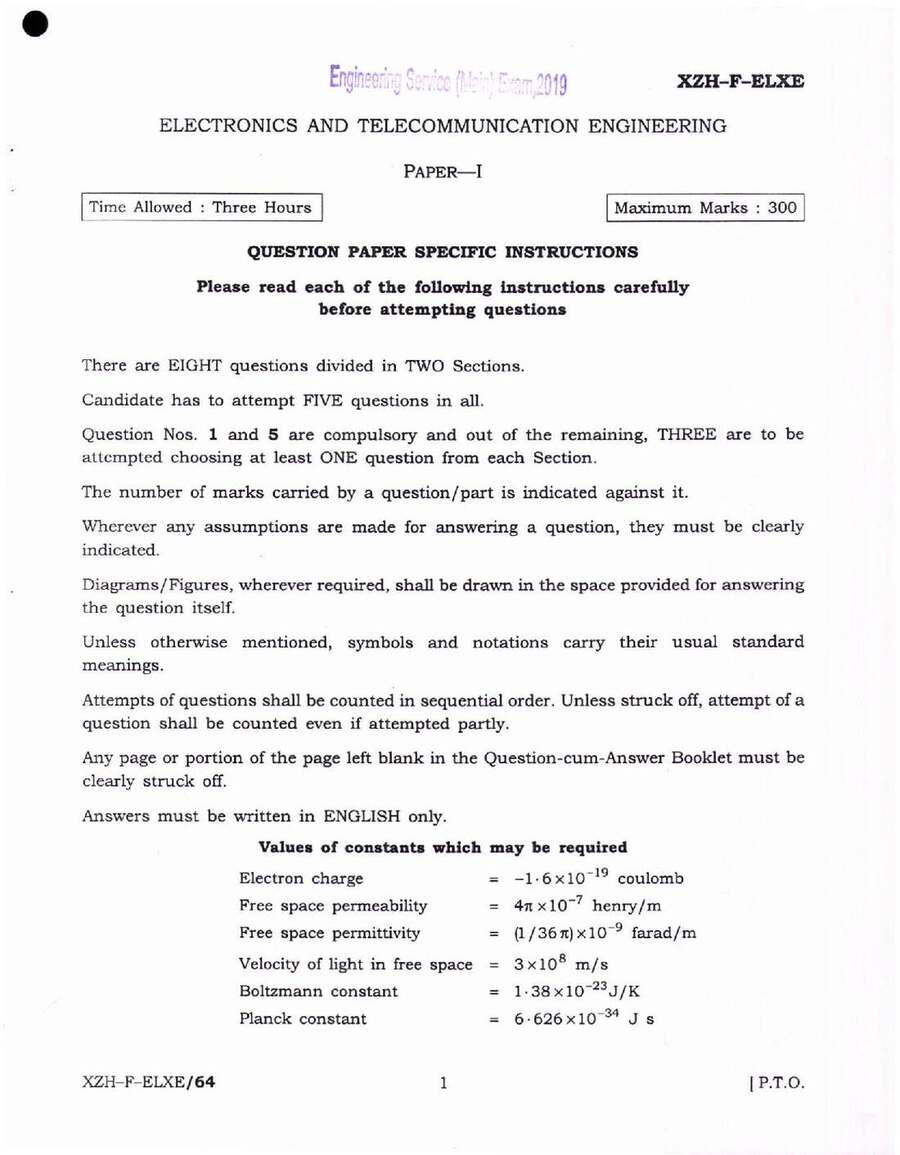
  • There are EIGHT questions divided in TWO Sections.
  • Candidate has to attempt FIVE questions in all.
  • Question Nos. 1 and 5 are compulsory and out of the remaining, THREE are to be attempted choosing at least ONE question from each Section.
  • The number of marks carried by a question/part is indicated against it.
  • Wherever any assumptions are made for answering a question, they must be clearly indicated.
  • Diagrams/Figures, wherever required, shall be drawn in the space provided for answering the question itself.
  • Unless otherwise mentioned, symbols and notations carry their usual standard meanings.
  • Attempts of questions shall be counted in sequential order.
  • Unless struck off, attempt of a question shall be counted even if attempted partly.
  • Any page or portion of the page left blank in the Question-cum-Answer Booklet must be clearly struck off.
  • Answers must be written in ENGLISH only.
  • Values of constants which may be required = -1.6 \times 10^{-19} coulomb Electron charge = 4\pi \times 10^{-7} henry/m Free space permeability = (1/36 \pi) \times 10^{-9} farad/m Free space permittivity Velocity of light in free space = 3 \times 10^8 m/s = 1.38 \times 10^{-23} J/K Boltzmann constant = 6.626 \times 10^{-34} J s Planck constant

Questions (page 2)

Section A

Q1.

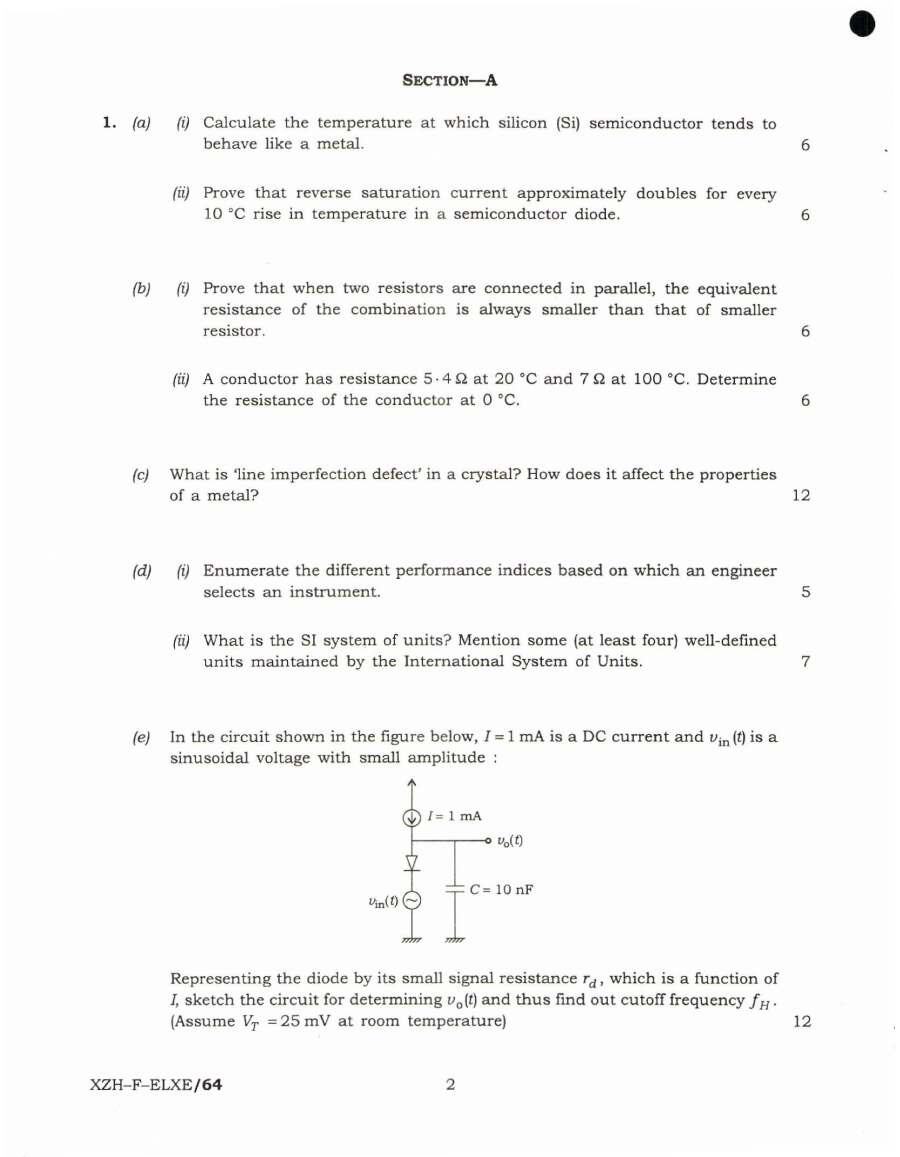
(a) (i) Calculate the temperature at which silicon (Si) semiconductor tends to behave like a metal. (ii) Prove that reverse saturation current approximately doubles for every 10 °C rise in temperature in a semiconductor diode.

(b) (i) Prove that when two resistors are connected in parallel, the equivalent resistance of the combination is always smaller than that of smaller resistor. (ii) A conductor has resistance 5.4 \Omega at 20 °C and 7 \Omega at 100 °C. Determine the resistance of the conductor at 0 °C.

(c) What is 'line imperfection defect' in a crystal? How does it affect the properties of a metal?

(d) (i) Enumerate the different performance indices based on which an engineer selects an instrument. (ii) What is the SI system of units? Mention some (at least four) well-defined units maintained by the International System of Units.

(e) In the circuit shown in the figure below, I = 1 mA is a DC current and v_{\textin}(t) is a sinusoidal voltage with small amplitude : Representing the diode by its small signal resistance rd, which is a function of I, sketch the circuit for determining v0(t) and thus find out cutoff frequency fH. (Assume VT = 25 mV at room temperature)
Question paper preview

Scanned pages 1–2 for reference. Download the official PDF for the full paper.

Page 1
UPSC Engineering Service Main Examination 2019 Electronics and Telecommunication Engineering Paper-I page 1 instructions scan PDF download
Page 2
UPSC Engineering Service Main Examination 2019 Electronics and Telecommunication Engineering Paper-I page 1 instructions scan PDF download

Free question paper download

Download question paper PDF

  • 2.8 MB
  • 12 pages
  • PDF format

Frequently asked questions

What is the name of the examination?

The examination is the Engineering Service (Main) Examination.

Which year is this question paper from?

This question paper is from the year 2019.

Who conducts the Engineering Service Examination?

The examination is conducted by UPSC (Union Public Service Commission).

What is the subject of this paper?

The subject is Electronics and Telecommunication Engineering.

What is the paper code?

The paper code is XZH-F-ELXE.

What is the duration allowed for the exam?

The time allowed for the exam is Three Hours.

← Back to Engineer papers