Engineering Service Electrical Engineering Paper I 2019 Question Paper PDF

Central Government Jobs Engineer 2019

  • Year 2019
  • Conducted By UPSC
  • Maximum Marks 300
  • Duration Three Hours
  • Languages English

Exam Details

Detail Information
Examination Engineering Service (Main) Examination
Year 2019
Conducting Body UPSC
Paper Electrical Engineering Paper I
Subject Electrical Engineering
Duration Three Hours
Maximum Marks 300
Question Type Mixed

This is the official question paper for the UPSC Engineering Service (Main) Examination 2019, specifically for Electrical Engineering Paper I. The exam was conducted by the Union Public Service Commission (UPSC) and allowed candidates three hours to complete the paper, which carried a maximum of 300 marks. This paper is crucial for aspirants preparing for the main stage of the Engineering Service Examination, offering insights into the types of objective and descriptive questions asked in Electrical Engineering.

Major Topics Covered

  • Eigen vectors
  • Superconductivity
  • Superconducting materials
  • Capacitor plates
  • Electric flux density
  • Gauss's law
  • Z parameters
  • Hall effect
  • Free electrons in metals

Why This Paper is Important

  • Useful for Engineering Service (Main) Examination preparation
  • Helps understand the latest exam pattern
  • Useful for practice and self-assessment
  • Covers frequently asked General Studies topics
  • Helpful for analysing question trends

Related Resources

  • UPSC Engineering Service (Main) Examination 2019 - Electrical Engineering Paper II
  • UPSC Engineering Service (Preliminary) Examination 2019 - Paper I
  • UPSC Engineering Service (Preliminary) Examination 2019 - Paper II
  • ESE 2019 Electrical Engineering Paper I Answer Key
  • UPSC ESE 2019 Electrical Engineering Solutions
  • ESE Electrical Engineering Syllabus
  • UPSC Engineering Service Exam Syllabus
  • ESE Exam Pattern

Instructions

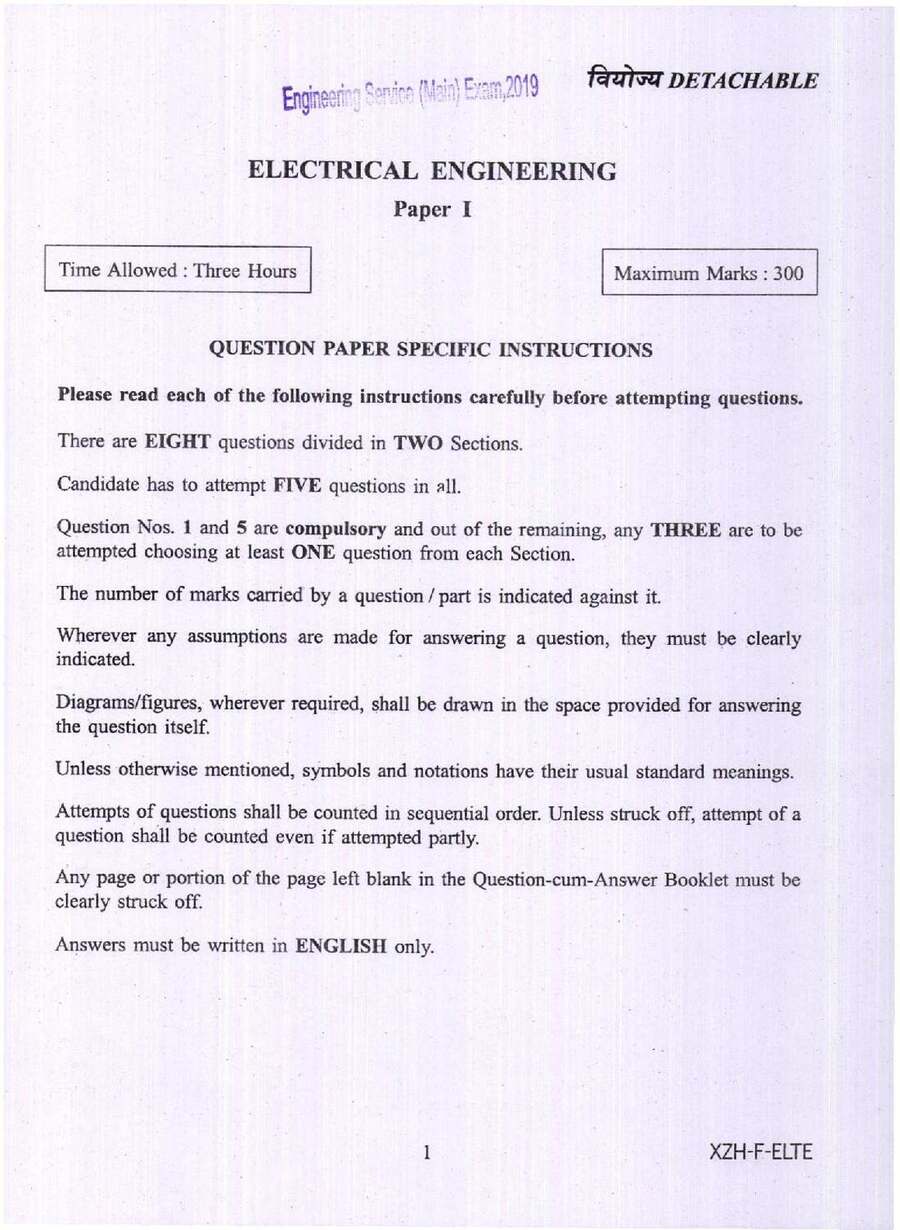
  • वियोज्य DETACHABLE Engineering Service (Main) Exam, 2019 ELECTRICAL ENGINEERING Paper I

  • There are EIGHT questions divided in TWO Sections.
  • Candidate has to attempt FIVE questions in all.
  • Question Nos. 1 and 5 are compulsory and out of the remaining, any THREE are to be attempted choosing at least ONE question from each Section.
  • The number of marks carried by a question / part is indicated against it.
  • Wherever any assumptions are made for answering a question, they must be clearly indicated.
  • Diagrams/figures, wherever required, shall be drawn in the space provided for answering the question itself.
  • Unless otherwise mentioned, symbols and notations have their usual standard meanings.
  • Attempts of questions shall be counted in sequential order.
  • Unless struck off, attempt of a question shall be counted even if attempted partly.
  • Any page or portion of the page left blank in the Question-cum-Answer Booklet must be clearly struck off.
  • Answers must be written in ENGLISH only.

Questions (page 2)

Section A

Q1.

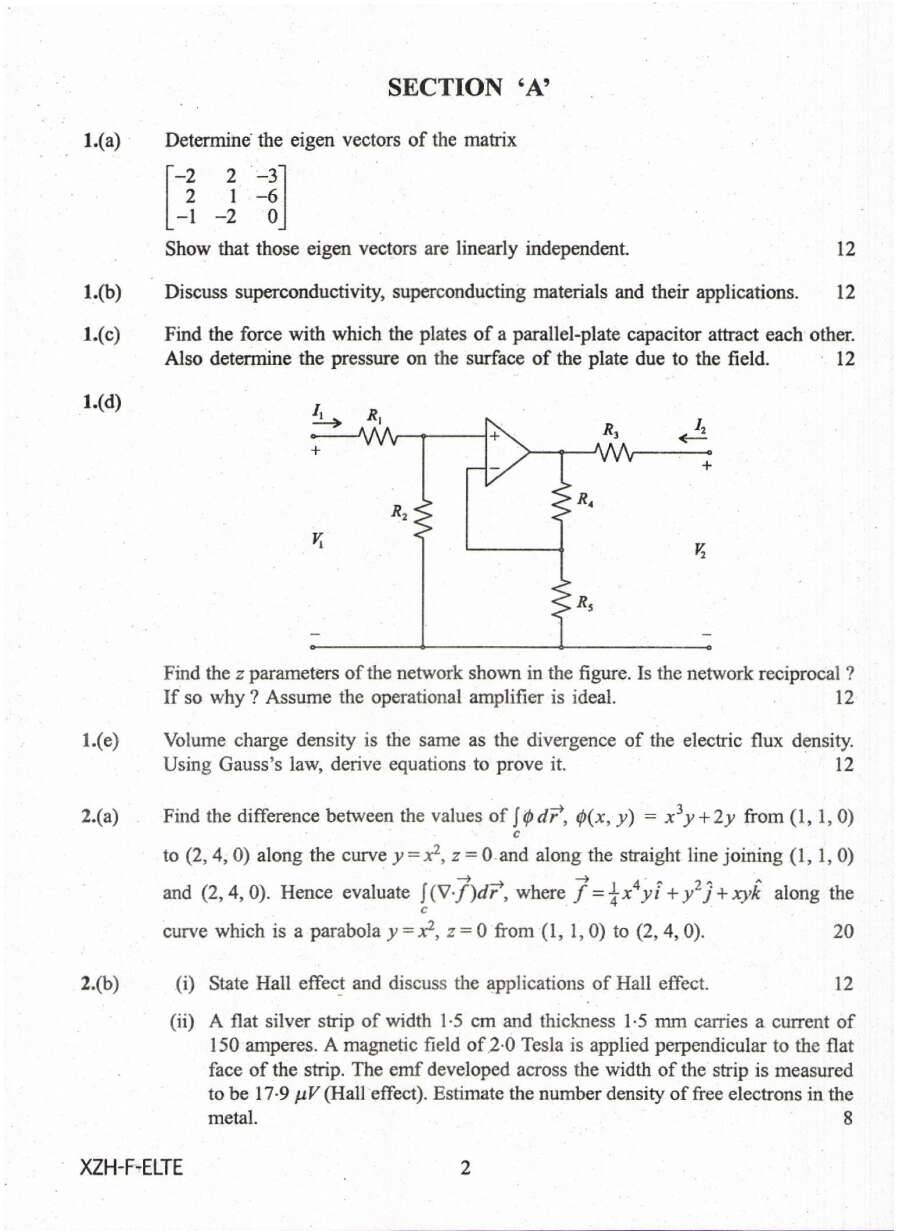
(a) Determine the eigen vectors of the matrix \beginvmatrix -2 & 2 & -3 \\ 2 & 1 & -6 \\ -1 & -2 & 0 \endvmatrix Show that those eigen vectors are linearly independent.

(b) Discuss superconductivity, superconducting materials and their applications.

(c) Find the force with which the plates of a parallel-plate capacitor attract each other. Also determine the pressure on the surface of the plate due to the field.

(d) Find the z parameters of the network shown in the figure. Is the network reciprocal? If so why? Assume the operational amplifier is ideal.

(e) Volume charge density is the same as the divergence of the electric flux density. Using Gauss's law, derive equations to prove it.
Section A

Q2.

(a) Find the difference between the values of ∫ \phi d\vecr, \phi(x, y) = x3y + 2y from (1, 1, 0) to (2, 4, 0) along the curve y = x2, z = 0 and along the straight line joining (1, 1, 0) and (2, 4, 0). Hence evaluate ∫ (\nabla \cdot \vecf)d\vecr, where \vecf = 1/4x4y\hati + y2\hatj + xy\hatk along the curve which is a parabola y = x2, z = 0 from (1, 1, 0) to (2, 4, 0).

(b) (i) State Hall effect and discuss the applications of Hall effect.
(ii) A flat silver strip of width 1.5 cm and thickness 1.5 mm carries a current of 150 amperes. A magnetic field of 2.0 Tesla is applied perpendicular to the flat face of the strip. The emf developed across the width of the strip is measured to be 17.9 \muV (Hall effect). Estimate the number density of free electrons in the metal.

Question paper preview

Scanned pages 1–2 for reference. Download the official PDF for the full paper.

Page 1
UPSC Engineering Service (Main) Examination 2019 Electrical Engineering Paper I question paper page 1 instructions scan PDF download
Page 2
UPSC Engineering Service (Main) Examination 2019 Electrical Engineering Paper I question paper page 1 instructions scan PDF download

Free question paper download

Download question paper PDF

  • 3.2 MB
  • 8 pages
  • PDF format

Frequently asked questions

What is the name of the examination?

The examination is the Engineering Service (Main) Examination.

Which year is this question paper from?

This question paper is from the year 2019.

Who conducts the Engineering Service Examination?

The Engineering Service Examination is conducted by the UPSC (Union Public Service Commission).

What is the subject of this paper?

This paper is for Electrical Engineering, specifically Paper I.

What is the duration of the exam?

The time allowed for this paper is Three Hours.

What is the maximum marks for this paper?

The maximum marks for Electrical Engineering Paper I is 300.

← Back to Engineer papers