Uttarakhand High Court ARO/Typist Exam 2014 - English Language Paper-I

Uttarakhand Government Jobs Other Jobs 2014

  • Year 2014
  • Conducted By UKPSC
  • Maximum Marks 200
  • Duration Three Hours

Exam Details

Detail Information
Examination Uttarakhand High Court Assistant Review Officer (ARO) / Typist Examination
Year 2014
Conducting Body UKPSC
Duration Three Hours
Maximum Marks 200

This page hosts the Uttarakhand High Court Assistant Review Officer (ARO) / Typist Examination (2014) question paper conducted by UKPSC. Maximum marks: 200. Duration: Three Hours. Read exam instructions and page-2 questions online, or download the official PDF for offline practice.

Major Topics Covered

  • Uttarakhand High Court Assistant Review Officer (ARO) / Typist Examination
  • UKPSC
  • 2014 question paper
  • previous year paper
  • PDF download

Why This Paper is Important

  • Useful for Uttarakhand High Court Assistant Review preparation
  • Helps understand the latest exam pattern
  • Useful for practice and self-assessment
  • Covers frequently asked General Studies topics
  • Helpful for analysing question trends

Related Resources

Instructions

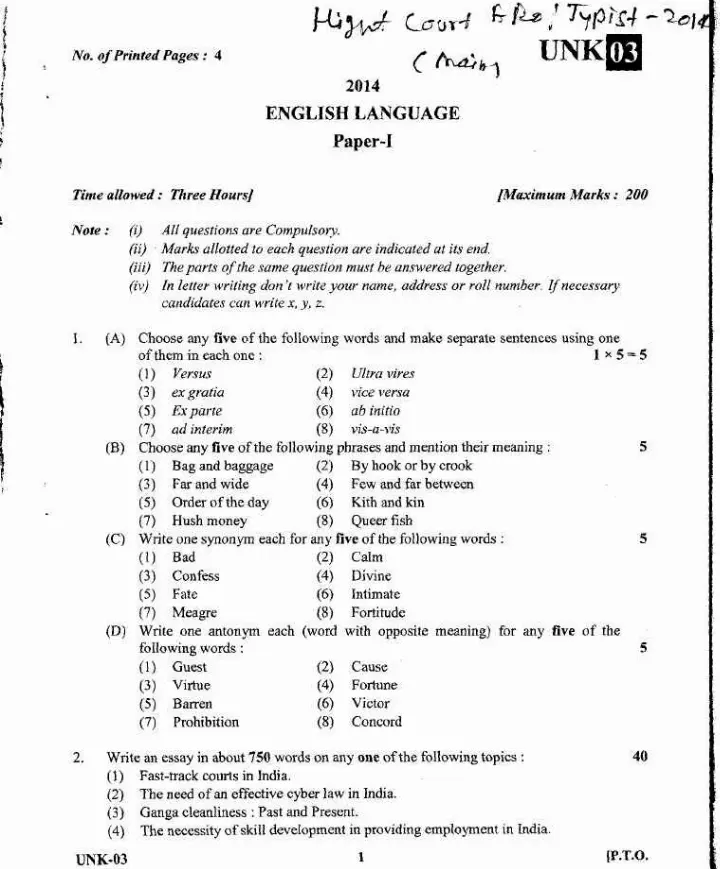
  • Hight Court Ele/Typist-2014 No. of Printed Pages: 4 2014 ENGLISH LANGUAGE Paper-I Time allowed: Three Hours] [Maximum Marks: 200
  • Note: All questions are Compulsory.
  • (ii) Marks allotted to each question are indicated at its end.
  • (iii) The parts of the same question must be answered together.
  • (iv) In letter writing don't write your name, address or roll number. If necessary candidates can write x, y, z.

Questions (page 2)

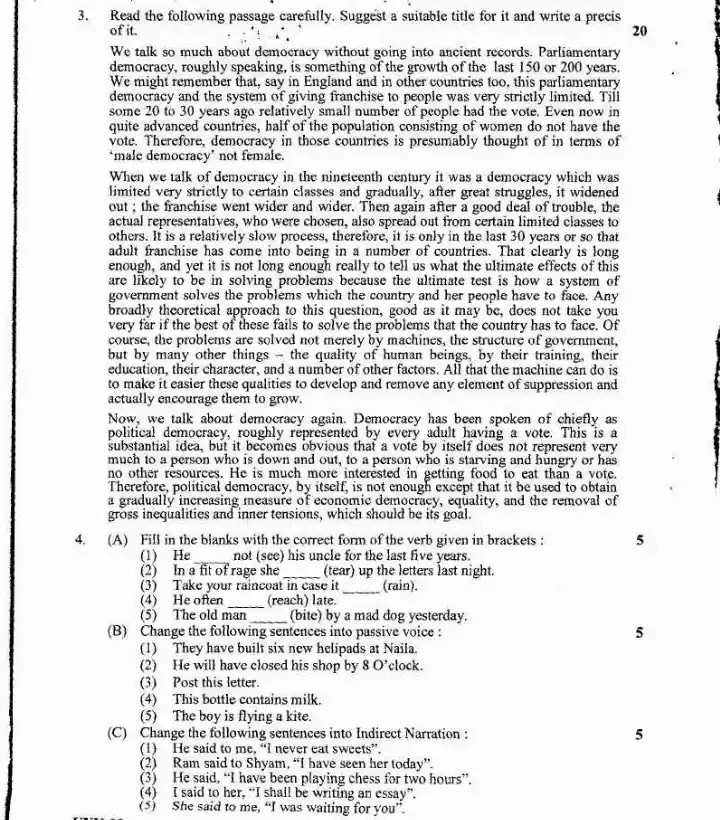
Q3. Read the following passage carefully. Suggest a suitable title for it and write a precis of it.

(अ) We talk so much about democracy without going into ancient records. Parliamentary democracy, roughly speaking, is something of the growth of the last 150 or 200 years. We might remember that, say in England and in other countries too, this parliamentary democracy and the system of giving franchise to people was very strictly limited. Till some 20 to 30 years ago relatively small number of people had the vote. Even now in quite advanced countries, half of the population consisting of women do not have the vote. Therefore, democracy in those countries is presumably thought of in terms of 'male democracy' not female.
When we talk of democracy in the nineteenth century it was a democracy which was limited very strictly to certain classes and gradually, after great struggles, it widened out; the franchise went wider and wider. Then again after a good deal of trouble, the actual representatives, who were chosen, also spread out from certain limited classes to others. It is a relatively slow process, therefore, it is only in the last 30 years or so that adult franchise has come into being in a number of countries. That clearly is long enough, and yet it is not long enough really to tell us what the ultimate effects of this are likely to be in solving problems because the ultimate test is how a system of government solves the problems which are before it and her people have to face. Any broadly theoretical approach to this question, good and bad as it may be, does not take you very far; the best of these fails to solve the problems which the country has to face. Of course, the problems are solved not merely by machines, the structure of government, but by many other things, - the quality and nature of human beings, by their training, their education, their character, and a number of other factors. All that the machine can do is to make it easier these qualities to develop and remove any element of suppression and actually encourage them to grow.
Now, we talk about democracy again. Democracy has been spoken of chiefly as political democracy, roughly represented by every adult having a vote. This is a substantial idea, but it becomes obvious that a vote by itself does not represent very much to a person who is down and out, to a person who is starving and hungry or has no other resources. He is much more interested in getting food to eat than a vote. Therefore, political democracy, by itself, is not enough except that it be used to obtain a gradually increasing measure of economic democracy, equality, and the removal of gross inequalities and inner tensions, which should be its goal.
Q4.

(अ) (A) Fill in the blanks with the correct form of the verb given in brackets:
(1) He ___ not (see) his uncle for the last five years.
(2) In a fit of rage she ___ (tear) up the letters last night.
(3) Take your raincoat in case it ___ (rain).
(4) He often ___ (reach) late.
(5) The old man ___ (bite) by a mad dog yesterday.

(ब) (B) Change the following sentences into passive voice:
(1) They have built six new helipads at Naila.
(2) He will have closed his shop by 8 O'clock.
(3) Post this letter.
(4) This bottle contains milk.
(5) The boy is flying a kite.

(स) (C) Change the following sentences into Indirect Narration:
(1) He said to me, "I never eat sweets".
(2) Ram said to Shyam, "I have seen her today".
(3) He said, "I have been playing chess for two hours".
(4) I said to her, "I shall be writing an essay".
(5) She said to me, "I was waiting for you".

Question paper preview

Scanned pages 1–2 for reference. Download the official PDF for the full paper.

Page 1
Uttarakhand High Court ARO/Typist Exam 2014 - English Language Paper-I — page 1 instructions scan PDF download
Page 2
Uttarakhand High Court ARO/Typist Exam 2014 - English Language Paper-I — page 1 instructions scan PDF download

Free question paper download

Download question paper PDF

  • 159 KB
  • PDF format

Frequently asked questions

Where can I download the Uttarakhand High Court Assistant Review Officer (ARO) / Typist Examination question paper PDF?

Use the Download PDF button on this page to save the official Uttarakhand High Court Assistant Review Officer (ARO) / Typist Examination (2014) General paper paper hosted on QuizCurrent.

Who conducts the Uttarakhand High Court Assistant Review Officer (ARO) / Typist Examination?

The Uttarakhand High Court Assistant Review Officer (ARO) / Typist Examination is conducted by UKPSC. This portal reproduces the scanned question paper for practice and revision.

Does this page include exam instructions and questions?

Yes. Page 1 instructions and page 2 questions are extracted from the official PDF OCR so you can read them without downloading.

How many questions are on this paper?

Refer to the instructions section on page 1 for the total question count and marking scheme.

← Back to Other Jobs papers