
UKPSC Forest Range Officer Mains 2015 Botany Question Paper PDF
- Year 2015
- Conducted By UKPSC
- Maximum Marks 200
- Duration Three Hours
- Languages Hindi & English
Exam Details
| Detail | Information |
|---|---|
| Examination | UKPSC Forest Range Officer (Mains) Exam |
| Year | 2015 |
| Conducting Body | UKPSC |
| Paper | Botany |
| Subject | Botany |
| Duration | Three Hours |
| Maximum Marks | 200 |
| Question Type | Mixed |
This is the Botany paper for the UKPSC Forest Range Officer (Mains) Examination held in 2015. The paper is divided into two sections, 'A' and 'B', with a total of eight questions, requiring candidates to attempt any five, with at least two from each section. Each question carries equal marks, contributing to a maximum of 200 marks for the entire paper, which is to be completed within three hours. This question paper is a crucial resource for aspirants aiming to understand the exam's scope, difficulty level, and key topics in Botany for the UKPSC Forest Range Officer role. This previous year Uttarakhand Public Service Commission (UKPSC) Forest Range Officer (Mains) Exam question paper (2015) is useful for Other Jobs aspirants preparing for Uttarakhand government recruitment. The paper was conducted by UKPSC and reflects the official exam pattern, marking scheme and difficulty level seen in recent cycles. Use it for timed practice, topic-wise revision and understanding how questions are framed in the real examination. Download the free PDF on QuizCurrent to read instructions, attempt MCQs and compare your answers with the study notes provided on this page. Key syllabus areas include Industrial Processes, Microbes, Microbial Role, Microbial Diversity, Human Microbiome, Commensals, Infection, Immunity. Useful for Forest Range Officer (Mains) Exam preparation. Helps understand the latest exam pattern. Useful for practice and self-assessment.
Major Topics Covered
- Industrial Processes
- Microbes
- Microbial Role
- Microbial Diversity
- Human Microbiome
- Commensals
- Infection
- Immunity
- Antibiotics
- Viruses
- Gram Staining
- Fungi
- Plant Diseases
- Pathogenicity
- Wheat Diseases
- Fungal Diseases
- Plant Pathology
- Plant Defense Mechanisms
- Biochemical Defense
- Viral Diseases in Plants
- Disease Diagnosis
Why This Paper is Important
- Useful for Forest Range Officer (Mains) Exam preparation
- Helps understand the latest exam pattern
- Useful for practice and self-assessment
- Covers frequently asked General Studies topics
- Helpful for analysing question trends
Related Resources
- UKPSC Forest Range Officer (Mains) Exam 2016 Botany
- UKPSC Forest Range Officer (Mains) Exam 2014 Botany
- UKPSC ACF Exam Botany Paper
- UKPSC Forest Range Officer Mains 2015 Botany Answer Key
- UKPSC Forest Range Officer Mains Syllabus
- Botany Syllabus for Competitive Exams
- UKPSC Forest Range Officer Mains Exam Pattern
- UKPSC Exam Pattern for Mains
Instructions
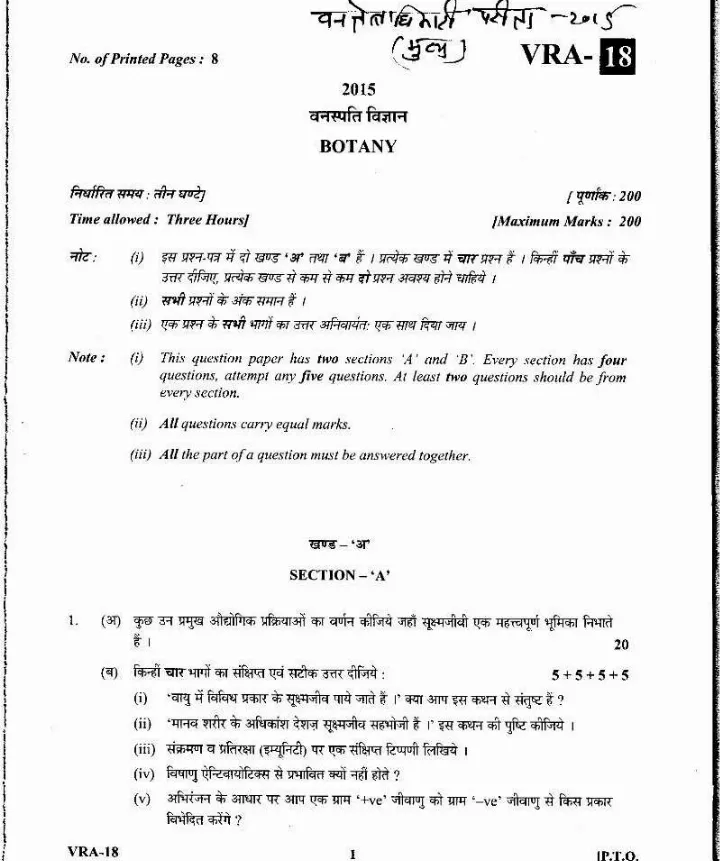
- पूर्णांक : 200 Time allowed: Three Hours] [Maximum Marks: 200 (i) इस प्रश्न-पत्र में दो खण्ड ‘अ’ तथा ‘ब’ हैं । प्रत्येक खण्ड में चार प्रश्न हैं । किन्हीं पाँच प्रश्नों के नोट: उत्तर दीजिए, प्रत्येक खण्ड से कम से कम दो प्रश्न अवश्य होने चाहिये । (ii) सभी प्रश्नों के अंक समान हैं । (iii) एक प्रश्न के सभी भागों का उत्तर अनिवार्यत: एक साथ दिया जाय । This question paper has two sections 'A' and 'B'. Every section has four
- Note: \left( i\right) questions, attempt any five questions. At least two questions should be from every section.
- (ii) All questions carry equal marks.
- (iii) All the part of a question must be answered together. खण्ड – ‘अ’ SECTION - 'A' (अ) कुछ उन प्रमुख औद्योगिक प्रक्रियाओं का वर्णन कीजिये जहाँ सूक्ष्मजीवी एकं महत्त्वपूर्ण भूमिका निभाते
- (i) ‘मानव शरीर के अधिकांश देशज़ सूक्ष्मजीव सहभोजी हैं ।’ इस कथन की पृष्टि कीजिये ।
- (iii) संक्रमण व प्रतिरक्षा (इम्यूनिटी) पर एक संक्षिप्त टिप्पणी लिखिये ।
- (iv) विषाणु ऐन्टिबायोटिक्स से प्रभावित क्यों नहीं होते ?
- (v) अभिरंजन के आधार पर आप एक ग्राम ‘+ve’ जीवाणु को ग्राम ‘–ve’ जीवाणु से किस प्रकार विभेदित करेंगे ? VRA-18 1
Questions (page 2)
Formatted from page 2 OCR. Download the PDF for the full paper.
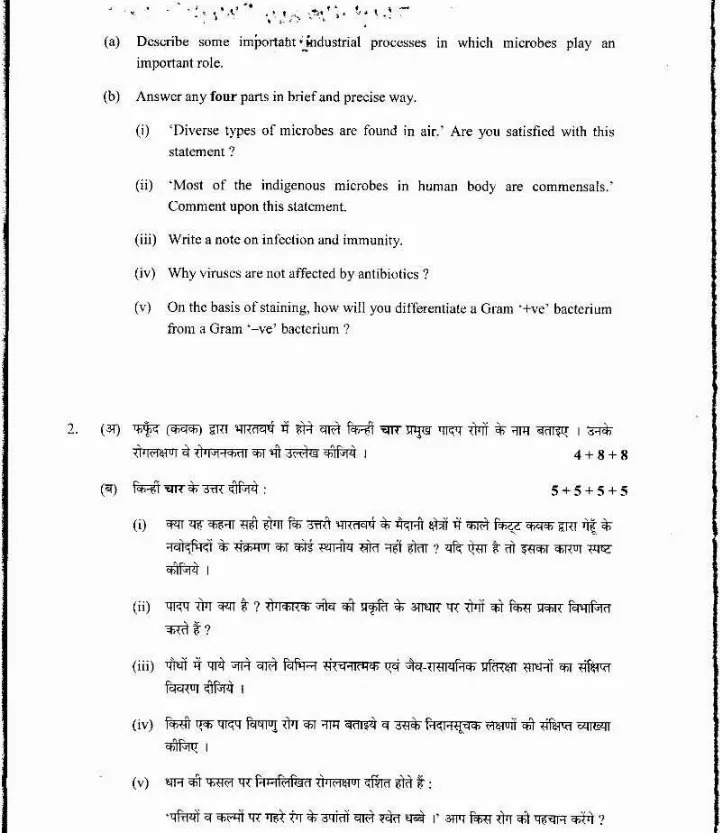
ានសារដែលជា ប្រទេសដែលជា Describe some important industrial processes in which microbes play an (a) important role. (b) Answer any four parts in brief and precise way. (i) 'Diverse types of microbes are found in air.' Are you satisfied with this statement? (ii) 'Most of the indigenous microbes in human body are commensals.' Comment upon this statement. (iii) Write a note on infection and immunity. (iv) Why viruses are not affected by antibiotics? On the basis of staining, how will you differentiate a Gram ' + ve' bacterium (v) from a Gram '-ve' bacterium ? (अ) फफूँद (कवक) द्वारा भारतवर्ष में होने वाले किन्हीं चार प्रमुख पादप रोगों के नाम बताइए । उनके
Question paper preview
Scanned pages 1–2 for reference. Download the official PDF for the full paper.
Free question paper download
Download question paper PDF
Your download starts in 10s
Preparing your question paper file…
Frequently asked questions
What is the name of the exam for which this Botany paper was conducted?
This Botany paper is from the UKPSC Forest Range Officer (Mains) Examination.
What is the conducting body for this exam?
The exam is conducted by the Uttarakhand Public Service Commission (UKPSC).
In which year was this Botany paper released?
This Botany paper was released in the year 2015.
What is the maximum marks for this Botany paper?
The maximum marks for this Botany paper is 200.
What is the time duration allowed for this paper?
The time allowed for this paper is Three Hours.
How many sections are there in this Botany paper?
This Botany paper has two sections: Section 'A' and Section 'B'.