
Uttarakhand Judicial Service Paper I – Substantive Law 2015
- Year 2015
- Conducted By Uttarakhand Government
- Questions 6
- Maximum Marks 200
- Duration Three Hours
- Languages Hindi & English
Exam Details
| Detail | Information |
|---|---|
| Examination | LAW - I (Substantive Law) Paper - I |
| Year | 2015 |
| Conducting Body | Uttarakhand Government |
| Paper | LAW - I (Substantive Law) Paper - I |
| Subject | Law |
| Duration | Three Hours |
| Maximum Marks | 200 |
| Number of Questions | 6 |
| Question Type | Descriptive / Subjective |
This SEO bundle consolidates PAGE 1 and PAGE 2 OCR for LAW I (Substantive Law) Paper I (2015 Uttarakhand Judicial Service Civil Judge Junior Division). Page 1 provides exam header, time, marks, compulsory questions, and the start of two questions. Page 2 contains the repaired, numbered questions (1–5) covering Transfer of Property Act 53A, partnership dissolution, Hindu and Muslim law topics, contract of indemnity, easements, ostensible ownership, and representative liability. The combined content yields six questions in the paper with a total of 200 marks in three hours. The materials offer bilingual Hindi-English phrasing and reflect the exam’s descriptive/essay style with subparts. This previous year Uttarakhand Judicial Service Civil Judge (Junior Division) Exam question paper (2015) is useful for Judicial aspirants preparing for Uttarakhand government recruitment. The paper was conducted by UKPSC and reflects the official exam pattern, marking scheme and difficulty level seen in recent cycles. Use it for timed practice, topic-wise revision and understanding how questions are framed in the real examination. Download the free PDF on QuizCurrent to read instructions, attempt MCQs and compare your answers with the study notes provided on this page. Key syllabus areas include 53A Transfer of Property Act, Possession without title, Privity of consideration, Privity of contract, Partnership firm registration and consequences, Dissolution of partnership by court, English law principles in India, Transfer of property and title issues. Useful for LAW - I (Substantive Law) Paper - I preparation. Helps understand the latest exam pattern. Useful for practice and self-assessment.
Major Topics Covered
- 53A Transfer of Property Act
- Possession without title
- Privity of consideration
- Privity of contract
- Partnership firm registration and consequences
- Dissolution of partnership by court
- English law principles in India
- Transfer of property and title issues
- Easements
- Ostensible owner
- Indemnity vs Guarantee
- Representative liability
- Hindu Marriage Act, 1955
- Grounds for divorce in Hindu law
- Maintenance obligations under Muslim law
Why This Paper is Important
- Useful for LAW - I (Substantive Law) Paper - I preparation
- Helps understand the latest exam pattern
- Useful for practice and self-assessment
- Covers frequently asked General Studies topics
- Helpful for analysing question trends
Related Resources
- Uttarakhand Judicial Service Civil Judge 2025 GK & Laws Question Paper PDF
- UKPSC Judicial Service Civil Judge 2025 GK & Laws Question Paper PDF
- UKPSC Judicial Service Civil Judge 2021 General Knowledge & Law Question Paper PDF
- Uttarakhand Judicial Service Language Paper I 2019 - Translation & Rights
- UKPSC Uttarakhand Judicial Service Law III 2019 Question Paper PDF
Instructions
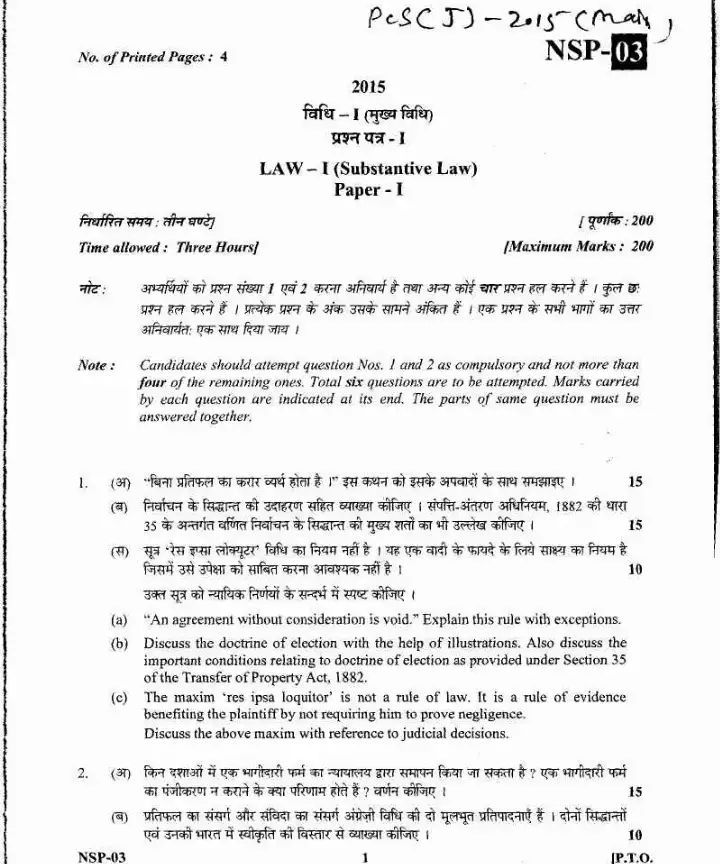
- प्रश्न पत्र - I LAW - I (Substantive Law) Paper - I निर्धारित समय : तीन घण्टे] [ पूर्णांक : 200 [Maximum Marks: 200 Time allowed: Three Hours] अभ्यर्थियों को प्रश्न संख्या 1 एवं 2 करना अनिवार्य है तथा अन्य कोई चार प्रश्न हल करने हैं । कुल छ:
- नोट: प्रश्न हल करने हैं । प्रत्येक प्रश्न के अंक उसके सामने अंकित हैं । एक प्रश्न के सभी भागों का उत्तर अनिवार्यत: एक साथ दिया जाय । Note: Candidates should attempt question Nos. 1 and 2 as compulsory and not more than four of the remaining ones. Total six questions are to be attempted. Marks carried by each question are indicated at its end. The parts of same question must be answered together. (अ) “बिना प्रतिफल का करार व्यर्थ होता है । ” इस कथन को इसके अपवादों के साथ समझाइए ।
- निर्वाचन के सिद्धान्त की उदाहरण सहित व्याख्या कीजिए । संपत्ति-अंतरण अधिनियम, 1882 की धारा (ৰ) 35 के अन्तर्गत वर्णित निर्वाचन के सिद्धान्त को मुख्य शर्तों का भी उल्लेख कीजिए । 15 सूत्र ‘रेस इप्सा लोक्यूटर’ विधि का नियम नहीं है । यह एक वादी के फायदे के लिये साक्ष्य का नियम है (F) जिसमें उसे उपेक्षा को साबित करना आवश्यक नहीं है । 10 उक्त सूत्र को न्यायिक निर्णयों के सन्दर्भ में स्पष्ट कोजिए । "An agreement without consideration is void." Explain this rule with exceptions. (a) Discuss the doctrine of election with the help of illustrations. Also discuss the (b) important conditions relating to doctrine of election as provided under Section 35 of the Transfer of Property Act,
- The maxim 'res ipsa loquitor' is not a rule of law. It is a rule of evidence
Questions (page 2)
Q2.
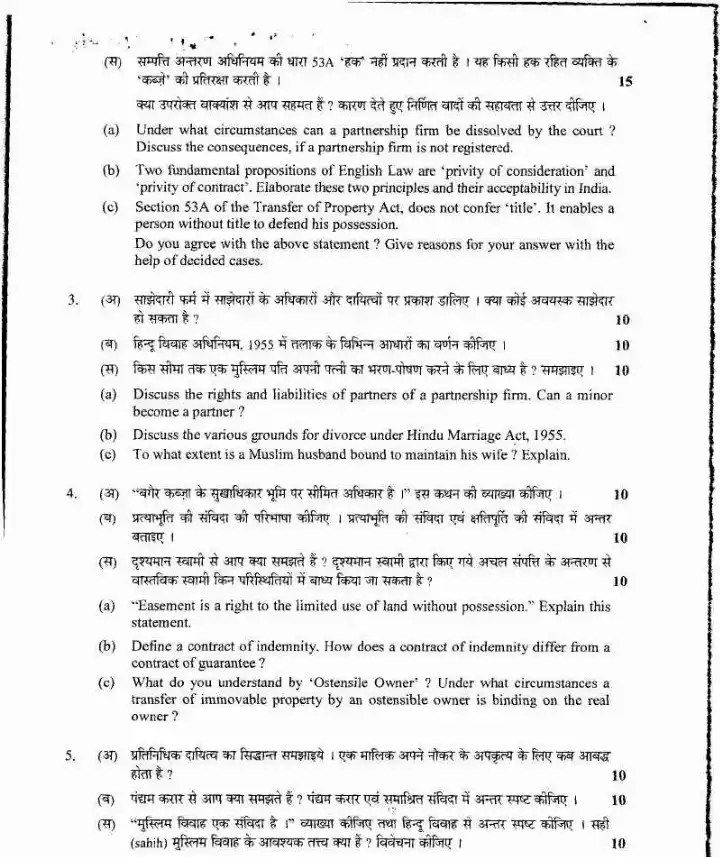
(a) Under what circumstances can a partnership firm be dissolved by the court? Discuss the consequences, if a partnership firm is not registered.
(b) Two fundamental propositions of English Law are 'privity of consideration' and 'privity of contract'. Elaborate these two principles and their acceptability in India.
(c) Section 53A of the Transfer of Property Act, does not confer 'title'. It enables a person without title to defend his possession. Do you agree with the above statement? Give reasons for your answer with the help of decided cases.
Q3.
(a) हिन्दू विवाह अधिनियम, 1955 में तलाक के विभिन्न आधारों का वर्णन कीजिए।
10 किस सीमा तक एक मुस्लिम पति अपनी पत्नी का भरण-पोषण करने के लिए बाध्य है ? समझाइए ।
Discuss the rights and liabilities of partners of a partnership firm. Can a minor become a partner?
(b) Discuss the various grounds for divorce under Hindu Marriage Act, 1955.
(c) To what extent is a Muslim husband bound to maintain his wife? Explain. "बगैर कब्ज़ा के सुखाधिकार भूमि पर सीमित अधिकार है ।" इस कथन की व्याख्या कौजिए ।
Q4.
(a) (3) 10 प्रत्याभूति की संविदा की परिभाषा कीजिए । प्रत्याभूति की संविदा एवं क्षतिपूर्ति की संविदा में अन्तर (র) बताइए ।
10 दृश्यमान स्वामी से आप क्या समझते हैं ? दृश्यमान स्वामी द्वारा किए गये अचल संपत्ति के अन्तरण से (F) वास्तविक स्वामी किन परिस्थितियों में बाध्य किया जा सकता है ?
10 "Easement is a right to the limited use of land without possession." Explain this statement.
(b) Define a contract of indemnity. How does a contract of indemnity differ from a contract of guarantee? What do you understand by 'Ostensile Owner' ? Under what circumstances a
(c) transfer of immovable property by an ostensible owner is binding on the real owner? प्रतिनिधिक दायित्व का सिद्धान्त समझाइये । एक मालिक अपने नौकर के अपकृत्य के लिए कब आबद्ध
Q5. (চঞ্চ) 10 पंद्यम करार से आप क्या समझते हैं ? पंद्यम करार एवं समाश्रিত संविदा में अन्तर स्पष्ट कीजिए ।
10 (র) “म Muslim विवाह एक संविदा है।” व्याख्या कीजिए तथा हिन्दू विवाह से अन्तर स्पष्ट कीजिए । सही (F) (sahih) मुस्लिम विवाह के आवश्यक तत्त्व क्या हैं ? विवेचना कीजिए ।
Question paper preview
Scanned pages 1–2 for reference. Download the official PDF for the full paper.
Free question paper download
Download question paper PDF
Your download starts in 10s
Preparing your question paper file…
Frequently asked questions
What is 53A of the Transfer of Property Act?
53A does not confer title; it protects possession for a person without title and allows defense of possession in certain circumstances.
What are the consequences if a partnership firm is not registered?
An unregistered partnership firm faces legal limitations, including restricted ability to sue or be sued; partners may face personal liability in certain circumstances.
Difference between privity of consideration and privity of contract?
Privity of consideration concerns the receipt of consideration in a contract; privity of contract concerns the right of a party to enforce the contract against the other contracting party.
What is an easement?
An easement is a non-possessory right to use another’s land for a specific limited purpose.
Define indemnity contract and distinguish it from a guarantee contract.
An indemnity contract promises to compensate for loss; a guarantee contract involves a secondary promise to fulfill the obligation if the principal defaults.
Who is an ostensible owner and when is transfer binding on the real owner?
An ostensible owner is one who appears to own the property; transfers by ostensible owner are binding on the real owner under certain circumstances if the transfer aligns with apparent authority.