
UKPSC JE Civil Engineering Paper I 2013 Question Paper PDF
- Year 2013
- Conducted By UKPSC
- Questions 180
- Maximum Marks 360
- Duration 03 Hours
- Languages Hindi & English
Exam Details
| Detail | Information |
|---|---|
| Examination | Uttarakhand Combined Junior Engineer Selection Examination |
| Year | 2013 |
| Conducting Body | UKPSC |
| Paper | Civil Engineering (Paper-I) |
| Subject | Civil Engineering |
| Duration | 03 Hours |
| Maximum Marks | 360 |
| Number of Questions | 180 |
| Question Type | Objective (MCQ) |
This is the Civil Engineering (Paper-I) question paper from the Uttarakhand Combined Junior Engineer Selection Examination held in 2013, conducted by UKPSC. The paper consists of 180 objective questions and is allotted a total of 360 marks, with a duration of 3 hours. This paper is crucial for aspirants preparing for junior engineer positions in Uttarakhand, offering a clear understanding of the exam's scope, difficulty level, and the types of questions asked in Civil Engineering. This previous year Uttarakhand Combined Junior Engineer Selection Examination question paper (2013) is useful for Engineer aspirants preparing for Uttarakhand government recruitment. The paper was conducted by UKPSC and reflects the official exam pattern, marking scheme and difficulty level seen in recent cycles. Use it for timed practice, topic-wise revision and understanding how questions are framed in the real examination. Download the free PDF on QuizCurrent to read instructions, attempt MCQs and compare your answers with the study notes provided on this page. Key syllabus areas include Under-reamed piles, Soil compaction, Friction piles, Trapezoidal combined footings, Failure plane, Soil samples, Shrinkage limit test, Consolidation test. Useful for Uttarakhand Combined Junior Engineer Sel preparation. Helps understand the latest exam pattern. Useful for practice and self-assessment.
Major Topics Covered
- Under-reamed piles
- Soil compaction
- Friction piles
- Trapezoidal combined footings
- Failure plane
- Soil samples
- Shrinkage limit test
- Consolidation test
- Specific gravity test
- Critical gradient
- Air content of soil
- Degree of saturation
- Singly reinforced beam
- Tension reinforcement
- Modulus of elasticity
- Reinforced concrete beam
- Neutral axis
Why This Paper is Important
- Useful for Uttarakhand Combined Junior Engineer Sel preparation
- Helps understand the latest exam pattern
- Useful for practice and self-assessment
- Covers frequently asked General Studies topics
- Helpful for analysing question trends
Related Resources
- UKPSC JE Civil Engineering Paper II 2013
- UKPSC JE Civil Engineering 2014 Paper I
- UKPSC JE Civil Engineering 2012 Paper I
- UKPSC JE Civil Engineering Paper I 2013 Answer Key
- UKPSC JE Civil Engineering Syllabus
- UKPSC JE Exam Pattern
- UKPSC JE
- SSC JE
Instructions
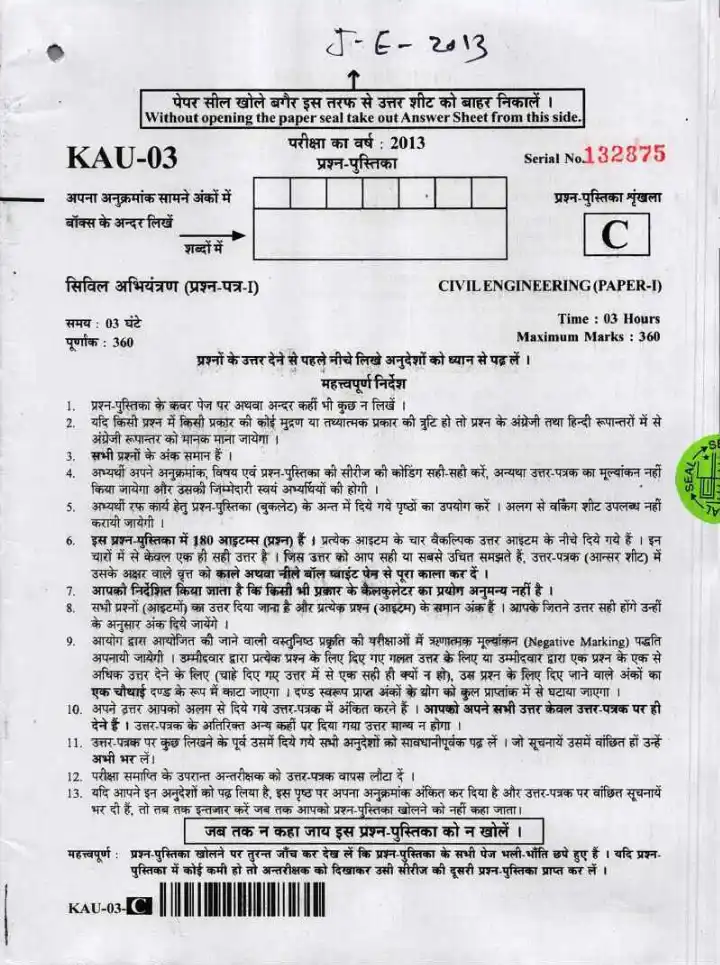
- यदि किसी प्रश्न में किसी प्रकार की कोई मुद्रण या तथ्यात्मक प्रकार की त्रुटि हो तो प्रश्न के अंग्रेजी तथा हिन्दी रूपान्तरों में से
- अंग्रेजी रूपान्तर को मानक माना जायेगा । सभी प्रश्नों के अंक समान हैं ।
- अभ्यर्थी अपने अनुक्रमांक, विषय एवं प्रश्न-पुस्तिका की सीरीज की कोडिंग सही-सही करें, अन्यथा उत्तर-पत्रक का मूल्यांकन नहीं
- किया जायेगा और उसकी जिम्मेदारी स्वयं अभ्यर्थियों की होगी ।
- अभ्यर्थी रफ कार्य हेतु प्रश्न-पुस्तिका (बुकलेट) के अन्त में दिये गये पृष्ठों का उपयोग करें ।
- इस प्रश्न-पुस्तिका में 180 आइटम्स (प्रश्न) हैं ।
- प्रत्येक आइटम के चार वैकल्पिक उत्तर आइटम के नीचे दिये गये हैं ।
- जिस उत्तर को आप सही या सबसे उचित समझते हैं, उत्तर-पत्रक (आन्सर शीट) में उसके अक्षर वाले वृत्त को काले अथवा नीले बॉल प्वाइंट प्रेन से पूरा काला कर दें।
- आपको निर्देशित किया जाता है कि किसी भी प्रकार के कैलकुलेटर का प्रयोग अनुमन्य नहीं है ।
- सभी प्रश्नों (आइटमों) का उत्तर दिया जाना है और प्रत्येक प्रश्न (आइटम) के समान अंक हैं ।
- आयोग द्वारा आयोजित की जाने वाली वस्तुनिष्ठ प्रकृति की परीक्षाओं में ऋणात्मक मूल्खांकन (Negative Marking) पद्धति
- उम्मीदवार द्वारा प्रत्येक प्रश्न के लिए दिए गए गलत उत्तर के लिए या उम्मीदवार द्वारा एक प्रश्न के एक से अधिक उत्तर देने के लिए (चाहे दिए गए उत्तर में से एक सही ही क्यों न हो), उस ग्रश्न के लिए दिए जाने वाले अंकों का एक चौथाई दण्ड के रूप में काटा जाएगा ।
- दण्ड स्वरूप प्राप्त अंकों के योग को कुल प्राप्तांक में से घटाया जाएगा ।
- अपने उत्तर आपको अलग से दिये गये उत्तर-पत्रक में अंकित करने हैं ।
- आपको अपने सभी उत्तर केवल उत्तर-पत्रक पर ही देने हैं ।
- उत्तर-पत्रक के अतिरिक्त अन्य कहीं पर दिया गया उत्तर मान्य न होगा ।
- उत्तर-पत्रक पर कुछ लिखने के पूर्व उसमें दिये गये सभी अनुदेशों को सावधानीपूर्वक पढ़ लें ।
- जो सूचनायें उसमें वांछित हों उन्हें अभी भर लें।
- परीक्षा समाप्ति के उपरान्त अन्तरीक्षक को उत्तर-पत्रक वापस लौटा दें ।
- यदि आपने इन अनुदेशों को पढ़ लिया है, इस पृष्ठ पर अपना अनुक्रमांक अंकित कर दिया है और उत्तर-पत्रक पर वांछित सूचनायें भर दी हैं, तो तब तक इन्तजार करें जब तक आपको प्रश्न-पुस्तिका खोलने को नहीं कहा जाता।
- जब तक न कहा जाय इस प्रश्न-पुस्तिका को न खोलें ।
- महत्त्वपूर्ण : प्रश्न-पुस्तिका खोलने पर तुरन्त जाँच कर देख लें कि प्रश्न-पुस्तिका के सभी पेज भली-भाँति छपे हुए हैं ।
- यदि प्रश्न- पुस्तिका में कोई कमी हो तो अन्तरीक्षक को दिखाकर उसी सीरीज की दूसरी प्रश्न-पुस्तिका प्राप्त कर लें । KAU-03-C
Questions (page 2)
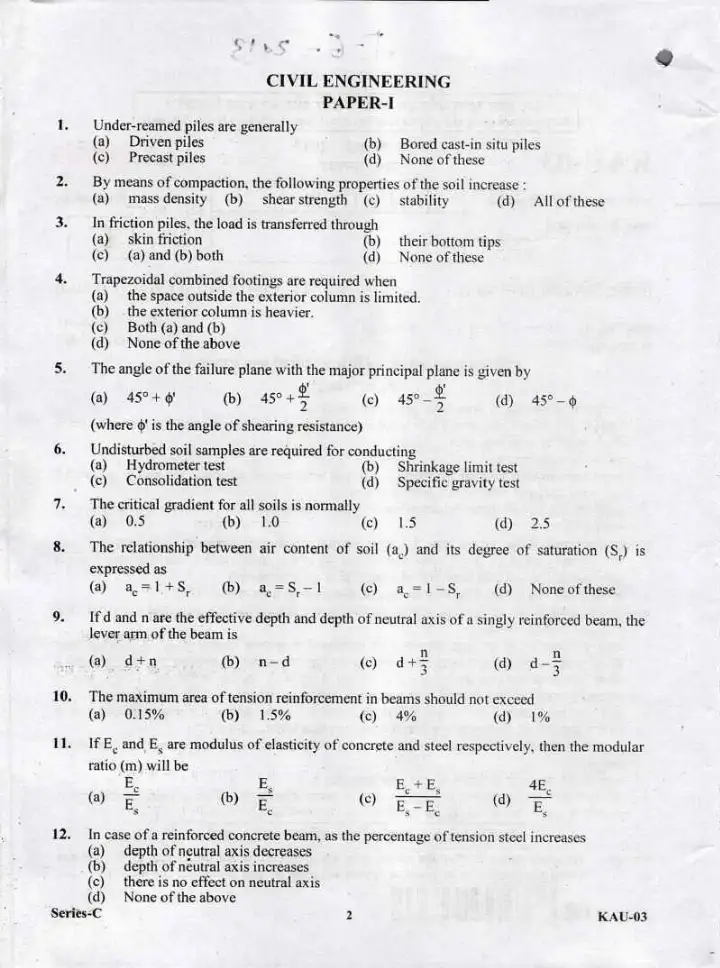
Q2. By means of compaction, the following properties of the soil increase :
Q3. In friction piles, the load is transferred through
Q4. Trapezoidal combined footings are required when
Q5. The angle of the failure plane with the major principal plane is given by
Q6. Undisturbed soil samples are required for conducting
Q7. The critical gradient for all soils is normally
Q8. The relationship between air content of soil (ac) and its degree of saturation (Sr) is expressed as
Q9. If d and n are the effective depth and depth of neutral axis of a singly reinforced beam, the lever arm of the beam is
Q10. The maximum area of tension reinforcement in beams should not exceed
Q11. If Ec and Es are modulus of elasticity of concrete and steel respectively, then the modular ratio (m) will be
Q12. In case of a reinforced concrete beam, as the percentage of tension steel increases
Question paper preview
Scanned pages 1–2 for reference. Download the official PDF for the full paper.
Free question paper download
Download question paper PDF
Your download starts in 10s
Preparing your question paper file…
Frequently asked questions
What is the full name of the exam?
The full name of the exam is the Uttarakhand Combined Junior Engineer Selection Examination.
Which year is this question paper from?
This question paper is from the year 2013.
Who conducts the Uttarakhand JE exam?
The Uttarakhand Public Service Commission (UKPSC) conducts the Uttarakhand JE exam.
What is the subject of this paper?
This paper is for Civil Engineering, specifically Paper-I.
What is the total duration for the exam?
The total duration allowed for the exam is 03 Hours.
What are the maximum marks for this paper?
The maximum marks for this paper are 360.