RPSC Assistant Professor Paediatric Hepatology 2024 Question Paper PDF

Rajasthan Government Jobs Professor 2024

  • Year 2024
  • Conducted By RPSC
  • Questions 150
  • Maximum Marks 150
  • Duration 02:30 Hours + 10 Minutes Extra
  • Languages Hindi & English

Exam Details

Detail Information
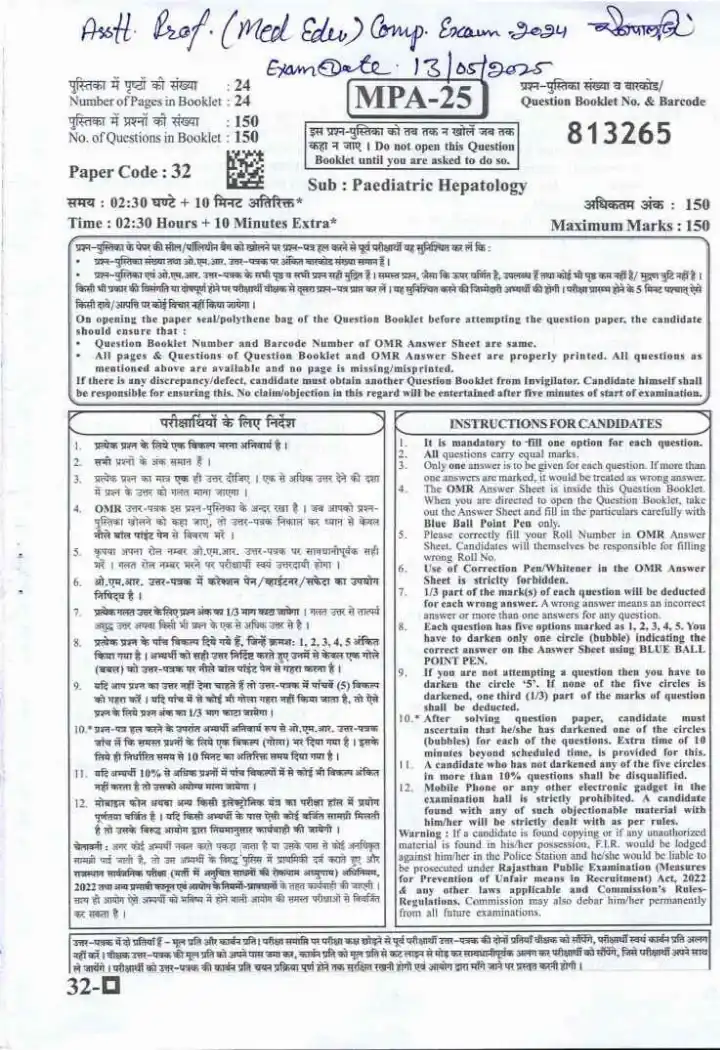
Examination Assistant Professor (Medical Education)
Year 2024
Conducting Body RPSC
Paper Paediatric Hepatology
Subject Paediatric Hepatology
Duration 02:30 Hours + 10 Minutes Extra
Maximum Marks 150
Number of Questions 150
Question Type Objective (MCQ)

This is the official question paper for the RPSC Assistant Professor (Medical Education) examination held in 2024. The paper focuses on Paediatric Hepatology and consists of 150 objective questions, with a total maximum mark of 150. Candidates were allowed 2 hours and 30 minutes, plus an additional 10 minutes. This paper is vital for aspirants preparing for the RPSC recruitment process, offering insights into the exam pattern, difficulty level, and key topics covered in Paediatric Hepatology.

Major Topics Covered

  • Paediatric Hepatology
  • Liver Diseases in Children
  • Cirrhosis
  • Portal Hypertension
  • Hepatorenal Syndrome
  • Bacterial Peritonitis
  • Neonatal Liver Failure

Why This Paper is Important

  • Useful for Assistant Professor (Medical Education) preparation
  • Helps understand the latest exam pattern
  • Useful for practice and self-assessment
  • Covers frequently asked General Studies topics
  • Helpful for analysing question trends

Related Resources

  • RPSC Assistant Professor (Medical Education) 2023
  • RPSC Paediatric Surgery Question Paper
  • Medical Entrance Exam Papers
  • RPSC Assistant Professor Paediatric Hepatology 2024 Answer Key
  • RPSC Assistant Professor Syllabus
  • Paediatric Hepatology Syllabus
  • RPSC Assistant Professor Exam Pattern
  • RPSC Recruitment Process

Instructions

  • Only one answer is to be given for each question. If more than प्रत्येक प्रश्न का मात्र एक ही उत्तर दीजिए ।
  • एक से अधिक उत्तर देने की दशा one answers are marked, it would be treated as wrong answer.
  • The OMR Answer Sheet is inside this Question Booklet. में प्रश्न के उत्तर को गलत माना जाएगा । When you are directed to open the Question Booklet, take OMR उत्तर-पत्रक इस प्रश्न-पुस्तिका के अन्दर रखा है। जब आपको प्रश्न-।
  • out the Answer Sheet and fill in the particulars carefully with पुस्तिका खोलने को कहा जाए, तो उत्तर-पत्रक निकाल कर ध्यान से केवल Blue Ball Point Pen only.
  • नीले बॉल पॉइंट पेन से विवरण भरें । Please correctly fill your Roll Number in OMR Answer Sheet. Candidates will themselves be responsible for filling
  • कृपया अपना रोल नम्बर ओ.एम.आर. उत्तर-पत्रक पर सावधानीपूर्वक सही wrong Roll No. भरें ।
  • गलत रोल नम्बर भरने पर परीक्षार्थी स्वयं उत्तरदायी होगा ।
  • Use of Correction Pen/Whitener in the OMR Answer ओ.एम.आर. उत्तर-पत्रक में करेक्शन पेन/व्हाईटनर/सफेदा का उपयोग Sheet is stricity forbidden.
  • 1/3 part of the mark(s) of each question will be deducted निषिद्ध है । for each wrong answer. A wrong answer means an incorrect.
  • प्रत्येक गलत उत्तर के लिए प्रश्न अंक का 1/3 भाग काटा जायेगा ।
  • गलत उत्तर से तात्पर्य answer or more than one answers for any question. अशुद्ध उत्तर अथवा किसी भी प्रश्न के एक से अधिक उत्तर से है।
  • प्रत्येक प्रश्न के पाँच विकल्प दिये गये हैं, जिन्हें क्रमश: 1, 2, 3, 4, 5 अंकित correct answer on the Answer Sheet using BLUE BALL किया गया है ।
  • अभ्यर्थी को सही उत्तर निर्दिष्ट करते हुए उनमें से केवल एक गोले POINT PEN. (बबल) को उत्तर-पत्रक पर नीले बॉल पॉइंट पेन से गहरा करना है।
  • यदि आप प्रश्न का उत्तर नहीं देना चाहते हैं तो उत्तर-पत्रक में पाँचवें (5) विकल्प darkened, one third (1/3) part of the marks of question को गहरा करें।
  • यदि पाँच में से कोई भी गोला गहरा नहीं किया जाता है, तो ऐसे shall be deducted. प्रश्न के लिये प्रश्न अंक का 1/3 भाग काटा जायेगा।
  • * प्रश्न-पत्र हल करने के उपरांत अभ्यर्थी अनिवार्य रूप से ओ.एम.आर. उत्तर-पत्रक ascertain that he/she has darkened one of the circles (bubbles) for each of the questions. Extra time of 10 जाँच लें कि समस्त प्रश्नों के लिये एक विकल्प (गोला) भर दिया गया है।
  • इसके minutes beyond scheduled time, is provided for this. लिये ही निर्धारित समय से 10 मिनट का अतिरिक्त समय दिया गया है।
  • यदि अभ्यर्थी 10% से अधिक प्रश्नों में पाँच विकल्पों में से कोई भी विकल्प अंकित in more than 10% questions shall be disqualified. नहीं करता है तो उसको अयोग्य माना जायेगा।
  • मोबाइल फोन अथवा अन्य किसी इलेक्ट्रोनिक यंत्र का परीक्षा हॉल में प्रयोग found with any of such objectionable material with पर्णतया वर्जित है।
  • यदि किसी अभ्यर्थी के पास ऐसी कोई वर्जित सामग्री मिलती him/her will be strictly dealt with as per rules. है तो उसके विरुद्ध आयोग द्वारा नियमानुसार कार्यवाही की जायेगी । Warning: If a candidate is found copying or if any unauthorized चेतावनी: अगर कोई अभ्यर्थी नकल करते पकड़ा जाता है या उसके पास से कोई अनधिकृत material is found in his/her possession, F.I.R. would be lodged against him/her in the Police Station and he/she would be liable to सामग्री पाई जाती है, तो उस अभ्यर्थी के विरुद्ध पुलिस में प्राथमिकी दर्ज कराते हुए और be prosecuted under Rajasthan Public Examination (Measures राजस्थान सार्वजनिक परीक्षा (भर्ती में अनुचित साधनों की रोकथाम अध्युपाय) अधिनियम, for Prevention of Unfair means in Recruitment) Act, 2022 2022 तथा अन्य प्रभावी कानून एवं आयोग के नियमों-प्रावधानों के तहत कार्यवाही की जाएगी । & any other laws applicable and Commission's Rules- साथ ही आयोग ऐसे अभ्यर्थी को भविष्य में होने वाली आयोग की समस्त परीक्षाओं से विवर्जित Regulations. Commission may also debar him/her permanently from all future examinations. कर सकता है।
  • उत्तर–पत्रक में दो प्रतियाँ हैं – मूल प्रति और कार्बन प्रति।
  • परीक्षा समाप्ति पर परीक्षा कक्ष छोड़ने से पूर्व परीक्षार्थी उत्तर–पत्रक की दोनों प्रतियाँ वीक्षक को सौंपेंगे, परीक्षार्थी स्वयं कार्बन प्रति अलग नहीं करें।
  • वीक्षक उत्तर–पत्रक की मूल प्रति को अपने पास जमा कर, कार्बन प्रति को मूल पति से कट लाइन से मोड़ कर सावधानीपूर्वक अलग कर परीक्षार्थी को सौंपेंगे, जिसे परीक्षार्थी अपने साथ ले जायेंगे।
  • परीक्षार्थी को उत्तर-पत्रक की कार्बन प्रति चयन प्रक्रिया पूर्ण होने तक सुरक्षित रखनी होगी एवं आयोग द्वारा माँगे जाने पर प्रस्तुत करनी होगी। 32 - 11

  • Each question has five options marked as 1, 2, 3, 4, 5. You have to darken only one circle (bubble) indicating the
  • If you are not attempting a question then you have to darken the circle '5'. If none of the five circles is
  • * After solving question paper, candidate must
  • A candidate who has not darkened any of the five circles
  • Mobile Phone or any other electronic gadget in the examination hall is strictly prohibited. A candidate

Questions (page 2)

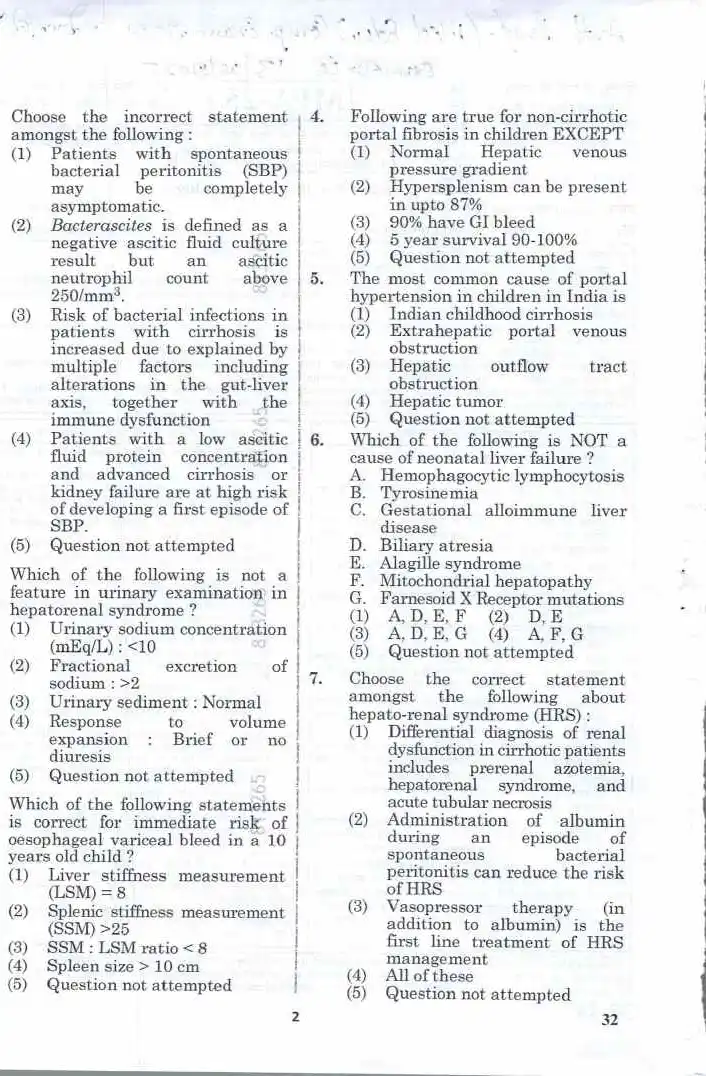
Q1. Choose the incorrect statement amongst the following:

  • (1) Patients with spontaneous bacterial peritonitis (SBP) may be completely asymptomatic.
  • (2) Bacterascites is defined as a negative ascitic fluid culture result but an ascitic neutrophil count above 250/mm3.
  • (3) Risk of bacterial infections in patients with cirrhosis is increased due to multiple factors including alterations in the gut-liver axis, together with the immune dysfunction
  • (4) Patients with a low ascitic fluid protein concentration and advanced cirrhosis or kidney failure are at high risk of developing a first episode of SBP.
  • (5) Question not attempted

Q2. Which of the following is not a feature in urinary examination in hepatorenal syndrome?

  • (1) Urinary sodium concentration (mEq/L): <10
  • (2) Fractional excretion of sodium : >2
  • (3) Urinary sediment : Normal
  • (4) Response to volume expansion : Brief or no diuresis
  • (5) Question not attempted

Q3. Which of the following statements is correct for immediate risk of oesophageal variceal bleed in a 10 years old child?

  • (1) Liver stiffness measurement (LSM) = 8
  • (2) Splenic stiffness measurement (SSM) >25
  • (3) SSM : LSM ratio < 8
  • (4) Spleen size > 10 cm
  • (5) Question not attempted

Q4. Following are true for non-cirrhotic portal fibrosis in children EXCEPT

  • (1) Normal Hepatic venous pressure gradient
  • (2) Hypersplenism can be present in upto 87%
  • (3) 90% have GI bleed
  • (4) 5 year survival 90-100%
  • (5) Question not attempted

Q5. The most common cause of portal hypertension in children in India is

  • (1) Indian childhood cirrhosis
  • (2) Extrahepatic portal venous obstruction
  • (3) Hepatic outflow tract obstruction
  • (4) Hepatic tumor
  • (5) Question not attempted

Q6. Which of the following is NOT a cause of neonatal liver failure?

  • (a) Hemophagocytic lymphocytosis
  • (b) Tyrosinemia
  • (c) Gestational alloimmune liver disease
  • (d) Biliary atresia
  • (e) Alagille syndrome
  • (f) Mitochondrial hepatopathy
  • (g) Farnesoid X Receptor mutations
  • (1) A, D, E, F
  • (2) D, E
  • (3) A, D, E, G
  • (4) A, F, G
  • (5) Question not attempted

Q7. Choose the correct statement amongst the following about hepato-renal syndrome (HRS) :

  • (1) Differential diagnosis of renal dysfunction in cirrhotic patients includes prerenal azotemia, hepatorenal syndrome, and acute tubular necrosis
  • (2) Administration of albumin during an episode of spontaneous bacterial peritonitis can reduce the risk of HRS
  • (3) Vasopressor therapy (in addition to albumin) is the first line treatment of HRS management
  • (4) All of these
  • (5) Question not attempted

Question paper preview

Scanned pages 1–2 for reference. Download the official PDF for the full paper.

Page 1
RPSC Assistant Professor Medical Education 2024 Paediatric Hepatology question paper page 1 instructions scan PDF download
Page 2
RPSC Assistant Professor Medical Education 2024 Paediatric Hepatology question paper page 1 instructions scan PDF download

Free question paper download

Download question paper PDF

  • 10.2 MB
  • 24 pages
  • PDF format

Frequently asked questions

What is the name of the exam?

The exam is for the Assistant Professor (Medical Education) position.

Which subject does this paper cover?

This paper covers Paediatric Hepatology.

What is the conducting body for this exam?

The exam is conducted by RPSC.

In which year was this exam conducted?

This exam was conducted in 2024.

What is the total number of questions in the paper?

There are 150 questions in the booklet.

What is the maximum marks for this paper?

The maximum marks for this paper is 150.

← Back to Professor papers