Veterinary Officer Exam 2013 Question Paper PDF | RPSC

Rajasthan Government Jobs Other Jobs 2013

  • Year 2013
  • Conducted By RPSC
  • Languages English

Exam Details

Detail Information
Examination Veterinary Officer Exam
Year 2013
Conducting Body RPSC
Paper Veterinary Officer Exam 2013
Subject Veterinary Science
Question Type Objective (MCQ)

This page provides the official question paper for the Veterinary Officer Examination held in 2013 by the Rajasthan Public Service Commission (RPSC). The exam tests candidates on various aspects of veterinary science. This paper is crucial for aspirants preparing for the Veterinary Officer role, offering insights into the exam pattern, question types, and difficulty level. Practicing with this paper can significantly boost preparation and understanding of the subject matter. The exam was conducted on 12.02.2015.

Major Topics Covered

  • Veterinary Science
  • Animal Husbandry
  • Genetics
  • Animal Nutrition
  • Animal Reproduction
  • Poultry Rearing
  • Animal Physiology

Why This Paper is Important

  • Useful for VETERINARY OFFICER EXAM preparation
  • Helps understand the latest exam pattern
  • Useful for practice and self-assessment
  • Covers frequently asked General Studies topics
  • Helpful for analysing question trends

Related Resources

  • RPSC Veterinary Officer 2015 Question Paper
  • RPSC Veterinary Officer 2018 Question Paper
  • Rajasthan Forest Guard Question Paper
  • Rajasthan Police Constable Question Paper
  • Veterinary Officer Exam 2013 Answer Key
  • RPSC Veterinary Officer Answer Key PDF
  • Veterinary Officer Exam Syllabus
  • RPSC Veterinary Officer Syllabus PDF

Instructions

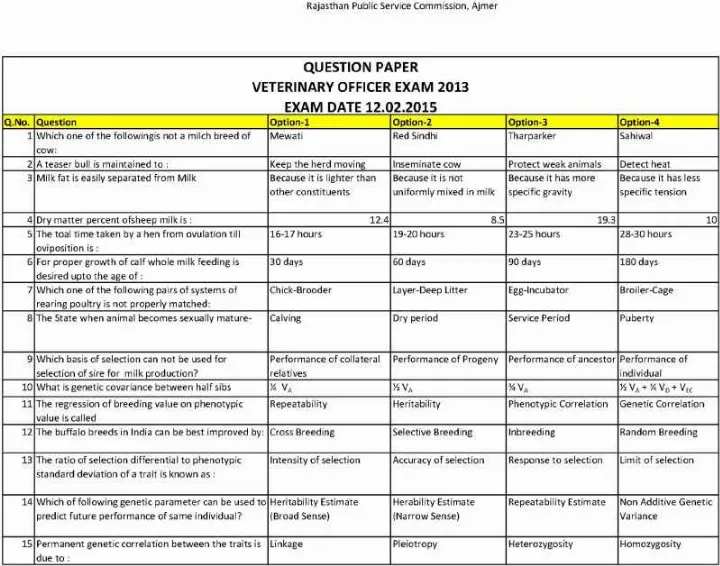
  • Rajasthan Public Service Commission, Ajmer QUESTION PAPER VETERINARY OFFICER EXAM 2013 EXAM DATE 12. 2015 Q. No.
  • Option-1 Option-2 Option-3 Option-4 Question 1 Which one of the followingis not a milch breed of Mewati Red Sindhi Tharparker Sahiwal cow: 2 A teaser bull is maintained to: Keep the herd moving Inseminate cow Protect weak animals Detect heat 3 Milk fat is easily separated from Milk Because it is lighter than Because it is not Because it has more Because it has less other constituents uniformly mixed in milk specific gravity specific tension 4 Dry matter percent of sheep milk is: 12.4 8.5 19.3 10 5 The toal time taken by a hen from ovulation till 16-17 hours 19-20 hours 23-25 hours 28-30 hours oviposition is: 6 For proper growth of calf whole milk feeding is 30 days 60 days 90 days 180 days desired upto the age of : 7 Which one of the following pairs of systems of Chick-Brooder Layer-Deep Litter Broiler-Cage Egg-Incubator rearing poultry is not properly matched: 8 The State when animal becomes sexually mature- Calving Dry period Service Period Puberty 9 Which basis of selection can not be used for Performance of collateral Performance of Progeny Performance of ancestor Performance of selection of sire for milk production? relatives individual V_2 V_4 XVA V_2 V_A + V_3 V_D + V_{EC} 10 What is genetic covariance between half sibs \frac{3}{4}V_A Heritability 11 The regression of breeding value on phenotypic Repeatability Phenotypic Correlation Genetic Correlation value is called 12 The buffalo breeds in India can be best improved by: Cross Breeding Selective Breeding Inbreeding Random Breeding 13 The ratio of selection differential to phenotypic Limit of selection Intensity of selection Accuracy of selection Response to selection standard deviation of a trait is known as : 14 Which of following genetic parameter can be used to Heritability Estimate Herability Estimate Non Additive Genetic Repeatability Estimate predict future performance of same individual?
  • (Broad Sense) (Narrow Sense) Variance 15 Permanent genetic correlation between the traits is Pleiotropy Linkage Heterozygosity Homozygosity due to:

Questions (page 2)

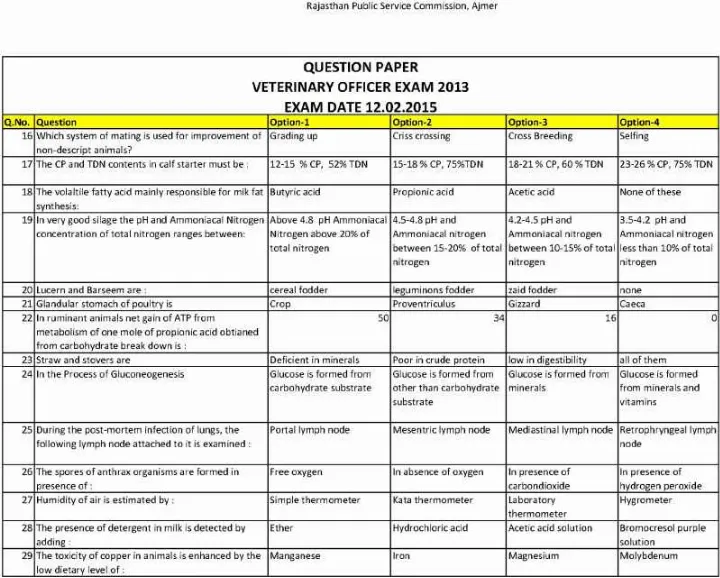
Q16. Which system of mating is used for improvement of non-descript animals?

  • (a) Grading up
  • (b) Cross Breeding
  • (c) Criss crossing
  • (d) Selfing

Q17. The CP and TDN contents in calf starter must be:

  • (a) 12-15 % CP, 52% TDN
  • (b) 15-18 % CP, 75%TDN
  • (c) 18-21 % CP, 60 % TDN
  • (d) 23-26 % CP, 75% TDN

Q18. The volatile fatty acid mainly responsible for milk fat synthesis:

  • (a) Butyric acid
  • (b) Propionic acid
  • (c) Acetic acid
  • (d) None of these

Q19. In very good silage the pH and Ammoniacal Nitrogen concentration of total nitrogen ranges between:

  • (a) Above 4.8 pH Ammoniacal Nitrogen above 20% of total nitrogen
  • (b) 4.5-4.8 pH and Ammoniacal nitrogen between 15-20% of total nitrogen
  • (c) 4.2-4.5 pH and Ammoniacal nitrogen between 10-15% of total nitrogen
  • (d) 3.5-4.2 pH and Ammoniacal nitrogen less than 10% of total nitrogen

Q20. Lucern and Barseem are:

  • (a) cereal fodder
  • (b) leguminons fodder
  • (c) zaid fodder
  • (d) none

Q21. Glandular stomach of poultry is

  • (a) Crop
  • (b) Proventriculus
  • (c) Gizzard
  • (d) Caeca

Q22. In ruminant animals net gain of ATP from metabolism of one mole of propionic acid obtained from carbohydrate break down is:

  • (a) 50
  • (b) 34
  • (c) 16
  • (d) 0

Q23. Straw and stovers are

  • (a) Deficient in minerals
  • (b) Poor in crude protein
  • (c) low in digestibility
  • (d) all of them

Q24. In the Process of Gluconeogenesis

  • (a) Glucose is formed from carbohydrate substrate
  • (b) Glucose is formed from other than carbohydrate substrate
  • (c) Glucose is formed from minerals
  • (d) Glucose is formed from minerals and vitamins

Q25. During the post-mortem infection of lungs, the following lymph node attached to it is examined :

  • (a) Portal lymph node
  • (b) Mesentric lymph node
  • (c) Mediastinal lymph node
  • (d) Retrophryngeal lymph node

Q26. The spores of anthrax organisms are formed in presence of :

  • (a) Free oxygen
  • (b) In absence of oxygen
  • (c) In presence of carbondioxide
  • (d) In presence of hydrogen peroxide

Q27. Humidity of air is estimated by :

  • (a) Simple thermometer
  • (b) Kata thermometer
  • (c) Laboratory thermometer
  • (d) Hygrometer

Question paper preview

Scanned pages 1–2 for reference. Download the official PDF for the full paper.
Page 1
RPSC Veterinary Officer Exam 2013 question paper page 1 instructions scan PDF download
Page 2
RPSC Veterinary Officer Exam 2013 question paper page 1 instructions scan PDF download

Free question paper download

Download question paper PDF

  • 176 KB
  • 7 pages
  • PDF format

Frequently asked questions

What is the name of the exam?

The exam is the Veterinary Officer Exam 2013.

Which year is this question paper from?

This question paper is from the year 2013.

Who conducts the Veterinary Officer Exam?

The Veterinary Officer Exam is conducted by the Rajasthan Public Service Commission (RPSC).

What is the subject of the question paper?

The subject is Veterinary Science.

What is the exam date mentioned on the paper?

The exam date mentioned is 12.02.2015.

What type of questions are included in this paper?

The paper includes objective-type multiple-choice questions.

← Back to Other Jobs papers