RPSC ARO Agri Botany 2014 Question Paper PDF

Rajasthan Government Jobs Other Jobs 2014

  • Year 2014
  • Conducted By RPSC
  • Languages English

Exam Details

Detail Information
Examination Agriculture Research Officer (ARO)
Year 2014
Conducting Body RPSC
Paper ARO - Agri Botany
Subject Botany
Question Type Objective (MCQ)

This is the question paper for the Agriculture Research Officer (ARO) exam in Agri Botany, conducted by RPSC in 2014. The paper consists of objective-type questions designed to assess candidates' knowledge in agricultural botany. Aspirants can use this paper to understand the exam pattern, difficulty level, and important topics covered. Practicing with previous year papers like this one is crucial for effective preparation for the RPSC ARO examination.

Major Topics Covered

  • Cell Theory
  • Cell Division
  • Chromosome Morphology
  • Crossing Over
  • Gregor Mendel
  • Genetics
  • Plant Breeding
  • Crop Improvement
  • N.E. Borlaug
  • Centre of Origin
  • Darwin
  • Vavilov
  • Law of Segregation
  • Law of Dominance
  • Heritability
  • Genetic Gain
  • Pure Line
  • Domestication
  • Adaptation
  • Selection Methods
  • Mass Selection
  • Progeny Selection
  • Pedigree Method
  • Cross-pollinated Crops
  • Self-pollinated Crops
  • Natural Selection
  • Artificial Selection
  • Wheat Varieties
  • Back Cross
  • Hybrid Breeding
  • Heterosis
  • Apomixis
  • Male Sterility
  • Hybrid Seed Production
  • Breeder Seed
  • Foundation Seed
  • Certified Seed

Why This Paper is Important

  • Useful for AGRICULTURE RESEARCH OFFICER preparation
  • Helps understand the latest exam pattern
  • Useful for practice and self-assessment
  • Covers frequently asked General Studies topics
  • Helpful for analysing question trends

Related Resources

  • RPSC ARO 2016 Agri Botany Question Paper
  • RPSC ARO 2018 Agri Botany Question Paper
  • RPSC ARO 2020 Agri Botany Question Paper
  • RPSC ARO Agri Botany 2014 Answer Key
  • RPSC ARO Agri Botany Syllabus
  • RPSC ARO Exam Pattern
  • RPSC ARO Other Subjects
  • RPSC Assistant Professor Botany

Instructions

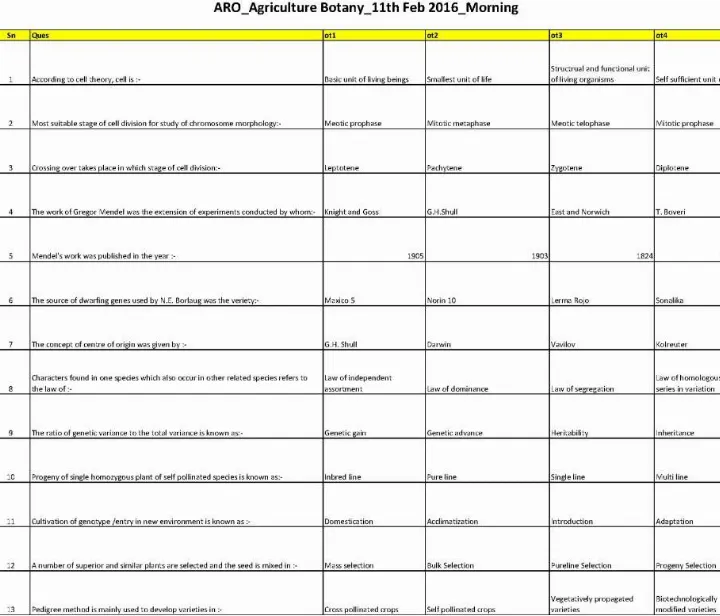
  • ARO_Agriculture Botany_11th Feb 2016_Morning Sn Ques ot1 ot2 lot3 ot4 Structrual and functional unit According to cell theory, cell is :- Basic unit of living beings Smallest unit of life of living organisms Self sufficient unit of life \overline{1} Most suitable stage of cell division for study of chromosome morphology:- Mitotic metaphase Meotic telophase Mitotic prophase \overline{2} Meotic prophase Crossing over takes place in which stage of cell division:- eptotene.
  • Pachytene Zygotene Diplotene \overline{\mathbf{3}} \boldsymbol{4} The work of Gregor Mendel was the extension of experiments conducted by whom:- Knight and Goss G.H.Shull East and Norwich T.
  • Boveri -5 Mendel's work was published in the year :- 1905 1903 1824 1866 6 The source of dwarfing genes used by N.E.
  • Borlaug was the veriety:- Maxico 5 Norin 10 erma Rojo Sonalika \overline{7} The concept of centre of origin was given by :- G.H.
  • Shull Darwin Vavilov Kolreuter Characters found in one species which also occur in other related species refers to Law of homologous Law of independent 8 the law of :- assortment Law of dominance Law of segregation series in variation The ratio of genetic variance to the total variance is known as:- 9 Genetic gain Genetic advance Heritability Inheritance 10 Progeny of single homozygous plant of self pollinated species is known as:- nbred line Pure line Single line Multi line Cultivation of genotype /entry in new environment is known as :- Domestication Acclimatization 11 ntroduction Adaptation 12 A number of superior and similar plants are selected and the seed is mixed in :- Mass selection Bulk Selection Pureline Selection Progeny Selection Vegetatively propagated Biotechnologically modified varieties Pedigree method is mainly used to develop varieties in :- varieties 13 Cross pollinated crops Self pollinated crops

Questions (page 2)

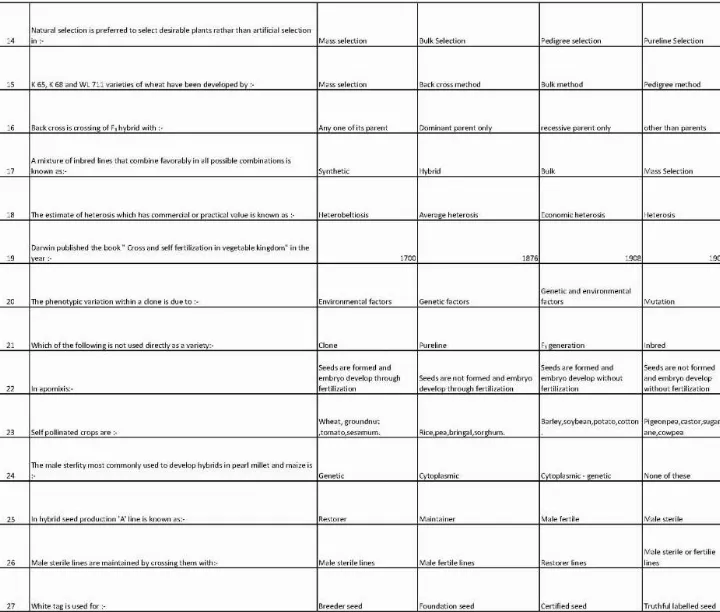
Q14. Natural selection is preferred to select desirable plants rather than artificial selection in :-

  • (a) Mass selection
  • (b) Bulk Selection
  • (c) Pedigree selection
  • (d) Pureline Selection

Q15. K 65, K 68 and WL 711 varieties of wheat have been developed by :-

  • (a) Mass selection
  • (b) Back cross method
  • (c) Bulk method
  • (d) Pedigree method

Q16. Back cross is crossing of F1 hybrid with :-

  • (a) Any one of its parent
  • (b) Dominant parent only
  • (c) recessive parent only
  • (d) other than parents

Q17. A mixture of inbred lines that combine favorably in all possible combinations is known as:-

  • (a) Synthetic
  • (b) Hybrid
  • (c) Bulk
  • (d) Mass Selection

Q18. The estimate of heterosis which has commercial or practical value is known as :-

  • (a) Hecorobeltiosis
  • (b) Average heterosis
  • (c) Economic heterosis
  • (d) Heterosis

Q19. Darwin published the book "Cross and self fertilization in vegetable kingdom" in the year :-

  • (a) 1700
  • (b) 1876
  • (c) 1908
  • (d) 1909

Q20. The phenotypic variation within a clone is due to :-

  • (a) Environmental factors
  • (b) Genetic factors
  • (c) Genetic and environmental factors
  • (d) Mutation

Q21. Which of the following is not used directly as a variety:-

  • (a) Clone
  • (b) Pureline
  • (c) F1 generation
  • (d) Inbred

Q22. In apomixis:-

  • (a) Seeds are formed and embryo develop through fertilization
  • (b) Seeds are not formed and embryo develop through fertilization
  • (c) Seeds are formed and embryo develop without fertilization
  • (d) Seeds are not formed and embryo develop without fertilization

Q23. Self pollinated crops are :-

  • (a) Wheat, groundnut, tomato,sesamum.
  • (b) Rice,pea,bringal,sorghum.
  • (c) Barley,soybean,potato,cotton
  • (d) Pigeonpea,castor,sugarcane,cowpea

Q24. The male sterility most commonly used to develop hybrids in pearl millet and maize is

  • (a) Genetic
  • (b) Cytoplasmic
  • (c) Cytoplasmic - genetic
  • (d) None of these

Q25. In hybrid seed production 'A' line is known as:-

  • (a) Restorer
  • (b) Maintainer
  • (c) Male fertile
  • (d) Male sterile

Question paper preview

Scanned pages 1–2 for reference. Download the official PDF for the full paper.
Page 1
RPSC ARO 2014 Agri Botany question paper page 1 instructions scan PDF download
Page 2
RPSC ARO 2014 Agri Botany question paper page 1 instructions scan PDF download

Free question paper download

Download question paper PDF

  • 471 KB
  • 16 pages
  • PDF format

Frequently asked questions

What is the name of the exam?

The exam is for the Agriculture Research Officer (ARO) position.

Which subject does this paper cover?

This paper specifically covers Agri Botany.

Which conducting body organized this exam?

The exam was conducted by RPSC (Rajasthan Public Service Commission).

In which year was this exam held?

This exam was held in 2014.

What type of questions are included in this paper?

This paper includes objective-type questions.

Can I download the RPSC ARO Agri Botany 2014 question paper?

Yes, the question paper is available for download in PDF format.

← Back to Other Jobs papers