
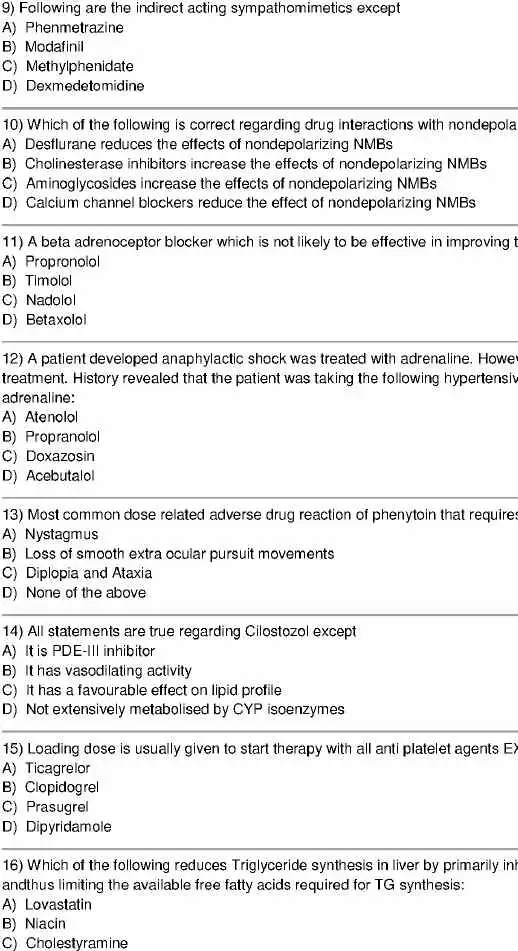
Q9. Following are the indirect acting sympathomimetics except
- (a) Phenmetrazine
- (b) Modafinil
- (c) Methylphenidate
- (d) Dexmedetomidine
| Detail | Information |
|---|---|
| Examination | Senior Demonstrator |
| Year | 2015 |
| Conducting Body | RPSC |
| Paper | Pharmacology |
| Subject | Pharmacology |
| Number of Questions | 16 |
| Question Type | Objective (MCQ) |
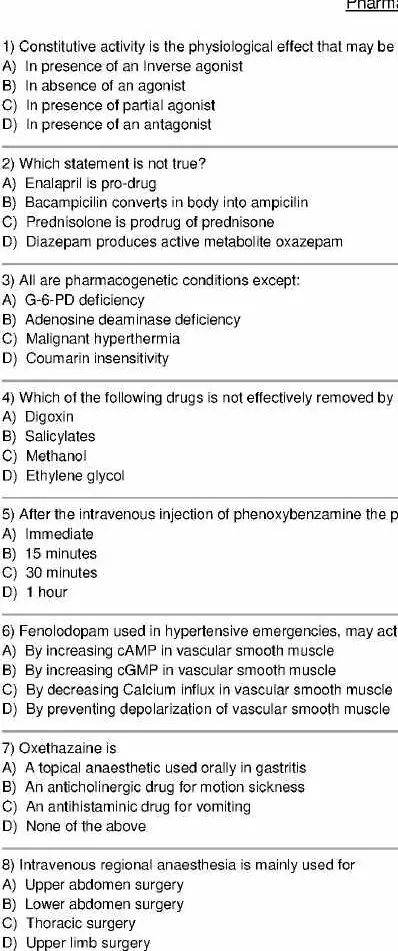
This document contains the Senior Demonstrator 2015 Pharmacology question paper conducted by RPSC. It features objective-type questions designed to test candidates' knowledge in Pharmacology. Aspirants preparing for the RPSC Senior Demonstrator examination can use this paper for practice and to understand the exam pattern, difficulty level, and important topics. Analyzing previous years' question papers is a crucial step in effective exam preparation. This previous year SR. DEMONSTRATOR 2015 question paper (2015) is useful for Other Jobs aspirants preparing for Rajasthan government recruitment. The paper was conducted by RPSC and reflects the official exam pattern, marking scheme and difficulty level seen in recent cycles. Use it for timed practice, topic-wise revision and understanding how questions are framed in the real examination. Download the free PDF on QuizCurrent to read instructions, attempt MCQs and compare your answers with the study notes provided on this page. Key syllabus areas include Pharmacology, Drug Interactions, Pharmacogenetics, Adverse Drug Reactions, Sympathomimetics, Neuromuscular Blockers, Beta-blockers, Antiplatelet Agents. Useful for SR. DEMONSTRATOR preparation. Helps understand the latest exam pattern. Useful for practice and self-assessment.
Scanned pages 1–2 for reference. Download the official PDF for the full paper.
Free question paper download
Your download starts in 10s
Preparing your question paper file…
The exam name is Senior Demonstrator.
This question paper is from the year 2015.
This paper was released by RPSC (Rajasthan Public Service Commission).
This question paper covers the subject of Pharmacology.
This paper consists of objective-type questions.
There are 16 questions in this paper.