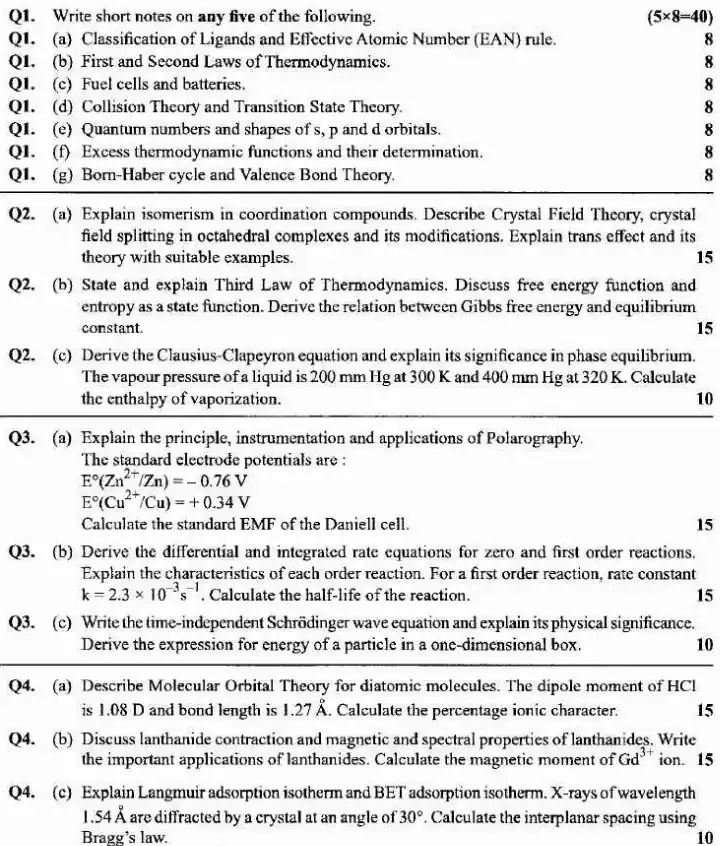
Q1.
(b) Q1. First and Second Laws of Thermodynamics.
(c) O1. Fuel cells and batteries.
(d) Collision Theory and Transition State Theory. O1.
(e) Quantum numbers and shapes of s, p and d orbitals. Q1. (f) Excess thermodynamic functions and their determination. Q1. Q1. (g) Born-Haber cycle and Valence Bond Theory. (a) Explain isomerism in coordination compounds. Describe Crystal Field Theory, crystal Q2. field splitting in octahedral complexes and its modifications. Explain trans effect and its theory with suitable examples. (b) State and explain Third Law of Thermodynamics. Discuss free energy function and Q2. entropy as a state function. Derive the relation between Gibbs free energy and equilibrium constant.
(c) Derive the Clausius-Clapeyron equation and explain its significance in phase equilibrium. Q2. The vapour pressure of a liquid is 200 mm Hg at 300 K and 400 mm Hg at 320 K. Calculate the enthalpy of vaporization. Q3. (a) Explain the principle, instrumentation and applications of Polarography. The standard electrode potentials are: E\circ(Zn2+/Zn) = -0.76 \text V E\circ(Cu 2 + /Cu) = + 0.34 V Calculate the standard EMF of the Daniell cell. Q3. (b) Derive the differential and integrated rate equations for zero and first order reactions. Explain the characteristics of each order reaction. For a first order reaction, rate constant k =