
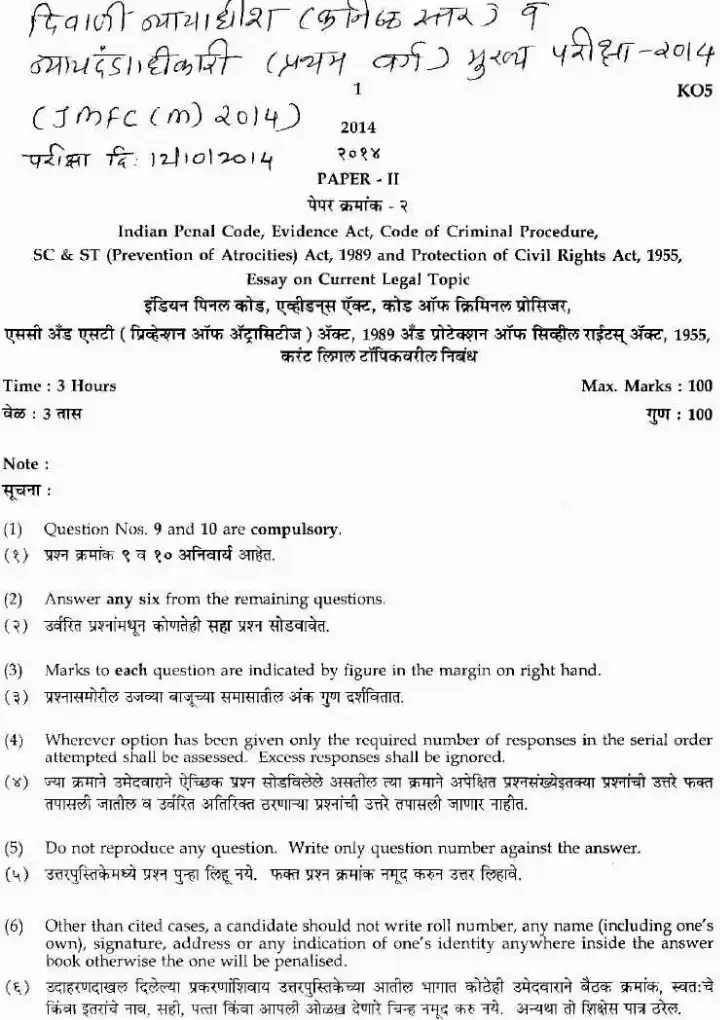
Paper II
- Year 2014
- Conducted By Government of Maharashtra
- Questions 10
- Maximum Marks 100
- Duration 3 Hours
- Languages Marathi & English & Hindi
Exam Details
| Detail | Information |
|---|---|
| Examination | Civil Judge (Jr. Dn.) and Judicial Magistrate (F.C.) Main Examination |
| Year | 2014 |
| Conducting Body | Government of Maharashtra |
| Paper | Paper II |
| Subject | Criminal Law & Procedure |
| Duration | 3 Hours |
| Maximum Marks | 100 |
| Number of Questions | 10 |
| Question Type | Descriptive + mcq |
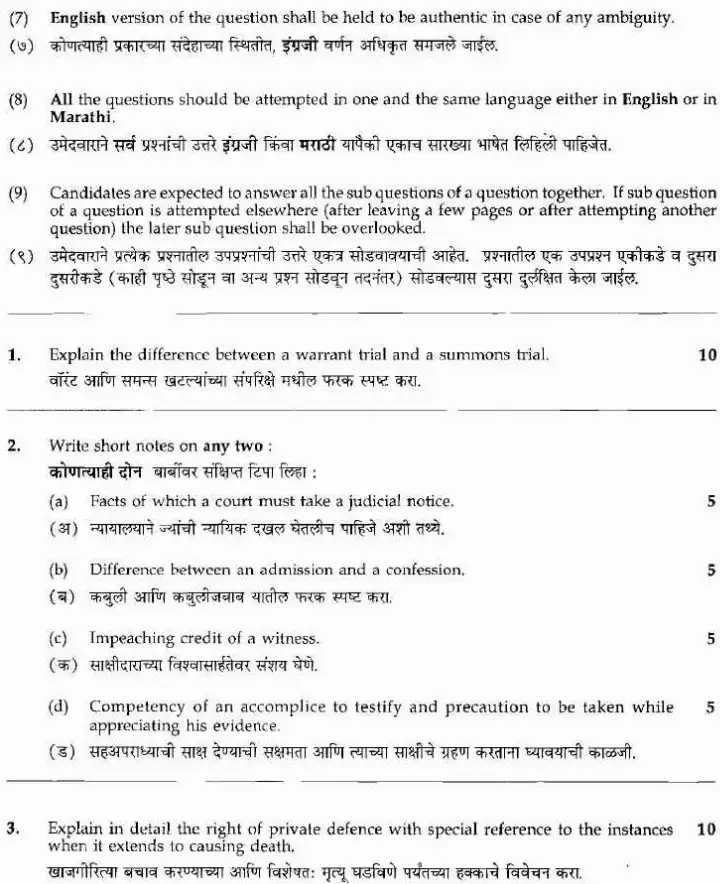
Paper II of the 2014 Maharashtra Civil Judge (Jr. Dn.) and Judicial Magistrate (F.C.) Main Examination covers core criminal law subjects: Indian Penal Code, Evidence Act, Code of Criminal Procedure, and statutory acts such as the SC & ST (Prevention of Atrocities) Act and the Protection of Civil Rights Act, 1955. The paper includes compulsory questions (Q9 and Q10) and a mix of descriptive and objective-type questions. Page 2 presents three descriptive questions, including a comparison of warrant and summons trials, a note on judicial notice with subparts, and a detailed discussion of the right of private defence (especially where death may result). The OCR repair preserves bilingual presentation (Marathi/English) and emphasizes answering in one language, not reproducing questions, and writing only the question numbers beside answers. The overall exam duration is 3 hours for 100 marks. This previous year Civil Judge (Jr. Dn) and Judicial Magistrate (F.C.) Main Examination question paper (2014) is useful for Judicial aspirants preparing for Maharashtra government recruitment. The paper was conducted by MPSC and reflects the official exam pattern, marking scheme and difficulty level seen in recent cycles. Use it for timed practice, topic-wise revision and understanding how questions are framed in the real examination. Download the free PDF on QuizCurrent to read instructions, attempt MCQs and compare your answers with the study notes provided on this page. Key syllabus areas include Indian Penal Code (IPC), Evidence Act, Code of Criminal Procedure (CrPC), SC & ST (Prevention of Atrocities) Act, 1989, Protection of Civil Rights Act, 1955, Warrant trial vs. Summons trial, Judicial notice, Admission vs. confession. Useful for Civil Judge (Jr. Dn.) and Judicial Magis preparation. Helps understand the latest exam pattern. Useful for practice and self-assessment.
Major Topics Covered
- Indian Penal Code (IPC)
- Evidence Act
- Code of Criminal Procedure (CrPC)
- SC & ST (Prevention of Atrocities) Act, 1989
- Protection of Civil Rights Act, 1955
- Warrant trial vs. Summons trial
- Judicial notice
- Admission vs. confession
- Impeachment of witnesses
- Competency of an accomplice to testify
- Credibility of witnesses
- Private defence
- Right of private defence
- Instances of private defence extending to death
- Judicial procedure language
- Examination and cross-examination
- Evidence evaluation and interpretation
- Legal terminology in Marathi and English
- Answer script conventions
- Essay writing on Current Legal Topic
Why This Paper is Important
- Useful for Civil Judge (Jr. Dn.) and Judicial Magis preparation
- Helps understand the latest exam pattern
- Useful for practice and self-assessment
- Covers frequently asked General Studies topics
- Helpful for analysing question trends
Related Resources
- Civil Judge Main Exam 2017 Paper I – Maharashtra Government
- Maharashtra Paper II 2016 - Civil Judge Main Exam (IPC, Evidence Act, CrPC)
- Civil Procedure Code, Transfer of Property Act, Specific Relief Act, Law of Contracts, Sale of Goods Act and Partnership Act
- Maharashtra Judicial Paper II 2015 Essay - Current Legal Topic
- Maha Judicial Exam Paper I 2015 - CPC and Allied Acts
Instructions
Questions (page 2)
Q1. 2 KO 5 English version of the question shall be held to be authentic in case of any ambiguity.
Q2.
- (a) कोणत्याही दोन बार्बोवर संक्षिप्त टिपा लिहा : Facts of which a court must take a judicial notice. (अ) न्यायालयाने ज्यांची न्यायिक दखल घेतलीच पाहिजे अशी तथ्ये. Difference between an admission and a confession.
- (b) कबुली आणि कबुलीजबाब यातील फरक स्पष्ट करा. ( ৰ) Impeaching credit of a witness.
- (c) (क) साक्षीदाराच्या विश्वासार्हतेवर संशय घेणे. Competency of an accomplice to testify and precaution to be taken while
- (d) appreciating his evidence. (ड) सहअपराध्याची साक्ष देण्याची सक्षमता आणि त्याच्या साक्षीचे ग्रहण करताना घ्यावयाची काळजी. Explain in detail the right of private defence with special reference to the instances 3. when it extends to causing death. खाजगीरित्या बचाव करण्याच्या आणि विशेषत: मृत्यू घडविणे पर्यंतच्या हक्काचे विवेचन करा.
Q3. Explain in detail the right of private defence with special reference to the instances when it extends to causing death.
Question paper preview
Scanned pages 1–2 for reference. Download the official PDF for the full paper.
Free question paper download
Download question paper PDF
Your download starts in 10s
Preparing your question paper file…
Frequently asked questions
What is the exam for?
This is Paper II of the Civil Judge (Jr. Dn.) and Judicial Magistrate (F.C.) Main Examination, 2014, covering IPC, Evidence Act, CrPC, POSCO, and related topics.
Which questions are compulsory?
Question Nos. 9 and 10 are compulsory.
How many questions should be attempted?
Answer any six from the remaining questions (i.e., from Q1–Q8).
In what language should the answers be written?
All questions should be attempted in one and the same language, either English or Marathi.
Should candidates reproduce the questions in the answer book?
No. Write only the question number against the answer.
Are there any formatting or order rules for answering?
Where options are given, only the required number of responses in serial order will be assessed. Excess responses will be ignored.