JPSC FRO Chemical Engineering Paper-I 2024 Question Paper PDF

Jharkhand Government Jobs Engineer

  • Conducted By JPSC
  • Maximum Marks 200
  • Duration 3 Hours
  • Languages Hindi & English

Exam Details

Detail Information
Examination FOREST RANGE OFFICER, MAIN EXAMINATION
Conducting Body JPSC
Paper Chemical Engineering Paper-I
Subject Chemical Engineering
Duration 3 Hours
Maximum Marks 200
Question Type Descriptive / Subjective

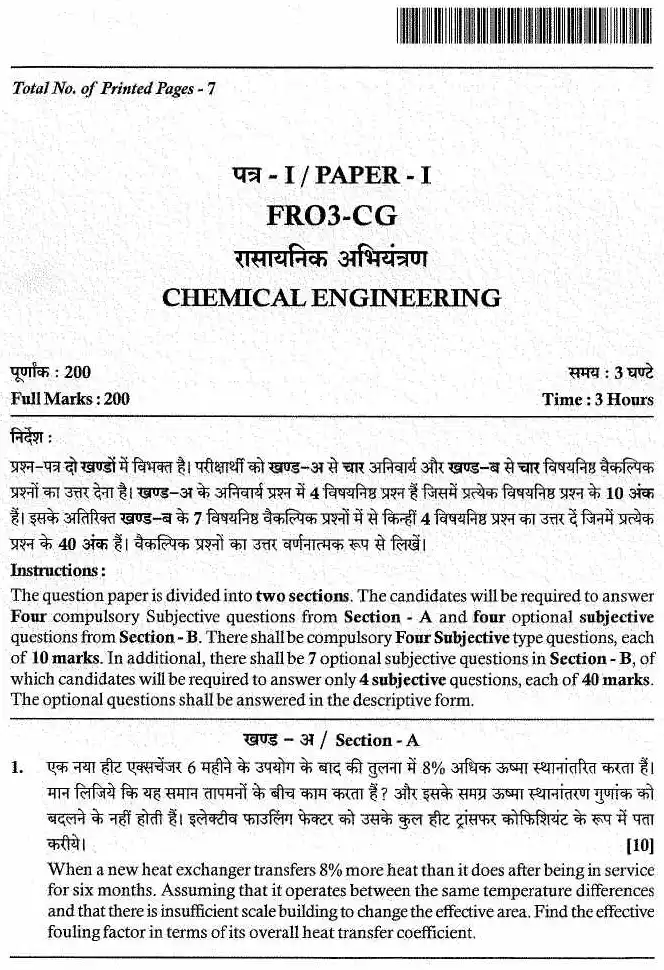
This document contains the Chemical Engineering Paper-I for the JPSC Forest Range Officer (FRO) Main Examination. The paper is divided into two sections, Section A and Section B, with a total of 200 marks and a time duration of 3 hours. Section A includes four compulsory subjective questions, each carrying 10 marks. Section B consists of seven optional subjective questions, out of which candidates must answer any four, each carrying 40 marks. This paper is crucial for aspirants preparing for the FRO examination, providing a clear understanding of the expected question format and difficulty level in Chemical Engineering.

Major Topics Covered

  • Heat Exchanger
  • Heat Transfer Coefficient
  • Fouling Factor
  • Fluidized Bed
  • Bed Pressure Drop
  • First Order Reaction
  • Phase Lag
  • Dead Time
  • Pressure Drop in Pipe
  • Shell-and-Tube Heat Exchanger
  • Log-Mean Temperature Difference
  • Heat Load Calculation

Why This Paper is Important

  • Useful for FOREST RANGE OFFICER, MAIN EXAMINATION preparation
  • Helps understand the latest exam pattern
  • Useful for practice and self-assessment
  • Covers frequently asked General Studies topics
  • Helpful for analysing question trends

Related Resources

  • JPSC FRO Paper-II
  • JPSC Assistant Engineer Electrical Paper
  • JPSC Assistant Engineer Mechanical Paper
  • ESE Chemical Engineering Paper
  • JPSC FRO Chemical Engineering Paper-I Answer Key 2024
  • JPSC FRO Main Exam Answer Key
  • JPSC FRO Syllabus
  • Chemical Engineering Syllabus for Competitive Exams

Instructions

  • मान लिजिये कि यह समान तापमनों के बीच काम करता हैं ? और इसके समग्र ऊष्मा स्थानांतरण गुणांक को बदलने के नहीं होती हैं।
  • इलेक्टीव फाउलिंग फेक्टर को उसके कुल हीट ट्रांसफर कोफिशियंट के रूप में पता करीये। [10] When a new heat exchanger transfers 8% more heat than it does after being in service for six months. Assuming that it operates between the same temperature differences and that there is insufficient scale building to change the effective area. Find the effective fouling factor in terms of its overall heat transfer coefficient. FRO3-CG [1] PTO

Questions (page 2)

Section B

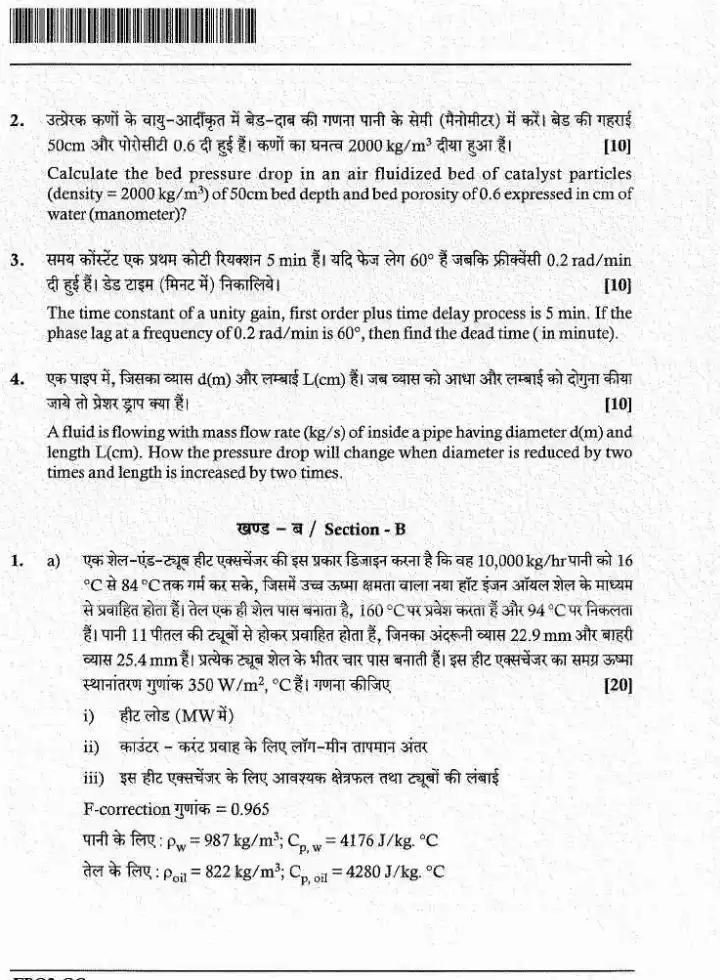
Q1. एक शेल-एंड-ट्यूब हीट एक्सचेंजर की इस प्रकार डिजाइन करना है कि वह 10,000 kg/hr पानी को 16 °C से 84 °C तक गर्म कर सके, जिसमें उच्च ऊष्मा क्षमता वाला नया हॉट इंजन ऑयल शेल के माध्यम से प्रवाहित होता हैं। तेल एक ही शेल पास बनाता है, 160 °C पर प्रवेश करता हैं और 94 °C पर निकलता हैं। पानी 11 पीतल की ट्यूबों से होकर प्रवाहित होता हैं, जिनका अंदरूनी व्यास 22.9 mm और बाहरी व्यास 25.4 mm हैं। प्रत्येक ट्यूब शेल के भीतर चार पास बनाती हैं। इस हीट एक्सचेंजर का समग्र ऊष्मा स्थानांतरण गुणांक 350 W/m^2, °C हैं। गणना कीजिए [20]
Design a shell-and-tube heat exchanger to heat 10,000 kg/hr of water from 16 °C to 84 °C by a new hot engine oil with high heat capacity flowing through the shell. The oil makes a single shell pass, enters at 160 °C and leaves at 94 °C. Water flows through 11 brass tubes, each of inner diameter 22.9 mm and outer diameter 25.4 mm. Each tube makes four passes inside the shell. The overall heat transfer coefficient for this heat exchanger is 350 W/m^2, °C. Calculate

(a) हीट लोड (MW में)
i) काउंटर – करंट प्रवाह के लिए लॉग–मीन तापमान अंतर
ii)
iii) इस हीट एक्सचेंजर के लिए आवश्यक क्षेत्रफल तथा ट्यूबों की लंबाई
F-correction गुणांक = 0.965
पानी के लिए : \rho\rm w = 987 kg/m3; Cp, w = 4176 J/kg. °C
तेल के लिए : \rho\rm oil = 822 kg/m3; Cp, oil = 4280 J/kg. °C
Heat load (in MW)
i) Log-mean temperature difference for counter-current flow
ii)
iii) Required area and tube length for this heat exchanger
F-correction factor = 0.965
For water: \rho\rm w = 987 kg/m3; Cp, w = 4176 J/kg. °C
For oil: \rho\rm oil = 822 kg/m3; Cp, oil = 4280 J/kg. °C
Q2.

(a) उत्प्रेरक कणों के वायु-आर्दीकृत में बेड-दाब की गणना पानी के सेमी (मैनोमीटर) में करें। बेड की गहराई 50cm और पोरोसीटी 0.6 दी हुई हैं। कणों का घनत्व 2000 kg/m3 दीया हुआ हैं। [10]
Calculate the bed pressure drop in an air fluidized bed of catalyst particles (density = 2000 \text kg/m^3) of 50cm bed depth and bed porosity of 0.6 expressed in cm of water (manometer)?

Q3.

(a) समय कोंस्टेंट एक प्रथम कोटी रियक्शन 5 min हैं। यदि फेज लेग 60° हैं जबकि फ्रीक्वेंसी 0.2 rad/min दी हुई हैं। डेड टाइम (मिनट में) निकालिये। [10]
The time constant of a unity gain, first order plus time delay process is 5 min. If the phase lag at a frequency of 0.2 rad/min is 60^\circ, then find the dead time (in minute).

Q4.

(a) एक पाइप में, जिसका व्यास d(m) और लम्बाई L(cm) हैं। जब व्यास को आधा और लम्बाई को दोगना कीया जाये तो प्रेशर ड्राप क्या है। [10]
A fluid is flowing with mass flow rate (kg/s) of inside a pipe having diameter d(m) and length L(cm). How the pressure drop will change when diameter is reduced by two times and length is increased by two times.

Question paper preview

Scanned pages 1–2 for reference. Download the official PDF for the full paper.

Page 1
JPSC Forest Range Officer Main Examination Chemical Engineering Paper-I 2024 question paper page 1 instructions scan PDF download
Page 2
JPSC Forest Range Officer Main Examination Chemical Engineering Paper-I 2024 question paper page 1 instructions scan PDF download

Free question paper download

Download question paper PDF

  • 443 KB
  • 7 pages
  • PDF format

Frequently asked questions

What is the full name of the exam?

The full name of the exam is FOREST RANGE OFFICER, MAIN EXAMINATION.

Which conducting body organizes this exam?

The exam is conducted by JPSC.

What is the paper name?

The paper name is Chemical Engineering Paper-I.

What is the maximum marks for this paper?

The maximum marks for this paper are 200.

What is the time allowed for the exam?

The time allowed for the exam is 3 Hours.

How is the question paper divided?

The question paper is divided into two sections: Section A and Section B.

← Back to Engineer papers