
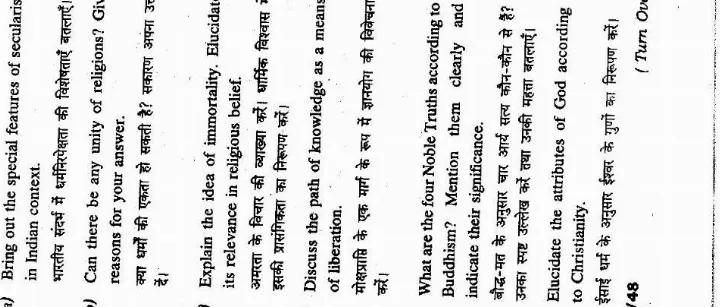
Q1. Bring out the special features of secularism in Indian context.
(a) Can there be any unity of religions? Give reasons for your answer.
| Detail | Information |
|---|---|
| Examination | 4th COMBINED CIVIL SERVICES (Main) EXAM - 2012 |
| Year | 2012 |
| Conducting Body | Jharkhand Public Service Commission |
| Paper | Philosophy (Paper II) |
| Subject | Philosophy (Paper II) |
| Duration | N/A Hours |
| Maximum Marks | N/A |
| Number of Questions | N/A |
| Question Type | Descriptive / Subjective |
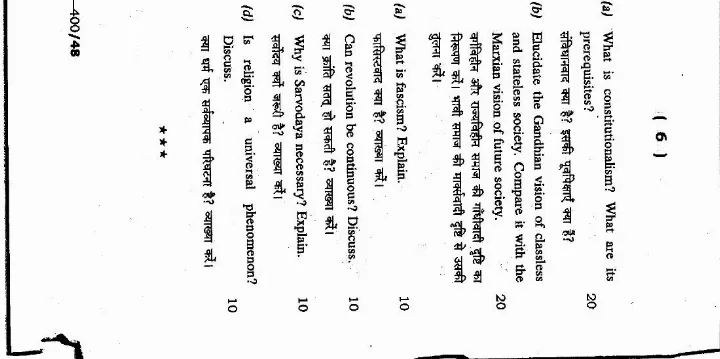
This document contains the Philosophy (Paper II) question paper for the 4th Combined Civil Services (Main) Examination held in 2012, conducted by the Jharkhand Public Service Commission (JPSC). The paper consists of descriptive questions, covering topics such as Sarvodaya, constitutionalism, fascism, Gandhian and Marxian visions of society, secularism in the Indian context, the unity of religions, the attributes of God in Christianity, the path of knowledge for liberation, and the Four Noble Truths of Buddhism. The questions require detailed explanations, comparisons, and elucidations, testing the candidates' in-depth understanding of philosophical concepts and their application. The paper is designed to assess analytical and critical thinking skills related to political philosophy, ethics, and comparative religion. It is a valuable resource for aspirants preparing for the JPSC Civil Services Main Examination, providing a clear understanding of the exam pattern and the depth of knowledge expected in the Philosophy subject. This previous year 4th COMBINED CIVIL SERVICES (Main) EXAM -2012 question paper (2012) is useful for Administrative / Civil Services aspirants preparing for Jharkhand government recruitment. The paper was conducted by JPSC and reflects the official exam pattern, marking scheme and difficulty level seen in recent cycles. Use it for timed practice, topic-wise revision and understanding how questions are framed in the real examination. Download the free PDF on QuizCurrent to read instructions, attempt MCQs and compare your answers with the study notes provided on this page. Key syllabus areas include Indian Secularism, Unity of Religions, Immortality, Attributes of God, Christianity, Path of Knowledge, Religious Belief, Buddhism. Useful for 4th COMBINED CIVIL SERVICES (Main) EXAM preparation. Helps understand the latest exam pattern. Useful for practice and self-assessment.
(a) Can there be any unity of religions? Give reasons for your answer.
(a) Elucidate the attributes of God according to Christianity. Indicate their significance.
(b) Discuss the path of knowledge as a means to liberation. Explain its relevance in religious belief.
(a) Explain the Gandhian vision of classless and stateless society.
(b) Compare it with the Marxian vision of future society.
Scanned pages 1–2 for reference. Download the official PDF for the full paper.
Free question paper download
Your download starts in 10s
Preparing your question paper file…
The exam is the 4th Combined Civil Services (Main) Examination, held in 2012.
This question paper is for Philosophy, Paper II.
The Jharkhand Public Service Commission (JPSC) conducts this examination.
This paper consists of descriptive questions.
Key topics include Sarvodaya, constitutionalism, fascism, Gandhian and Marxian visions of society, secularism, religious unity, attributes of God, the path of knowledge, and the Four Noble Truths of Buddhism.
Constitutionalism refers to the idea of limited government and the rule of law, where governmental power is defined and restricted by a constitution.
← Back to Administrative / Civil Services papers · Jharkhand Government Jobs