4th CCSME Botany Paper-I 2012 Question Paper | Jharkhand Jobs
Jharkhand Government Jobs·Administrative / Civil Services·2012
📅Year2012
🏛Conducted ByJharkhand Government Jobs
📝QuestionsN/A
🎯Maximum Marks200
⏱Duration3 Hours
🌐LanguagesEnglish & Hindi
Exam Details
Detail
Information
Examination
4th COMBINED CIVIL SERVICES (Main) EXAM
Year
2012
Conducting Body
Jharkhand Government Jobs
Paper
Paper-I
Subject
Botany
Duration
3 Hours
Maximum Marks
200
Number of Questions
N/A
Question Type
Descriptive / Subjective
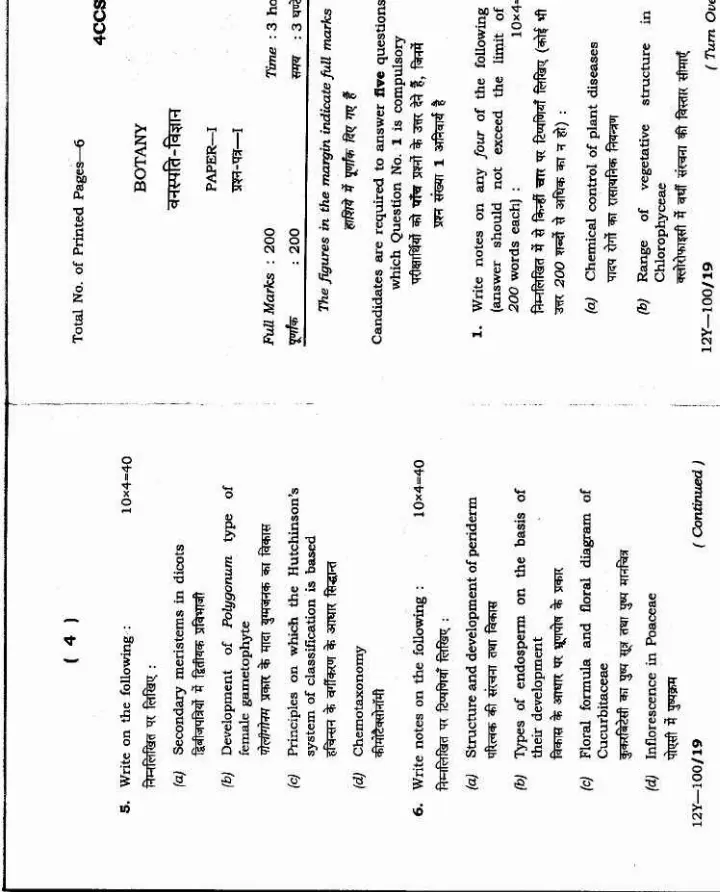
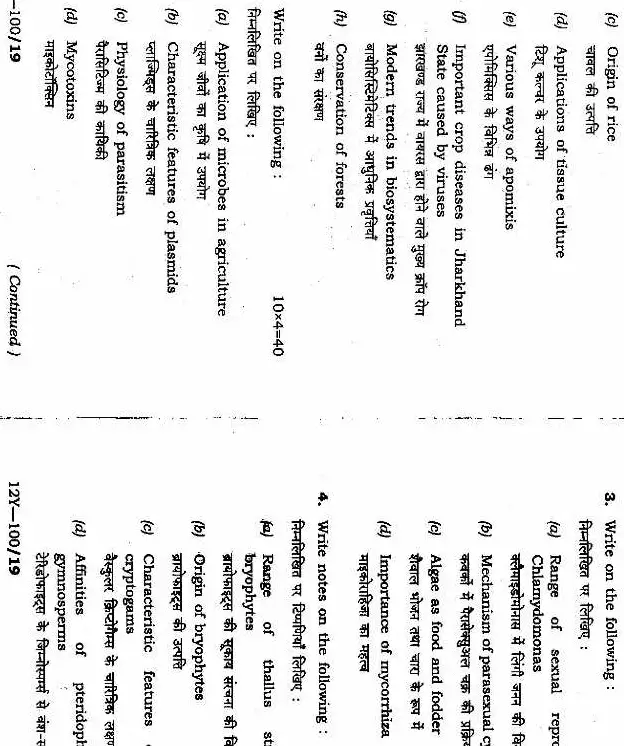
This document contains the Botany Paper-I question paper for the 4th Combined Civil Services (Main) Examination held in 2012, conducted by Jharkhand Government Jobs. The paper is divided into descriptive questions, with a total of 200 marks and a time duration of 3 hours. Question 1 is compulsory and requires notes on ten different topics including chemical control of plant diseases, vegetative structure of Chlorophyceae, development of Polygonum type of female gametophyte, types of endosperm, structure and development of periderm, secondary meristems in dicots, inflorescence in Poaceae, chemotaxonomy, floral formula and diagram of Cucurbitaceae, and principles of classification. Other questions require notes on mycotoxins, plasmids, application of microbes in agriculture, physiology of parasitism, origin of bryophytes, characteristics of vascular cryptogams, affinities of pteridophytes with gymnosperms, range of thallus structure in bryophytes, modern trends in biosystematics, origin of rice, viral crop diseases in Jharkhand, apomixis, sexual reproduction in Chlamydomonas, importance of mycorrhiza, parasexual cycle in fungi, and algae as food and fodder. The paper is presented in This previous year 4th COMBINED CIVIL SERVICES (Main) EXAM -2012 question paper (2012) is useful for Administrative / Civil Services aspirants preparing for Jharkhand government recruitment. The paper was conducted by JPSC and reflects the official exam pattern, marking scheme and difficulty level seen in recent cycles. Use it for timed practice, topic-wise revision and understanding how questions are framed in the real examination. Download the free PDF on QuizCurrent to read instructions, attempt MCQs and compare your answers with the study notes provided on this page. Key syllabus areas include Plant Pathology, Plant Morphology, Plant Anatomy, Plant Taxonomy, Plant Physiology, Genetics, Biosystematics, Algae. Useful for 4th COMBINED CIVIL SERVICES (Main) EXAM preparation. Helps understand the latest exam pattern. Useful for practice and self-assessment.
Major Topics Covered
Plant Pathology
Plant Morphology
Plant Anatomy
Plant Taxonomy
Plant Physiology
Genetics
Biosystematics
Algae
Fungi
Bryophytes
Pteridophytes
Gymnosperms
Angiosperms
Microbiology
Agriculture
Biotechnology
Ecology
Evolution
Classification Systems
Plant Diseases
Why This Paper is Important
Useful for 4th COMBINED CIVIL SERVICES (Main) EXAM preparation
Q1.(a) Write notes on the following: Chemical control of plant diseases
(a)Write notes on the following: Chemical control of plant diseases
(b)Vegetative structure of Chlorophyceae
(c)Development of Polygonum type of female gametophyte
(d)Types of endosperm on the basis of development
(e)Structure and development of periderm
(f) Secondary meristems in dicots
(g) Inflorescence in Poaceae
(h) Chemotaxonomy
(i) Hutchinson's Floral formula and floral diagram of Cucurbitaceae
(j) Principles on which the system of classification is based
(a)Write notes on the following: Chemical control of plant diseases
(b)Vegetative structure of Chlorophyceae
(c)Development of Polygonum type of female gametophyte
(d)Types of endosperm on the basis of development
Q2.(a) Write notes on the following: Mycotoxins
(a)Write notes on the following: Mycotoxins
(b)Characteristic features of plasmids
(c)Application of microbes in agriculture
(d)Physiology of parasitism
(a)Write notes on the following: Mycotoxins
(b)Characteristic features of plasmids
(c)Application of microbes in agriculture
(d)Physiology of parasitism
Q3.(a) Write notes on the following: Origin of bryophytes
(a)Write notes on the following: Origin of bryophytes
(b)Characteristic features of vascular cryptogams
(c)Affinities of pteridophytes with gymnosperms
(d)Range of thallus structure in bryophytes
(a)Write notes on the following: Origin of bryophytes
(b)Characteristic features of vascular cryptogams
(c)Affinities of pteridophytes with gymnosperms
(d)Range of thallus structure in bryophytes
Q4.(a) Write on the following: Modern trends in biosystematics
(a)Write on the following: Modern trends in biosystematics
(b)Origin of rice
(c)Important crop diseases in Jharkhand State caused by viruses
(d)Various ways of apomixis
(a)Write on the following: Modern trends in biosystematics
(b)Origin of rice
(c)Important crop diseases in Jharkhand State caused by viruses
(d)Various ways of apomixis
Q5.(a) Write on the following: Range of sexual reproduction in Chlamydomonas
(a)Write on the following: Range of sexual reproduction in Chlamydomonas
(b)Importance of mycorrhiza
(c)Mechanism of parasexual cycle in fungi
(d)Algae as food and fodder
(a)Write on the following: Range of sexual reproduction in Chlamydomonas
(b)Importance of mycorrhiza
(c)Mechanism of parasexual cycle in fungi
(d)Algae as food and fodder
Question paper preview
Scanned pages 1–2 for reference. Download the official PDF for the full paper.
Page 1Page 2
PDF
Free question paper download
Download question paper PDF
251 KB
4 pages
PDF format
10
PDF
Your download starts in 10s
Preparing your question paper file…
Frequently asked questions
What is the exam name and year for this Botany paper?
The exam name is the 4th Combined Civil Services (Main) Exam, and the year is 2012.
What is the conducting body for this examination?
The conducting body is Jharkhand Government Jobs.
What is the subject and paper for this question paper?
The subject is Botany, and it is Paper-I (01) of the 4th CCSME.
What is the total marks and time allowed for the Botany Paper-I?
The total marks are 200, and the time allowed is 3 hours.
What type of questions are asked in this paper?
The questions are descriptive, requiring notes and detailed answers on various botanical topics.
Is Question 1 compulsory in the Botany Paper-I?
Yes, Question 1 is compulsory and requires notes on ten different topics.