
JPSC Anthropology Paper 1 2012 Previous Year Question Paper
- Year 2012
- Conducted By Jharkhand Public Service Commission (JPSC)
- Questions N/A
- Maximum Marks 200
- Duration N/A Hours
- Languages English & Hindi
Exam Details
| Detail | Information |
|---|---|
| Examination | 4th COMBINED CIVIL SERVICES (Main) EXAM |
| Year | 2012 |
| Conducting Body | Jharkhand Public Service Commission (JPSC) |
| Paper | Anthropology (Paper-I) |
| Subject | Anthropology |
| Duration | N/A Hours |
| Maximum Marks | 200 |
| Number of Questions | N/A |
| Question Type | Descriptive / Subjective |
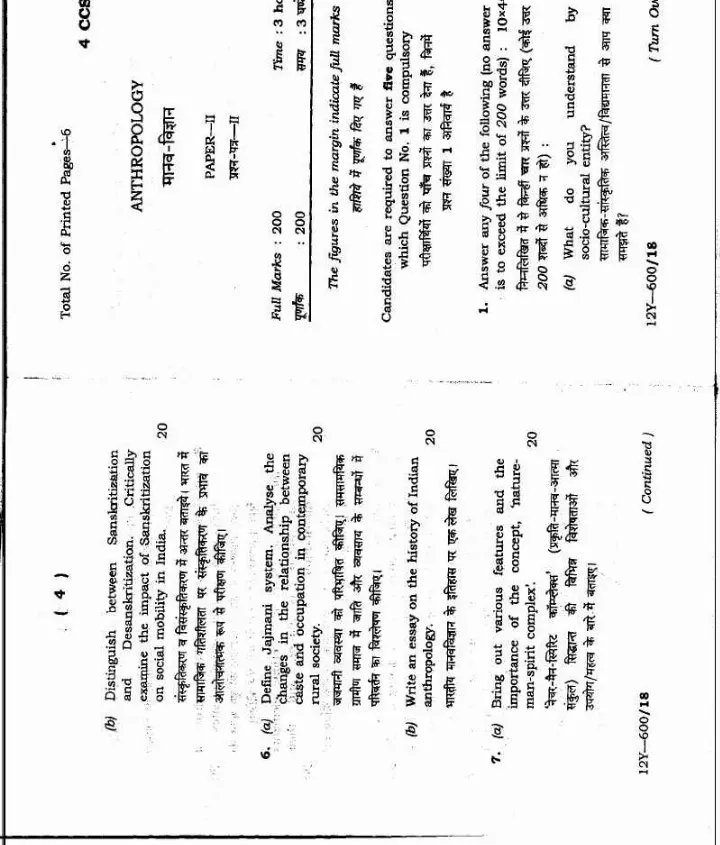
This document contains the Anthropology Paper-I from the 4th Combined Civil Services (Main) Examination held in 2012, conducted by the Jharkhand Public Service Commission (JPSC). The paper is worth 200 marks and consists of descriptive questions. Key topics covered include socio-cultural entities, urban planning in Harappan culture, dominant caste, the concept of rebirth, the distinction between Great and Little traditions, sacred complexes, mesolithic culture, joint family systems, casteism, racial elements in Indian population, neolithic culture, palaeolithic and neolithic tools, lower palaeolithic culture, and the Indus Valley Civilization. The questions require detailed analysis and critical evaluation of anthropological concepts and Indian social structures. This paper is crucial for candidates preparing for the JPSC Civil Services exams, offering insights into the expected depth and breadth of knowledge in Anthropology. This previous year 4th COMBINED CIVIL SERVICES (Main) EXAM -2012 question paper (2012) is useful for Administrative / Civil Services aspirants preparing for Jharkhand government recruitment. The paper was conducted by JPSC and reflects the official exam pattern, marking scheme and difficulty level seen in recent cycles. Use it for timed practice, topic-wise revision and understanding how questions are framed in the real examination. Download the free PDF on QuizCurrent to read instructions, attempt MCQs and compare your answers with the study notes provided on this page. Key syllabus areas include Anthropology, Indian Society, Cultural Anthropology, Social Anthropology, Archaeology, Ancient Civilizations, Harappan Civilization, Indus Valley Civilization. Useful for 4th COMBINED CIVIL SERVICES (Main) EXAM preparation. Helps understand the latest exam pattern. Useful for practice and self-assessment.
Major Topics Covered
- Anthropology
- Indian Society
- Cultural Anthropology
- Social Anthropology
- Archaeology
- Ancient Civilizations
- Harappan Civilization
- Indus Valley Civilization
- Caste System
- Social Mobility
- Family Systems
- Racial Elements
- Neolithic Culture
- Palaeolithic Culture
- Mesolithic Culture
- JPSC Civil Services
- Previous Year Papers
- Descriptive Questions
- Sanskritization
- Desanskritization
Why This Paper is Important
- Useful for 4th COMBINED CIVIL SERVICES (Main) EXAM preparation
- Helps understand the latest exam pattern
- Useful for practice and self-assessment
- Covers frequently asked General Studies topics
- Helpful for analysing question trends
Related Resources
- 4th Combined Civil Services Main Exam 2012 Paper I Urdu L&L
- JPSC 4th Combined Civil Services Main Exam 2012 Labour & Social Welfare Paper II
- Jharkhand JPSC 4th Combined Civil Services Main Exam 2012 Zoology Paper
- Jharkhand 4th Combined Civil Services Main Exam 2012 Zoology Paper I
- JPSC 4th Combined Civil Services Main Exam 2012 Kurmali Paper-II
Instructions
Questions (page 2)
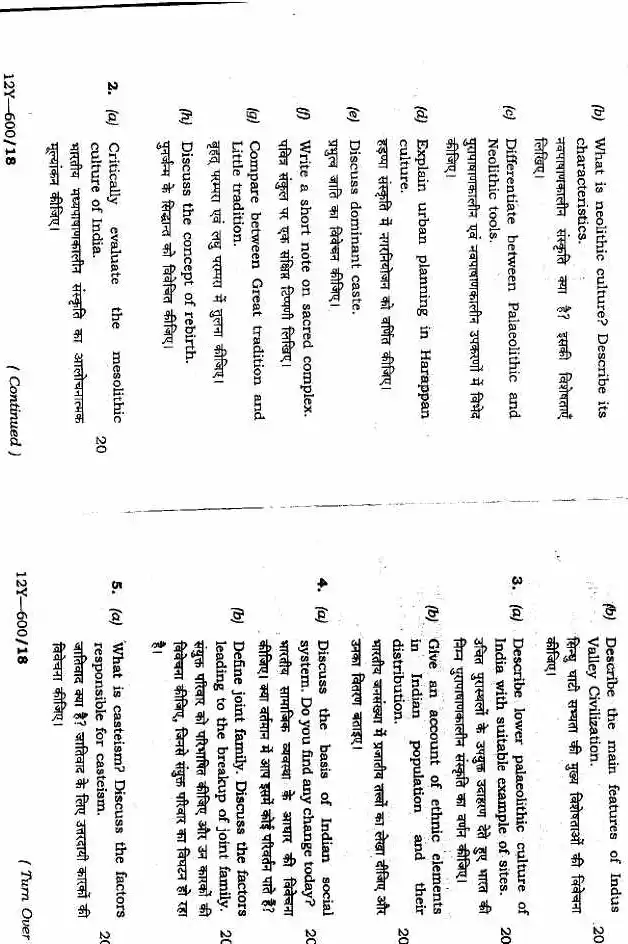
Q2. Explain urban planning in Harappan culture. हड़या संस्कृति में नगरनियोजन को वर्णित कीजिए।
Q3. Discuss dominant caste. प्रमुत्व जाति का विवेचन कीजिए।
Q4. Discuss the concept of rebirth. पुनर्जन्म के सिद्धान्त को विवेचित कीजिए।
Q5. Compare between Great tradition and Little tradition. बृहत् परम्परा एवं लघु परम्परा में तुलना कीजिए।
Q6. Write a short note on sacred complex. पवित्र सकुल पर एक संक्षिप्त टिप्पणी लिखिए।
Q7. Critically evaluate the mesolithic culture of India. भारतीय मध्यपाषाणकालीन संस्कृति का आलाचनात्मक मूल्याकन कोजिए।
Q8. Define joint family. Discuss the factors leading to the breakup of joint family. What is casteism? Discuss the factors responsible for casteism. संयुक्त परिवार को परिभाषित कीजिए और उन कारकों की विवेचना कीजिए, जिनसे संयुक्त परिवार का विघटन हो रहा है। जातिवाद क्या है? जातिवाद के लिए उत्तरदायी कारकों की विवेचना कीजिए।
Q9. Discuss the basis of Indian social system. Do you find any change today? भारतीय सामाजिक व्यवस्था के आधार की विवेचना कीजिए। क्या वर्तमान में आप इसमें कोई परिवर्तन पाते हैं?
Q10. Give an account of racial elements in Indian population and their distribution. भारतीय जनसंख्या में प्रजातीय तत्त्वों का लेखा दीजिए और उनका वितरण बताइए।
Q11. What is neolithic culture? Describe its characteristics. नवपाषाणकालीन संस्कृति क्या है? इसकी विशेषताएँ बताइए।
Q12. Differentiate between Palaeolithic and Neolithic tools. परापाषाणकालीन एवं नवपाषाणकालीन उपकरणों में विभेद कीजिए।
Question paper preview
Scanned pages 1–2 for reference. Download the official PDF for the full paper.
Free question paper download
Download question paper PDF
Your download starts in 10s
Preparing your question paper file…
Frequently asked questions
What is the exam name and year for this Anthropology paper?
The exam name is the 4th Combined Civil Services (Main) Exam, and the year is 2012.
What is the conducting body for this exam?
The exam is conducted by the Jharkhand Public Service Commission (JPSC).
What is the subject and paper code?
The subject is Anthropology, and the paper code is T - 57 - 17 (Paper-I).
What is the maximum marks for this paper?
The maximum marks for Anthropology Paper-I is 200.
What type of questions are asked in this paper?
This paper consists of descriptive questions.
What are some of the key topics covered in the descriptive questions?
Key topics include socio-cultural entities, Harappan urban planning, dominant caste, rebirth, Great vs. Little tradition, sacred complex, mesolithic culture, joint family, casteism, racial elements, neolithic and palaeolithic cultures, and Indus Valley Civilization.
← Back to Administrative / Civil Services papers · Jharkhand Government Jobs