
JPSC Physics Question Paper 2011 PDF Download
- Conducted By JPSC
- Maximum Marks 200
- Duration 2 Hours
- Languages English & Hindi
Exam Details
| Detail | Information |
|---|---|
| Examination | 4th COMBINED CIVIL SERVICES (PT) EXAM |
| Conducting Body | JPSC |
| Paper | Physics |
| Subject | Physics |
| Duration | 2 Hours |
| Maximum Marks | 200 |
| Question Type | Objective (MCQ) |
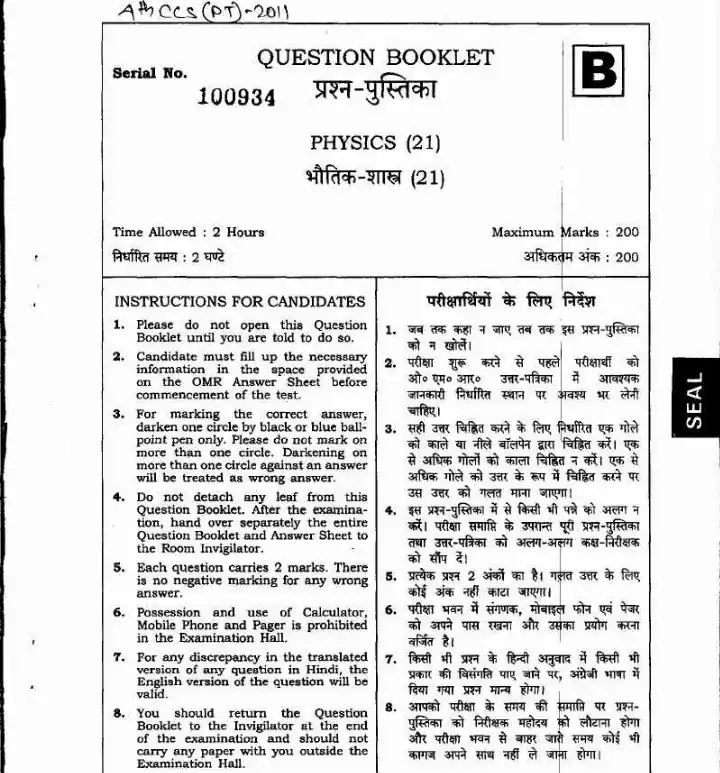
This is the official question paper for the Physics subject (Paper Code 21) of the 4th Combined Civil Services (PT) Examination conducted by JPSC in 2011. The paper is of objective type, carrying a maximum of 200 marks and a time duration of 2 hours. It includes instructions for candidates in both English and Hindi. Aspirants preparing for JPSC examinations can use this paper to understand the exam pattern, question difficulty, and important topics covered in Physics. Practicing with previous year papers like this is crucial for effective exam preparation. This previous year 4th COMBINED CIVIL SERVICES (PT) EXAM -2011 question paper is useful for Administrative / Civil Services aspirants preparing for Jharkhand government recruitment. The paper was conducted by JPSC and reflects the official exam pattern, marking scheme and difficulty level seen in recent cycles. Use it for timed practice, topic-wise revision and understanding how questions are framed in the real examination. Download the free PDF on QuizCurrent to read instructions, attempt MCQs and compare your answers with the study notes provided on this page. Key syllabus areas include Semiconductors, Van der Waals Equation, Critical Temperature, Degrees of Freedom, Monatomic Gas, Carnot Engine, Thermodynamics, Curie Point. Useful for 4th COMBINED CIVIL SERVICES (PT) EXAM preparation. Helps understand the latest exam pattern. Useful for practice and self-assessment.
Major Topics Covered
- Semiconductors
- Van der Waals Equation
- Critical Temperature
- Degrees of Freedom
- Monatomic Gas
- Carnot Engine
- Thermodynamics
- Curie Point
- Magnetism
- Alternating Current
- RMS Value
- Magnetic Induction
- Magnetising Field
- Permeability
Why This Paper is Important
- Useful for 4th COMBINED CIVIL SERVICES (PT) EXAM preparation
- Helps understand the latest exam pattern
- Useful for practice and self-assessment
- Covers frequently asked General Studies topics
- Helpful for analysing question trends
Related Resources
- JPSC Combined Civil Services PT Exam 2011 General Studies Paper
- JPSC Combined Civil Services PT Exam 2010 Physics Paper
- Previous Year JPSC Physics Papers
- JPSC 4th Combined Civil Services PT Exam 2011 Physics Answer Key
- JPSC Physics Syllabus
- JPSC Combined Civil Services PT Exam Syllabus
- JPSC Combined Civil Services PT Exam Pattern
- JPSC Civil Services Exam
Instructions
- जब तक कहा न जाए तब तक इस प्रश्न-पुस्तिका Booklet until you are told to do so. को न खोलें।
- परीक्षा शुरू करने से पहले परीक्षार्थी को information in the space provided SEAL ओ॰ एम॰ आर॰ उत्तर-पत्रिका में आवश्यक on the OMR Answer Sheet before जानकारी निर्धारित स्थान पर अवश्य भर लेनी commencement of the test. चाहिए।
- सही उत्तर चिह्नित करने के लिए निर्धारित एक गोले point pen only. Please do not mark on को काले या नीले बॉलपेन द्वारा चिह्नित करें।
- एक more than one circle. Darkening on से अधिक गोलों को काला चिह्नित न करें।
- एक से more than one circle against an answer अधिक गोले को उत्तर के रूप में चिह्नित करने पर will be treated as wrong answer. उस उत्तर को गलत माना जाएगा।
- इस प्रश्न-पुस्तिका में से किसी भी पन्ने को अलग न Question Booklet. After the examina- करें।
- परीक्षा समाप्ति के उपरान्त पूरी प्रश्न-पुस्तिका tion, hand over separately the entire Question Booklet and Answer Sheet to तथा उत्तर-पत्रिका को अलग-अलग कक्ष-निरीक्षक the Room Invigilator. को सौंप दें।
- प्रत्येक प्रश्न 2 अंकों का है। गलत उत्तर के लिए is no negative marking for any wrong कोई अंक नहीं काटा जाएगा। answer.
- परीक्षा भवन में संगणक, मोबाइल फोन एवं पेजर
- Possession and use of Calculator, को अपने पास रखना और उसका प्रयोग करना Mobile Phone and Pager is prohibited in the Examination Hall. वर्जित है।
- किसी भी प्रश्न के हिन्दी अनुवाद में किसी भी version of any question in Hindi, the प्रकार की विसंगति पाए जाने पर, अंग्रेजी भाषा में English version of the question will be दिया गया प्रश्न मान्य होगा। valid.
- आपको परीक्षा के समय की समाप्ति पर प्रश्न-
- You should return the Question पुस्तिका को निरीक्षक महोदय को लौटाना होगा Booklet to the Invigilator at the end और परीक्षा भवन से बाहर जाते समय कोई भी of the examination and should not carry any paper with you outside the कागज अपने साथ नहीं ले जाना होगा। Examination Hall.
- For marking the correct answer, darken one circle by black or blue ball-
Questions (page 2)
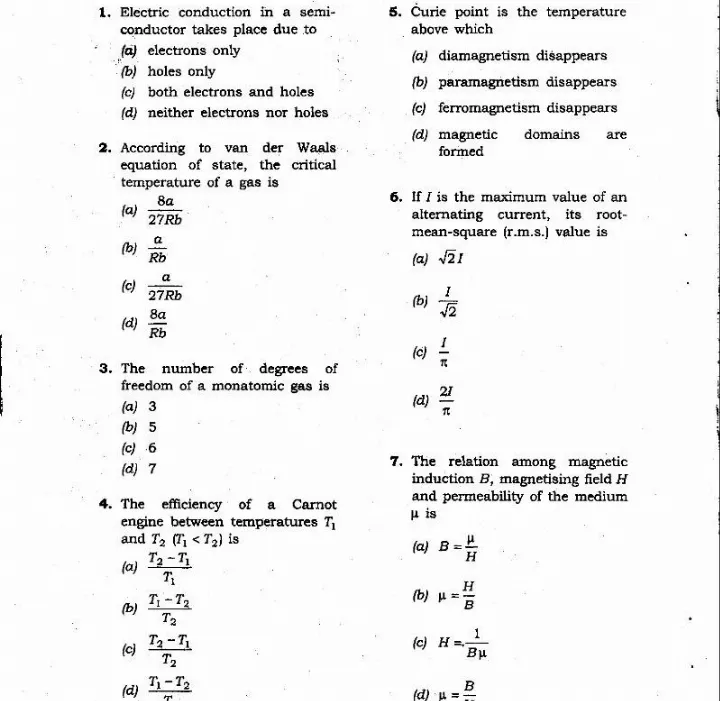
Q2. According to van der Waals equation of state, the critical temperature of a gas is
Q3. The number of degrees of freedom of a monatomic gas is
Q4. The efficiency of a Carnot engine between temperatures T1 and T2 (T1 < T2) is
Q5. Curie point is the temperature above which
Q6. If I is the maximum value of an alternating current, its root-mean-square (r.m.s.) value is
Q7. The relation among magnetic induction B, magnetising field H and permeability of the medium μ is
Question paper preview
Scanned pages 1–2 for reference. Download the official PDF for the full paper.
Free question paper download
Download question paper PDF
Your download starts in 10s
Preparing your question paper file…
Frequently asked questions
What is the name of the exam?
The exam is the 4th Combined Civil Services (PT) Exam.
Which conducting body organized this exam?
The exam was conducted by JPSC.
What is the subject of this question paper?
The subject is Physics, with paper code 21.
What is the maximum marks for this paper?
The maximum marks for this paper are 200.
What is the time allowed to complete the paper?
The time allowed is 2 hours.
What type of questions are included in this paper?
This paper consists of objective type questions.
← Back to Administrative / Civil Services papers · Jharkhand Government Jobs