
JPSC ACF Main Exam Mechanical Engineering Question Paper PDF
- Conducted By JPSC
- Questions 11
- Maximum Marks 200
- Duration 3 Hours
- Languages Hindi & English
Exam Details
| Detail | Information |
|---|---|
| Examination | ASSISTANT CONSERVATOR OF FOREST,MAIN EXAM. ,Advt.No.-03/2024 |
| Conducting Body | JPSC |
| Paper | Mechanical Engineering |
| Subject | Mechanical Engineering |
| Duration | 3 Hours |
| Maximum Marks | 200 |
| Number of Questions | 11 |
| Question Type | Descriptive / Subjective |
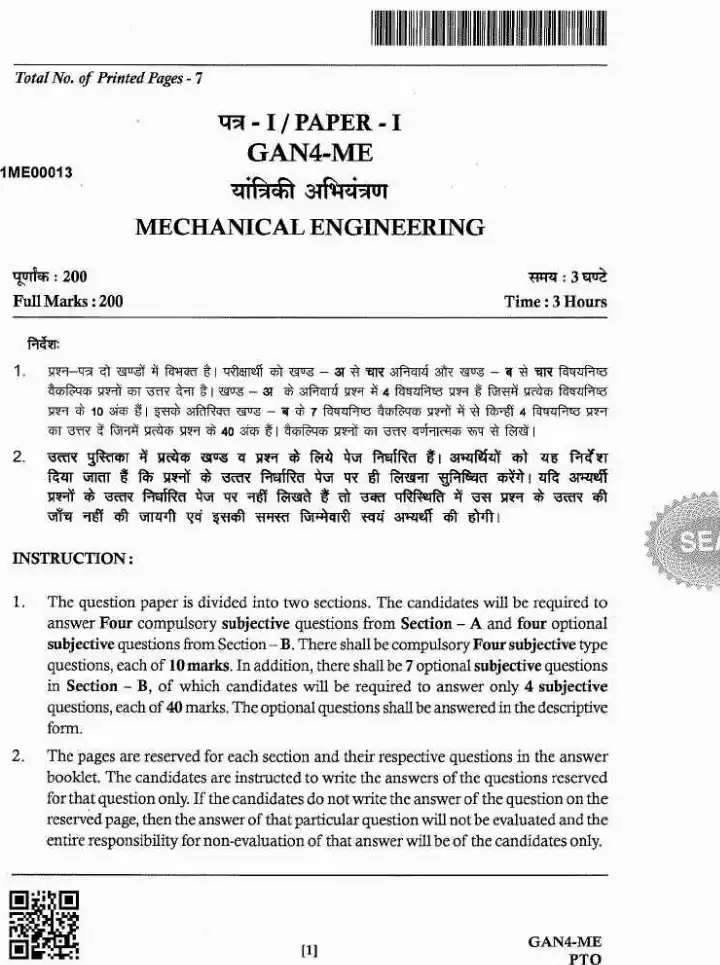
This document is the Mechanical Engineering question paper for the JPSC Assistant Conservator of Forest Main Examination. The paper is designed for 200 maximum marks and has a time allowance of 3 hours. It features descriptive-type questions, presented in both Hindi and English, covering core Mechanical Engineering concepts. Candidates are required to answer four compulsory questions from Section A and four optional questions from Section B, out of seven provided. This previous year ASSISTANT CONSERVATOR OF FOREST,MAIN EXAM. ,Advt.No.-03/2024 question paper is useful for Administrative / Civil Services aspirants preparing for Jharkhand government recruitment. The paper was conducted by JPSC and reflects the official exam pattern, marking scheme and difficulty level seen in recent cycles. Use it for timed practice, topic-wise revision and understanding how questions are framed in the real examination. Download the free PDF on QuizCurrent to read instructions, attempt MCQs and compare your answers with the study notes provided on this page. Key syllabus areas include Mechanical Engineering, Theory of Machines, Kinematic Pair, Constrained Motion, Strength of Materials, Beam Analysis, Shear Force, Bending Moment. Useful for ASSISTANT CONSERVATOR OF FOREST,MAIN EXA preparation. Helps understand the latest exam pattern. Useful for practice and self-assessment.
Major Topics Covered
- Mechanical Engineering
- Theory of Machines
- Kinematic Pair
- Constrained Motion
- Strength of Materials
- Beam Analysis
- Shear Force
- Bending Moment
- Material Science
- Surface Energy
- Crystallographic Orientation
- Manufacturing Processes
- EDM Process
- Metal Removal
Why This Paper is Important
- Useful for ASSISTANT CONSERVATOR OF FOREST,MAIN EXA preparation
- Helps understand the latest exam pattern
- Useful for practice and self-assessment
- Covers frequently asked General Studies topics
- Helpful for analysing question trends
Related Resources
- JPSC ACF General Studies Paper
- JPSC ACF Optional Subject Papers
- Previous Year Mechanical Engineering Papers
- JPSC ACF Mechanical Engineering Answer Key
- JPSC ACF Mechanical Engineering Syllabus
- JPSC Assistant Conservator of Forest Syllabus
- JPSC ACF Exam Pattern
- JPSC Main Exam Pattern
Instructions
- खण्ड – अबके अनिवार्य प्रश्न में 4 विषयनिष्ठ प्रश्न हैं जिसमें प्रत्येक विषयनिष्ठ प्रश्न के 10 अंक हैं।
- इसके अतिरिक्त खण्ड – ब के 7 विषयनिष्ठ वैकल्पिक प्रश्नों में से किन्हीं 4 विषयनिष्ठ प्रश्न का उत्तर दें जिनमें प्रत्येक प्रश्न के 40 अंक हैं।
- वैकल्पिक प्रश्नों का उत्तर वर्णनात्मक रूप से लिखें।
- उत्तर पुस्तिका में प्रत्येक खण्ड व प्रश्न के लिये पेज निर्धारित हैं।
- दिया जाता हैं कि प्रश्नों के उत्तर निर्धारित पेज पर ही लिखना सुनिष्चित करेंगे।
- यदि अभ्यर्थी प्रश्नों के उत्तर निर्धारित पेज पर नहीं लिखते हैं तो उक्त परिस्थिति में उस प्रश्न के उत्तर की जाँच नहीं की जायगी एवं इसकी समस्त जिम्मेवारी स्वयं अभ्यर्थी की होगी। INSTRUCTION: The question paper is divided into two sections. The candidates will be required to
Questions (page 2)
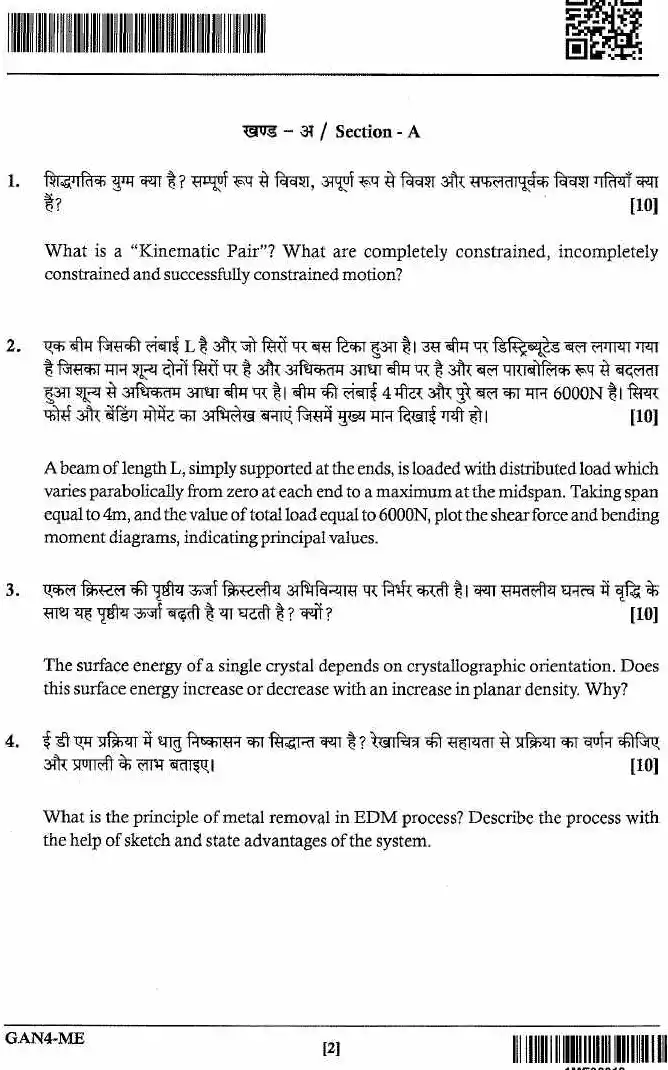
Q2. है जिसका मान शून्य दोनों सिरों पर है और अधिकतम आधा बीम पर है और बल पाराबोलिक रूप से बदलता हुआ शून्य से अधिकतम आधा बीम पर है। बीम की लंबाई 4 मीटर और पुरे बल का मान 6000N है। सियर फोर्स और बेंडिंग मोमेंट का अभिलेख बनाएं जिसमें मुख्य मान दिखाई गयी हो। A beam of length L, simply supported at the ends, is loaded with distributed load which varies parabolically from zero at each end to a maximum at the midspan.
Q3. साथ यह पृष्ठीय ऊर्जा बढ़ती है या घटती है?
Q4. और प्रणाली के लाभ बताइए। [10] What is the principle of metal removal in EDM process?
(1) the
(2) system.
(3) GAN4-ME
(4) [2]
Question paper preview
Scanned pages 1–2 for reference. Download the official PDF for the full paper.
Free question paper download
Download question paper PDF
Your download starts in 10s
Preparing your question paper file…
Frequently asked questions
Who is the conducting body for this exam?
The exam is conducted by the Jharkhand Public Service Commission (JPSC).
What is the subject of this question paper?
The subject of this question paper is Mechanical Engineering.
What is the maximum marks for the Mechanical Engineering paper?
The Mechanical Engineering paper carries a maximum of 200 marks.
What is the time allowed to complete this paper?
Candidates are allowed 3 hours to complete the Mechanical Engineering paper.
What type of questions are included in this paper?
This paper consists of descriptive (subjective) type questions.
How many questions are presented in total in this paper?
The paper presents a total of 11 questions (4 compulsory from Section A and 7 optional from Section B).
← Back to Administrative / Civil Services papers · Jharkhand Government Jobs