
Post Graduate Teachers (PGTs) - 2023 - Subject Knowledge Test
- Year 2023
- Conducted By HPSC
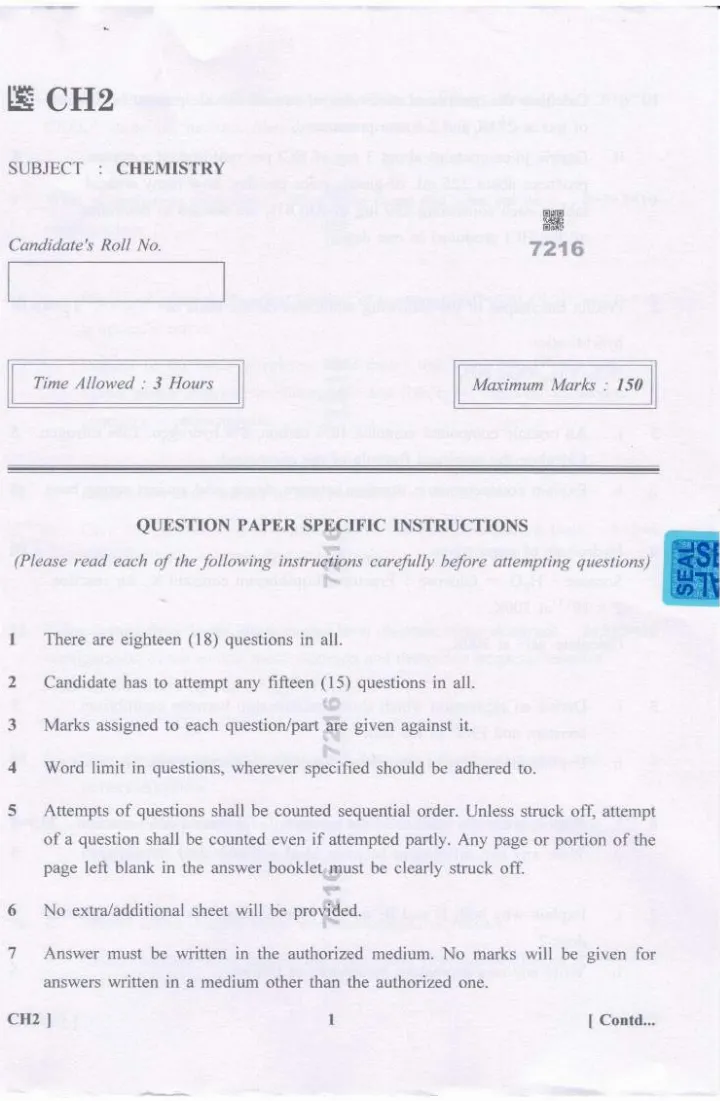
- Questions 18
- Maximum Marks 150
- Duration 3 Hours
- Languages Hindi & English
Exam Details
| Detail | Information |
|---|---|
| Examination | Chemistry |
| Year | 2023 |
| Conducting Body | HPSC |
| Paper | Post Graduate Teachers (PGTs) - 2023 - Subject Knowledge Test |
| Subject | Chemistry |
| Duration | 3 Hours |
| Maximum Marks | 150 |
| Number of Questions | 18 |
This page compiles the Chemistry PGT 2023 Subject Knowledge Test for Haryana Government Jobs, detailing the exam's structure: 18 questions on page 2 with objective style, 15 to be attempted, 3 hours, 150 marks. Page 1 contains overall instructions; page 2 provides several chemistry-focused MCQs and descriptive prompts (empirical formula, thermodynamics, kinetics, and general inorganic/organic topics). SEO data includes titles, descriptions, keywords, and image metadata to optimize discovery of the post. This previous year Post Graduate Teachers (PGTs) - 2023 - Subject Knowledge Test question paper (2023) is useful for Other Jobs aspirants preparing for Haryana government recruitment. The paper was conducted by HPSC and reflects the official exam pattern, marking scheme and difficulty level seen in recent cycles. Use it for timed practice, topic-wise revision and understanding how questions are framed in the real examination. Download the free PDF on QuizCurrent to read instructions, attempt MCQs and compare your answers with the study notes provided on this page. Key syllabus areas include Chemistry, Physical Chemistry, Inorganic Chemistry, Organic Chemistry, Thermodynamics, Chemical Equilibrium, Electrochemistry, Solutions. Useful for Chemistry preparation. Helps understand the latest exam pattern. Useful for practice and self-assessment.
Major Topics Covered
- Chemistry
- Physical Chemistry
- Inorganic Chemistry
- Organic Chemistry
- Thermodynamics
- Chemical Equilibrium
- Electrochemistry
- Solutions
- Empirical Formula
- Titration
- Gases
- Gas Laws
- Molecule Shapes
- Hybridisation
- Molecular Geometry
- Kinetics
- Hydrolysis
- Sugar Chemistry
- Carbohydrates
- Stereochemistry
Why This Paper is Important
- Useful for Chemistry preparation
- Helps understand the latest exam pattern
- Useful for practice and self-assessment
- Covers frequently asked General Studies topics
- Helpful for analysing question trends
Related Resources
Instructions
- Unless struck off, attempt of a question shall be counted even if attempted partly.
- Any page or portion of the page left blank in the answer booklet must be clearly struck off.
- No extra/additional sheet will be provided. 6 fled vdar nisional Answer must be written in the authorized medium.
- No marks will be given for 7 answers written in a medium other than the authorized one.
Questions (page 2)
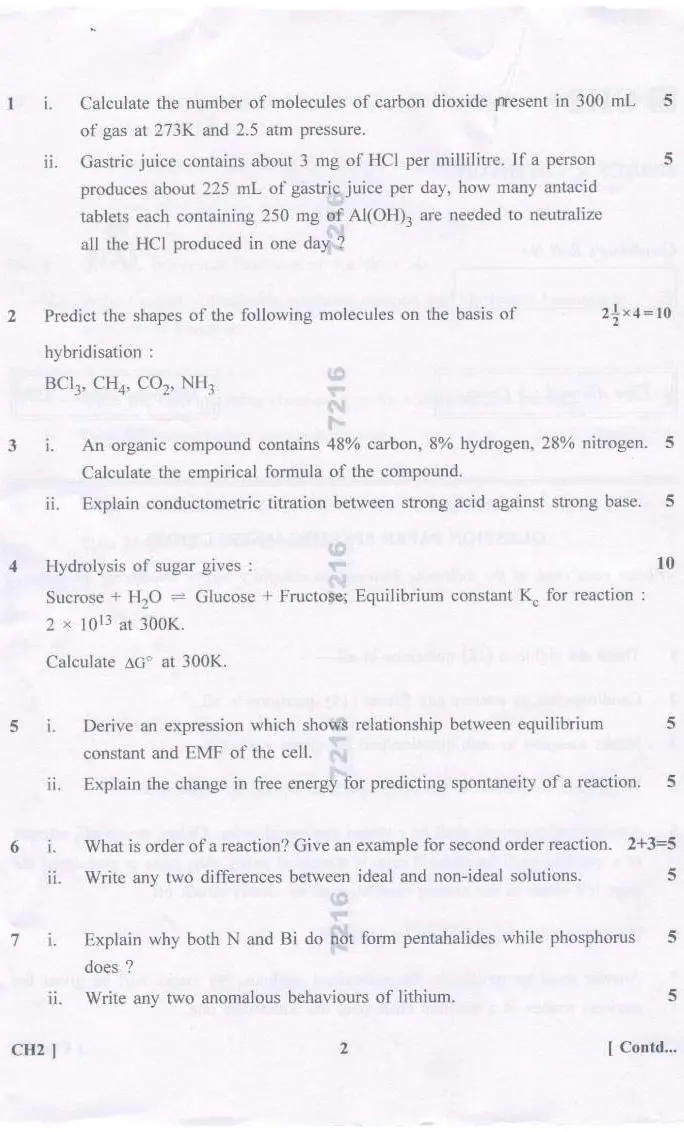
Q1. Calculate the number of molecules of carbon dioxide present in 300 mL 5 1 - i. of gas at 273K and
Q2. 5 atm pressure. Gastric juice contains about 3 mg of HCl per millilitre. If a person 5 ii. produces about 225 mL of gastric juice per day, how many antacid tablets each containing 250 mg of Al(OH)3 are needed to neutralize all the HCl produced in one day ? 21/2 × 4 = 10 Predict the shapes of the following molecules on the basis of \overline2 hybridisation : BCI3, CH4, CO2, NH3 \tildeN An organic compound contains 48% carbon, 8% hydrogen, 28% nitrogen. 3 \overline{\phantom0} i. Calculate the empirical formula of the compound. Explain conductometric titration between strong acid against strong base. 5 ii. 10 Hydrolysis of sugar gives : 4 Sucrose + H 2 O = Glucose + Fructose; Equilibrium constant K c for reaction : 2 × 10¹³ at 300K. A FOOT OF A THOMAS IN THE TELL Calculate \Delta G\circ at 300K. 5 Derive an expression which shows relationship between equilibrium 5 i. constant and EMF of the cell. 5 Explain the change in free energy for predicting spontaneity of a reaction. ii. What is order of a reaction? Give an example for second order reaction. 2 + 3 = 5 6 Write any two differences between ideal and non-ideal solutions. 5 Explain why both N and Bi do not form pentahalides while phosphorus \overline7 i. does ? 5 Write any two anomalous behaviours of lithium. ii. [Contd... \mathbf 2 CH2]
Q2. 5 atm pressure. Gastric juice contains about 3 mg of HCl per millilitre. If a person 5 ii. produces about 225 mL of gastric juice per day, how many antacid tablets each containing 250 mg of Al(OH)3 are needed to neutralize all the HCl produced in one day ? 21/2 × 4 = 10 Predict the shapes of the following molecules on the basis of \overline2 hybridisation : BCI3, CH4, CO2, NH3 \tildeN An organic compound contains 48% carbon, 8% hydrogen, 28% nitrogen. 3 \overline{\phantom0} i. Calculate the empirical formula of the compound. Explain conductometric titration between strong acid against strong base. 5 ii. 10 Hydrolysis of sugar gives : 4 Sucrose + H 2 O = Glucose + Fructose; Equilibrium constant K c for reaction : 2 × 10¹³ at 300K. A FOOT OF A THOMAS IN THE TELL Calculate \Delta G\circ at 300K. 5 Derive an expression which shows relationship between equilibrium 5 i. constant and EMF of the cell. 5 Explain the change in free energy for predicting spontaneity of a reaction. ii. What is order of a reaction? Give an example for second order reaction. 2 + 3 = 5 6 Write any two differences between ideal and non-ideal solutions. 5 Explain why both N and Bi do not form pentahalides while phosphorus \overline7 i. does ? 5 Write any two anomalous behaviours of lithium. ii. [Contd... \mathbf 2 CH2]
Q3. Predict the shapes of the following molecules on the basis of sp2/sp3 hybridisation : BCl3, CH4, CO2, NH3
Q4. An organic compound contains 48% carbon, 8% hydrogen, 28% nitrogen.
i. Calculate the empirical formula of the compound.
ii. Explain conductometric titration between strong acid against strong base.
Q5. Hydrolysis of sugar gives : 4 Sucrose + H2O = Glucose + Fructose; Equilibrium constant Kc for reaction : 2 × 10^{13} at 300 K. Calculate ΔG° at 300 K.
Q6. Derive an expression which shows relationship between equilibrium constant and EMF of the cell.
Q7. Explain the change in free energy for predicting spontaneity of a reaction.
i. What is order of a reaction? Give an example for second order reaction.
Q8. Write any two differences between ideal and non-ideal solutions.
Q9. Explain why both N and Bi do not form pentahalides while phosphorus does.
Q10. Write any two anomalous behaviours of lithium.
Question paper preview
Scanned pages 1–2 for reference. Download the official PDF for the full paper.
Free question paper download
Download question paper PDF
Your download starts in 10s
Preparing your question paper file…
Frequently asked questions
Where can I download the Chemistry question paper PDF?
Use the Download PDF button on this page to save the official Chemistry (2023) Post Graduate Teachers (PGTs) - 2023 - Subject Knowledge Test paper hosted on QuizCurrent.
Who conducts the Chemistry?
The Chemistry is conducted by HPSC. This portal reproduces the scanned question paper for practice and revision.
Does this page include exam instructions and questions?
Yes. Page 1 instructions and page 2 questions are extracted from the official PDF OCR so you can read them without downloading.
How many questions are on this paper?
The paper lists 18 questions as per the official booklet.
Which exam is this question paper for?
This is a previous year question paper for Post Graduate Teachers (PGTs) - 2023 - Subject Knowledge Test (2023).