
SSO Explosives Paper 2024 Haryana | 150 Marks, 3 Hours
- Year 2024
- Conducted By Government of Haryana (FSL Karnal)
- Questions 15
- Maximum Marks 150
- Duration 3 Hours
- Languages Hindi & English
Exam Details
| Detail | Information |
|---|---|
| Examination | Senior Scientific Officer (Explosive) |
| Year | 2024 |
| Conducting Body | Government of Haryana (FSL Karnal) |
| Paper | Question Paper: Senior Scientific Officer (Explosive) in FSL Madhuban, Karnal, Haryana |
| Subject | Explosive Chemistry and Instrumentation |
| Duration | 3 Hours |
| Maximum Marks | 150 |
| Number of Questions | 15 |
| Question Type | Mixed (mcq + descriptive) |
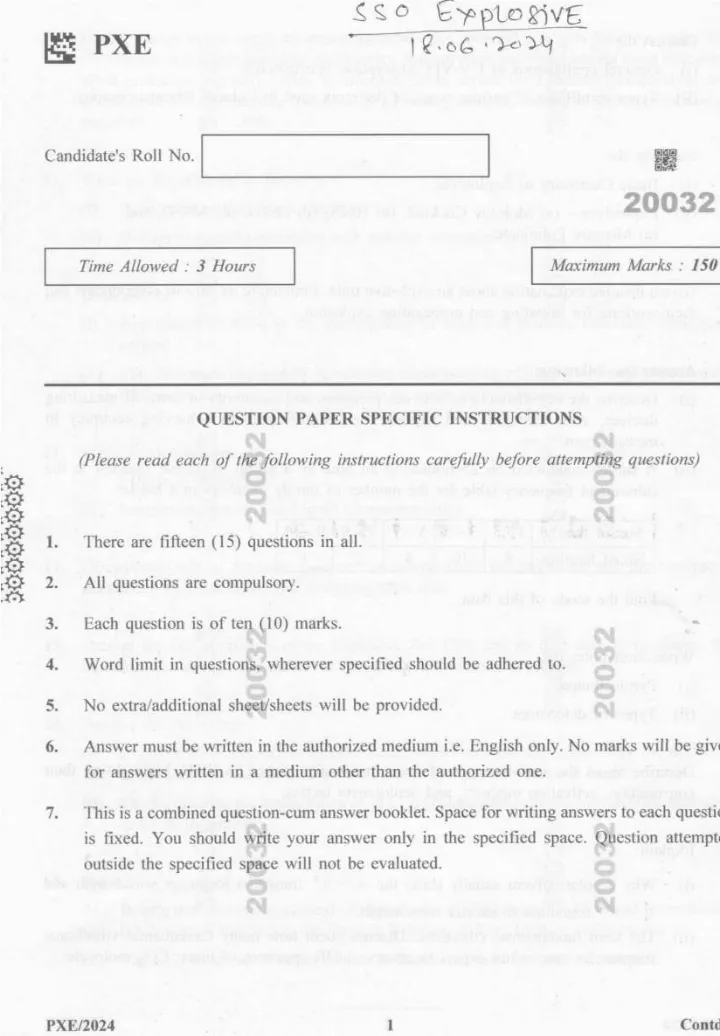
This file contains the Haryana SSO (Explosive) exam details and the two-page question set from the 2024 session held at FSL Madhuban, Karnal. Page 1 lists the exam metadata: 150 marks, 3 hours, bilingual (Hindi/English), and a note that there are 15 questions. Page 2 presents descriptive prompts and topical questions, including UV-VIS spectroscopy applications, explosive chemistry (Molotov Cocktail, HMX, PETN, ANFO, mercury fulminate), explosive trains, measurement concepts (precision vs. accuracy, data interpretation), detonators and firing mechanisms in IEDs, and spectroscopy concepts such as pi-pi* and n-pi* transitions in polar solvents and IR fundamentals for CO2. The content integrates both theory and applied analysis across analytical chemistry and explosive studies, suitable for exam preparation and SEO optimization. This previous year Senior Scientific Officer (Explosive) in FSL Madhuban, Karnal, Haryana question paper (2024) is useful for Other Jobs aspirants preparing for Haryana government recruitment. The paper was conducted by HPSC and reflects the official exam pattern, marking scheme and difficulty level seen in recent cycles. Use it for timed practice, topic-wise revision and understanding how questions are framed in the real examination. Download the free PDF on QuizCurrent to read instructions, attempt MCQs and compare your answers with the study notes provided on this page. Key syllabus areas include UV-VIS Spectroscopy, Detectors in Column Chromatography, General Applications of UV-VIS, Explosive Chemistry, Molotov Cocktail, HMX, PETN, ANFO. Useful for Senior Scientific Officer (Explosive) preparation. Helps understand the latest exam pattern. Useful for practice and self-assessment.
Major Topics Covered
- UV-VIS Spectroscopy
- Detectors in Column Chromatography
- General Applications of UV-VIS
- Explosive Chemistry
- Molotov Cocktail
- HMX
- PETN
- ANFO
- Mercury Fulminate
- Explosive Train
- Detonators
- Firing Mechanisms in IEDs
- Construction and Activation Methods of Detonators
- Deployment Tactics of IEDs
- Polar Solvents
- π-π* Transitions
- n-π* Transitions
- IR Spectroscopy
- Fundamental Vibrations
- CO2 IR Spectrum
Why This Paper is Important
- Useful for Senior Scientific Officer (Explosive) preparation
- Helps understand the latest exam pattern
- Useful for practice and self-assessment
- Covers frequently asked General Studies topics
- Helpful for analysing question trends
Related Resources
Instructions
- 00000000 compare virunti to roderum ada not alder vanament in managering I DY I Mind No.
- There are fifteen (15) questions in all.
- - and max1, loc.01 All questions are compulsory.
- List the mode of this data. Each question is of ten (10) marks.
- Word limit in questions, wherever specified should be adhered to.
- No extra/additional sheet/sheets will be provided.
- Stockhold Celebrate -419 Answer must be written in the authorized medium i.e. English only. No marks will be given
- for answers written in a medium other than the authorized one.
- This is a combined question-cum answer booklet.
- Space for writing answers to each question
- You should write your answer only in the specified space.
- Question attempted outside the specified space will not be evaluated.
Questions (page 2)
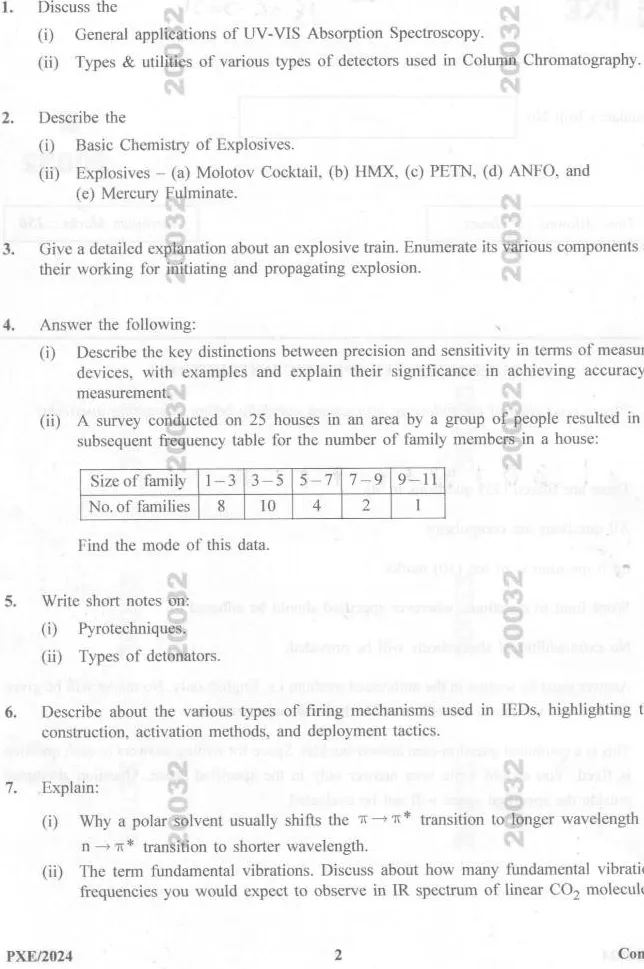
Q1. BViloJama 022 Discuss the
Q1. BViloJama 022 Discuss the
1. ΠGeneral applications of UV-VIS Absorption Spectroscopy. M
(i) Types & utilities of various types of detectors used in Column Chromatography.
(ii) Describe the Candidate's Rell No.
Q2.
(a) Basic Chemistry of Explosives.
(i) Explosives - Molotov Cocktail,
(b) HMX,
(c) PETN,
(d) ANFO, and
(i)
Q2. (a) Basic Chemistry of Explosives.
(i) Explosives - Molotov Cocktail,
(a) Basic Chemistry of Explosives.
(i) Explosives - Molotov Cocktail,
(b) HMX,
(c) PETN,
(d) ANFO, and
(i)
Q3. Give a detailed explanation about an explosive train. Enumerate its various components and their working for initiating and propagating explosion.
Q4. Describe the key distinctions between precision and sensitivity in terms of measuring devices, with examples and explain their significance in achieving accuracy in measurement.
A survey conducted on 25 houses in an area by a group of people resulted in the following frequency table for the number of family members in a house:
Size of family 9 - 11 7 - 9 5 - 7 1 - 3 3 - 5
No. of families 8 4 2 10 1
Find the mode of this data.
Q5. Bond limit in explosives wherever specified should be adhered. Pyrotechnics.
(i) Types of detonators.
(ii) Describe the various types of firing mechanisms used in IEDs, highlighting their construction, activation methods, and deployment tactics.
Q6. Explain why a polar solvent usually shifts the π → π* transition to longer wavelength and
(i) n → π* transition to shorter wavelength.
The term fundamental vibrations. Discuss how many fundamental vibrational frequencies you would observe in the IR spectrum of linear CO2 molecule.
Q7. Contd... PXE/2024
Question paper preview
Scanned pages 1–2 for reference. Download the official PDF for the full paper.
Free question paper download
Download question paper PDF
Your download starts in 10s
Preparing your question paper file…
Frequently asked questions
What is the name of the exam?
Senior Scientific Officer (Explosive) exam held in Haryana (FSL Karnal).
When was the exam conducted?
18 June 2024.
What is the maximum marks for the paper?
150 marks.
What is the duration of the exam?
3 hours.
In which languages can the answers be written?
Hindi and English.
How many questions are there?
Fifteen questions in total.