
Haryana 2024 District Ayurvedic Officer Exam Paper (Code 14) – Page 1-2
- Year 2024
- Conducted By Haryana Government
- Questions 15
- Maximum Marks 150
- Duration 3 Hours
- Languages English & Hindi
Exam Details
| Detail | Information |
|---|---|
| Examination | District Ayurvedic Officer in Ayush Deptt. |
| Year | 2024 |
| Conducting Body | Haryana Government |
| Paper | District Ayurvedic Officer in Ayush Deptt. |
| Subject | Ayurveda |
| Duration | 3 Hours |
| Maximum Marks | 150 |
| Number of Questions | 15 |
| Question Type | Descriptive/mixed |
This JSON combines PAGE 1 and PAGE 2 OCR content for the Haryana Government recruitment exam: District Ayurvedic Officer in Ayush Deptt. The pages present a mix of theoretical questions on classical Ayurveda (Siddhanta, Sankhya/Vaisheshik influence), practical distinctions (observational vs interventional studies; parametric vs non-parametric tests), disease concepts (tumors, Nidana/Samprapti/Chikitsa in Harak Samhita), and clinical topics (Manas Prakriti, Prana Vayu, Kamla/Jaundice, Pakshaghat/Hemiplegia, Kandara/Kurcha/Rajya structures, Veerya). The corrected questions (Q1–Q10) span descriptive essays and sub-parts, with a few sub-questions split to reflect two-column OCR layout. Page 1 provides header and instruction cues; Page 2 expands with advanced topics and multi-part questions, ready for SEO-oriented metadata, FAQs, topics, and image SEO fields. The dataset supports multilingual presentation (Hindi descriptions with English context) and is prepared for rich schema markup (WebPage, FAQPage, LearningResource, etc.). This previous year District Ayurvedic Officer in Ayush Deptt. question paper (2024) is useful for Medical aspirants preparing for Haryana government recruitment. The paper was conducted by HPSC and reflects the official exam pattern, marking scheme and difficulty level seen in recent cycles. Use it for timed practice, topic-wise revision and understanding how questions are framed in the real examination. Download the free PDF on QuizCurrent to read instructions, attempt MCQs and compare your answers with the study notes provided on this page. Key syllabus areas include Ayurveda, Siddhanta, Charaka Samhita, Sushruta Samhita, Darshan, Sankhya, Vaisheshik, Tridosha. Useful for District Ayurvedic Officer in Ayush Dept preparation. Helps understand the latest exam pattern. Useful for practice and self-assessment.
Major Topics Covered
- Ayurveda
- Siddhanta
- Charaka Samhita
- Sushruta Samhita
- Darshan
- Sankhya
- Vaisheshik
- Tridosha
- Nidana
- Samprapti
- Chikitsa Sutra
- Panchakarma
- Kamla
- Pakshaghat
- Jaundice
- Veerya
- Prabhav
- Manas Prakriti
- Prana Vayu
- Anatomy terms Kandara/Kurcha
Why This Paper is Important
- Useful for District Ayurvedic Officer in Ayush Dept preparation
- Helps understand the latest exam pattern
- Useful for practice and self-assessment
- Covers frequently asked General Studies topics
- Helpful for analysing question trends
Related Resources
Instructions
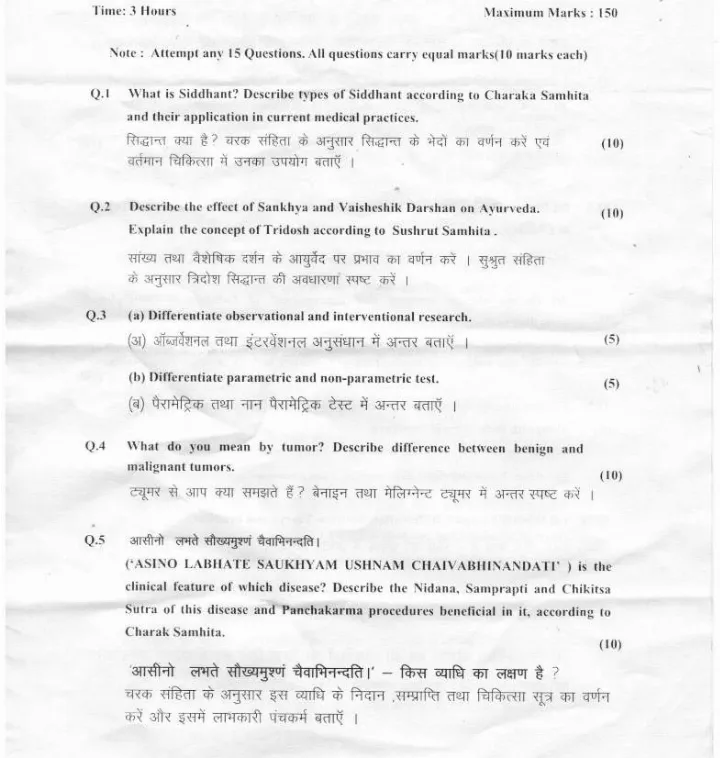
- 2024 Code 14 Time: 3 Hours Maximum Marks: 150 Note: Attempt any 15 Questions. All questions carry equal marks(10 marks each) What is Siddhant? Describe types of Siddhant according to Charaka Samhita Q.1 and their application in current medical practices. सिद्धान्त क्या है? चरक संहिता के अनुसार सिद्धान्त के भेदों का वर्णन करें एवं (10) वर्तमान चिकित्सा में उनका उपयोग बताएँ । Q.2 Describe the effect of Sankhya and Vaisheshik Darshan on Ayurveda. (10) Explain the concept of Tridosh according to Sushrut Samhita. सांख्य तथा वैशेषिक दर्शन के आयुर्वेद पर प्रभाव का वर्णन करें ।
- सुश्रुत संहिता के अनुसार त्रिदोश सिद्धान्त की अवधारणा स्पष्ट करें ।
Questions (page 2)
Q1. Q.1 Siddhant kya hai? Charaka Samhita ke anusar siddhant ke bhedon ka varnan karein evam vartaman chikitsa mein unka upyog batayein.
Q2. Q.2 Sankhya and Vaisheshik Darshan ka Ayurveda par prabhav varnan karein.
(10)
Q3. Q.3
(अ) Q.3 ऑब्जर्वेशनल तथा इंटरवेंशनल अनुसंधान में अन्तर बताएं
(5)
(ब) पैरामेट्रिक तथा नान पैरामेट्रिक टेस्ट में अन्तर बताएँ
(5)
Q4. Q.4 ट्यूमर से आप क्या समझते हैं? बेनाइन तथा मेलिग्नेन्ट ट्यूमर में अन्तर स्पष्ट करें
Q5. Q.5 ('ASINO LABHATE SAUKHYAM USHNAM CHAIVABHINANDATI') is the clinical feature of which disease? Describe the Nidana, Samprapti and Chikitsa Sutra of this disease and Panchakarma procedures beneficial in it, according to harak Samhita.
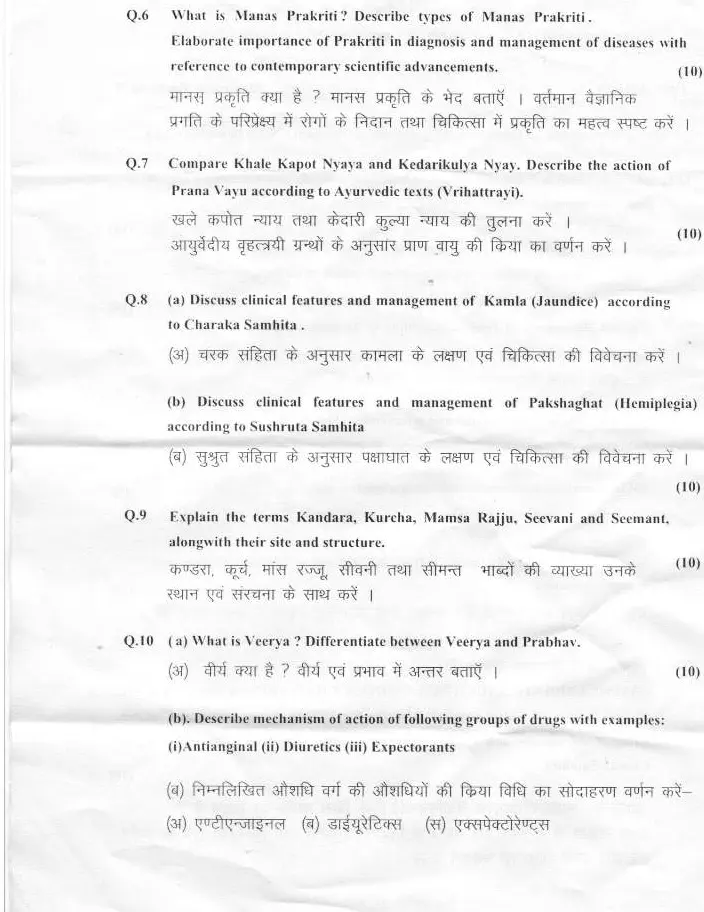
Q6. Q.6 What is Manas Prakriti? Describe types of Manas Prakriti. Elaborate importance of Prakriti in diagnosis and management of diseases with reference to contemporary scientific advancements.
Q7. Q.7 Prana Vayu according to Ayurvedic texts (Vrihattrayi). khale kapot nyaya तथा केदारी कुल्या nyay (Comparison).
Q8.
(अ) Q.8 Discuss clinical features and management of Kamla (Jaundice) according to Charaka Samhita. Charaka Samhita के अनुसार Kamla के लक्षण एवं चिकित्सा की विवेचना करें। (b) Discuss clinical features and management of Pakshaghat (Hemiplegia) according to Sushruta Samhita
(ब) सुश्रुत संहिता के अनुसार पक्षाघात के लक्षण एवं चिकित्सा की विवेचना करें ।
Q9. Q.9 Explain the terms Kandara, Kurcha, Mamsa Rajju, Seevani and Seemant, alongwith their site and structure.
Q10. (a) Q.10 What is Veerya? Differentiate between Veerya and Prabhav. (अ) वीर्य क्या है ? वीर्य एवं प्रभाव में अन्तर बताएँ
(10)
(a) Q.10 What is Veerya? Differentiate between Veerya and Prabhav. (अ) वीर्य क्या है ? वीर्य एवं प्रभाव में अन्तर बताएँ
(10)
(b) . Describe mechanism of action of following groups of drugs with examples:
(i) Antianginal
(ii) Diuretics
(iii) Expectorants
Question paper preview
Scanned pages 1–2 for reference. Download the official PDF for the full paper.
Free question paper download
Download question paper PDF
Your download starts in 10s
Preparing your question paper file…
Frequently asked questions
What is Siddhanta?
Siddhanta is a foundational concept discussed in Charaka Samhita describing fundamental principles of Ayurveda; its types and applications in medicine are described in classical texts.
How do Sankhya and Vaisheshik Darshan influence Ayurveda?
Sankhya and Vaisheshik philosophies provide theoretical underpinnings for Ayurveda by shaping concepts of matter, consciousness, and etiopathogenesis, influencing diagnostic and interpretive approaches.
What is the difference between observational and interventional research in Ayurveda contexts?
Observational research records existing conditions without intervention, while interventional research involves active changes or treatments to study outcomes.
What is the difference between parametric and non-parametric tests?
Parametric tests assume underlying statistical distributions (e.g., normal), while non-parametric tests do not require such assumptions and are used for ordinal data or non-normal distributions.
Define tumor and differentiate benign vs malignant tumors.
A tumor is an abnormal growth of tissue; benign tumors are non-cancerous and localized, while malignant tumors are cancerous and can invade surrounding tissues and metastasize.
Which disease is associated with the line 'ASINO LABHATE SAUKHYAM USHNAM CHAIVABHINANDATI'?
The OCR indicates this line as a disease feature and asks for Nidana, Samprapti and Chikitsa Sutra; the exact disease name is not specified in the OCR provided here.