
Mining Officer & Assistant Mining Engineer Exam 2023 – Question Paper
- Year 2023
- Conducted By Haryana Government
- Questions 18
- Maximum Marks 150
- Duration 3 Hours
- Languages English & Hindi
Exam Details
| Detail | Information |
|---|---|
| Examination | Mining Officer & Assistant Mining Engineer |
| Year | 2023 |
| Conducting Body | Haryana Government |
| Subject | Mining |
| Duration | 3 Hours |
| Maximum Marks | 150 |
| Number of Questions | 18 |
| Question Type | Descriptive (with sub-parts) |
The document is the Haryana region Mining Officer & Assistant Mining Engineer exam paper for 2023. It comprises page 1 with general instructions and page 2 containing the Subject Knowledge Test questions. Page 2 includes six primary questions with sub-parts focused on ventilation in underground mines, spontaneous heating of coal, life estimation of a mine using Taylor's Rule, ore processing and economic calculations for copper ore, coal mining method selection, longwall mining and mechanised longwall faces, and structural geology folding (Ramsay's classification). Marks allocated per sub-part range from 4 to 10, with a total maximum of 150 marks. Candidates are required to answer 15 of the 18 questions within 3 hours, in English or Hindi as per the exam instructions. This previous year Mining Officer & Assistant Mining Engineer question paper (2023) is useful for Engineer aspirants preparing for Haryana government recruitment. The paper was conducted by HPSC and reflects the official exam pattern, marking scheme and difficulty level seen in recent cycles. Use it for timed practice, topic-wise revision and understanding how questions are framed in the real examination. Download the free PDF on QuizCurrent to read instructions, attempt MCQs and compare your answers with the study notes provided on this page. Key syllabus areas include Underground mine ventilation, Ventilation systems (Ascensional/Descensional), Air leakage in mine ventilation, Spontaneous heating of coal, Crossing point temperature, Taylor's Rule, Mine life estimation, Long's revised empirical equation. Useful for Mining Officer & Assistant Mining Engine preparation. Helps understand the latest exam pattern. Useful for practice and self-assessment.
Major Topics Covered
- Underground mine ventilation
- Ventilation systems (Ascensional/Descensional)
- Air leakage in mine ventilation
- Spontaneous heating of coal
- Crossing point temperature
- Taylor's Rule
- Mine life estimation
- Long's revised empirical equation
- Room and Pillar mining
- Longwall mining
- Mechanised Longwall face
- Advancing vs retreating longwall
- Froth flotation
- Metal recovery
- Concentrate grade
- Tailings
- Structural geology
- Folding
- Ramsay's classification
- Parallel folds
Why This Paper is Important
- Useful for Mining Officer & Assistant Mining Engine preparation
- Helps understand the latest exam pattern
- Useful for practice and self-assessment
- Covers frequently asked General Studies topics
- Helpful for analysing question trends
Related Resources
- HSPCB AEE Group-B SKT 2026 – Roll No Wise Marks
- Mechanical Engineering 2017 Haryana Mains Paper (Code 1151) – Q2-3
- Mechanical Engineering HCS Mains 2021 Question Paper (5406) - Haryana
- HCS Electrical Eng Mains 2021 Paper (33A) – Section A & B
- Civil Engineering HCS Mains 2021 Question Paper (Page 1-2)
Instructions
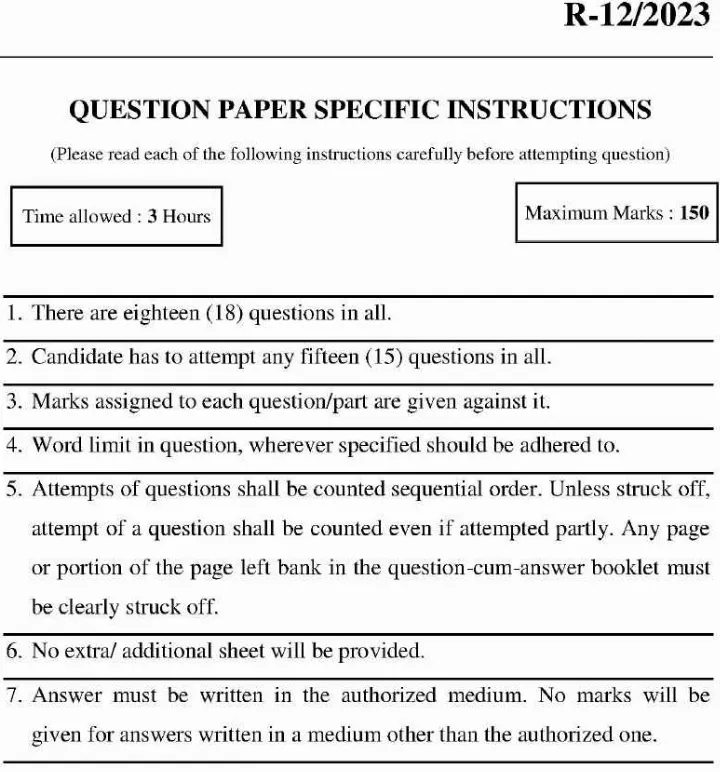
- There are eighteen (18) questions in all.
- Candidate has to attempt any fifteen (15) questions in all.
- Marks assigned to each question/part are given against it.
- Word limit in question, wherever specified should be adhered to.
- Attempts of questions shall be counted sequential order.
- Unless struck off, attempt of a question shall be counted even if attempted partly.
- Any page or portion of the page left bank in the question-cum-answer booklet must be clearly struck off.
- No extra/ additional sheet will be provided.
- Answer must be written in the authorized medium.
- No marks will be given for answers written in a medium other than the authorized one.
Questions (page 2)
Q1. Subject Knowledge Test Question Paper
Q1. Subject Knowledge Test Question Paper
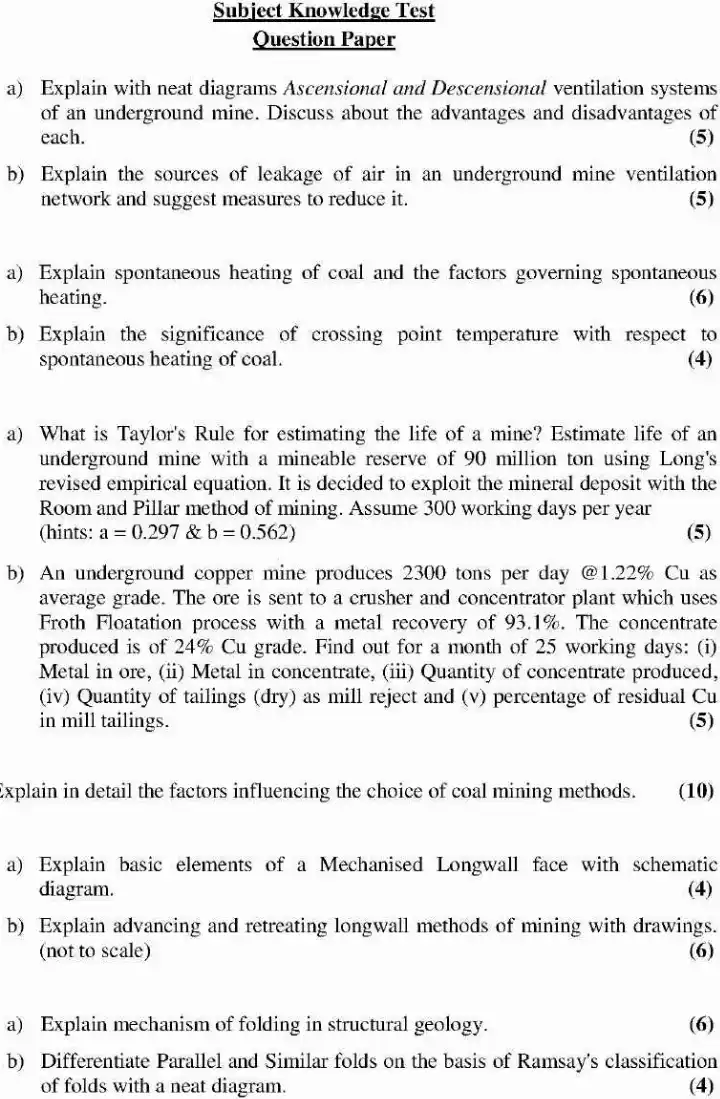
1. a) Explain with neat diagrams Ascensional and Descensional ventilation systems of an underground mine. Discuss about the advantages and disadvantages of each.
(5) Explain the sources of leakage of air in an underground mine ventilation b) network and suggest measures to reduce it.
(5)
Q2. a) Explain spontaneous heating of coal and the factors governing spontaneous heating.
(6) b) Explain the significance of crossing point temperature with respect to spontaneous heating of coal.
(4)
3. a) What is Taylor's Rule for estimating the life of a mine? Estimate life of an underground mine with a mineable reserve of 90 million ton using Long's revised empirical equation. It is decided to exploit the mineral deposit with the Room and Pillar method of mining. Assume 300 working days per year (hints: a = 0.297 \& b = 0.562)
(5) b) An underground copper mine produces 2300 tons per day @1.22\% Cu as average grade. The ore is sent to a crusher and concentrator plant which uses Froth Floatation process with a metal recovery of 93.1%. The concentrate produced is of 24% Cu grade. Find out for a month of 25 working days:
(i) Metal in ore,
(ii) Metal in concentrate,
(iii) Quantity of concentrate produced,
(iv) Quantity of tailings (dry) as mill reject and
(v) percentage of residual Cu in mill tailings.
(5)
4. Explain in detail the factors influencing the choice of coal mining methods.
(10)
5. a) Explain basic elements of a Mechanised Longwall face with schematic diagram.
(4) b) Explain advancing and retreating longwall methods of mining with drawings.
(6) (not to scale)
6. Explain mechanism of folding in structural geology.
(6) a) Differentiate Parallel and Similar folds on the basis of Ramsay's classification b) of folds with a neat diagram.
(4) \overline{\mathbfc}
Q2. a) Explain spontaneous heating of coal and the factors governing spontaneous heating.
(6) b) Explain the significance of crossing point temperature with respect to spontaneous heating of coal.
(4)
3. a) What is Taylor's Rule for estimating the life of a mine? Estimate life of an underground mine with a mineable reserve of 90 million ton using Long's revised empirical equation. It is decided to exploit the mineral deposit with the Room and Pillar method of mining. Assume 300 working days per year (hints: a = 0.297 \& b = 0.562)
(5) b) An underground copper mine produces 2300 tons per day @1.22\% Cu as average grade. The ore is sent to a crusher and concentrator plant which uses Froth Floatation process with a metal recovery of 93.1%. The concentrate produced is of 24% Cu grade. Find out for a month of 25 working days:
(i) Metal in ore,
(ii) Metal in concentrate,
(iii) Quantity of concentrate produced,
(iv) Quantity of tailings (dry) as mill reject and
(v) percentage of residual Cu in mill tailings.
(5)
4. Explain in detail the factors influencing the choice of coal mining methods.
(10)
5. a) Explain basic elements of a Mechanised Longwall face with schematic diagram.
(4) b) Explain advancing and retreating longwall methods of mining with drawings.
(6) (not to scale)
6. Explain mechanism of folding in structural geology.
(6) a) Differentiate Parallel and Similar folds on the basis of Ramsay's classification b) of folds with a neat diagram.
(4) \overline{\mathbfc}
Q3. 3. a) What is Taylor's Rule for estimating the life of a mine? Estimate life of an underground mine with a mineable reserve of 90 million ton using Long's revised empirical equation. It is decided to exploit the mineral deposit with the Room and Pillar method of mining. Assume 300 working days per year (hints: a = 0.297 \& b = 0.562)\n
(5) b) An underground copper mine produces 2300 tons per day @1.22\%Cu as average grade. The ore is sent to a crusher and concentrator plant which uses Froth Floatation process with a metal recovery of 93.1%. The concentrate produced is of 24% Cu grade. Find out for a month of 25 working days:
(i) Metal in ore,
(ii) Metal in concentrate,
(iii) Quantity of concentrate produced,
(iv) Quantity of tailings (dry) as mill reject and
(v) percentage of residual Cu in mill tailings.\n
(5)
() What is Taylor's Rule for estimating the life of a mine? Estimate life of an underground mine with a mineable reserve of 90 million ton using Long's revised empirical equation. It is decided to exploit the mineral deposit with the Room and Pillar method of mining. Assume 300 working days per year (hints: a = 0.297 & b = 0.562)
() An underground copper mine produces 2300 tons per day @1.22% Cu as average grade. The ore is sent to a crusher and concentrator plant which uses Froth Floatation process with a metal recovery of 93.1%. The concentrate produced is of 24% Cu grade. Find out for a month of 25 working days:
(i) Metal in ore,
(ii) Metal in concentrate,
(iii) Quantity of concentrate produced,
(iv) Quantity of tailings (dry) as mill reject and
(v) percentage of residual Cu in mill tailings.
Q4.
() Explain in detail the factors influencing the choice of coal mining methods.
Q5.
() 5. a) Explain basic elements of a Mechanised Longwall face with schematic diagram.\n
(4) b) Explain advancing and retreating longwall methods of mining with drawings.\n
(6)
() Explain advancing and retreating longwall methods of mining with drawings.
Q6. 6. Explain mechanism of folding in structural geology.\n
() a) Differentiate Parallel and Similar folds on the basis of Ramsay's classification with a neat diagram.
() b) of folds with a neat diagram.
Question paper preview
Scanned pages 1–2 for reference. Download the official PDF for the full paper.
Free question paper download
Download question paper PDF
Your download starts in 10s
Preparing your question paper file…
Frequently asked questions
What is the full name of the exam?
Mining Officer & Assistant Mining Engineer (Advt. No. 09/2023).
When was the exam held?
The exam/year is 2023; the paper title references 22.10.2023 as the examination date.
How many questions are in the paper?
There are 18 questions in total.
How many questions must a candidate attempt?
Candidates must attempt 15 questions.
What is the maximum marks?
Maximum marks are 150.
What are the allowed languages?
The exam is offered in English and Hindi.