Section A
Q1.
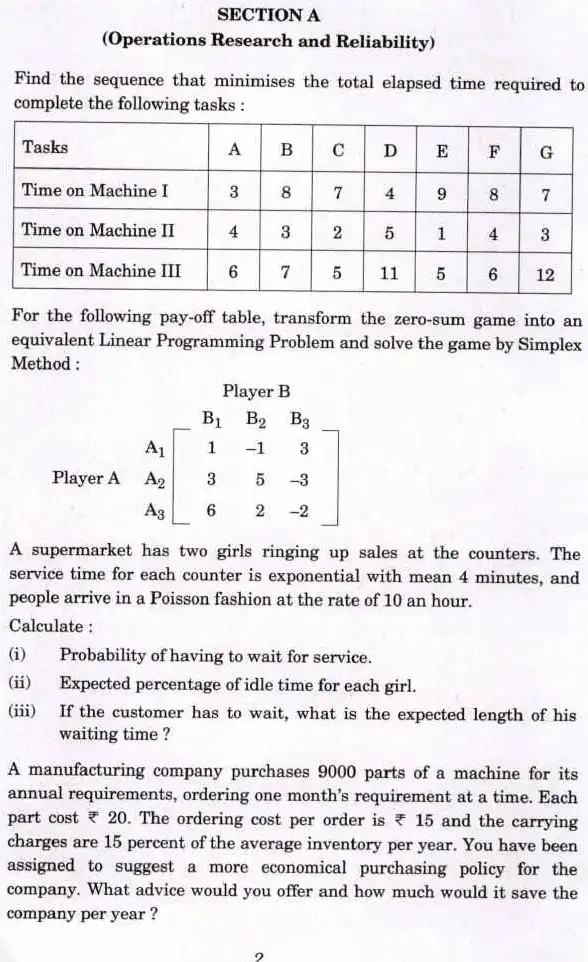
(a) Find the sequence that minimises the total elapsed time required to complete the following tasks: Tasks | A | B | C | D | E | F | G
Time on Machine I | 3 | 8 | 7 | 4 | 9 | 8 | 7
Time on Machine II | 4 | 3 | 2 | 5 | 1 | 4 | 3
Time on Machine III | 6 | 7 | 5 | 11 | 5 | 6 | 12
(b) For the following pay-off table, transform the zero-sum game into an equivalent Linear Programming Problem and solve the game by Simplex Method: Player B
B1 | B2 | B3
Player A A1 | 1 | -1 | 3
A2 | 3 | 5 | -3
A3 | 6 | 2 | -2
(c) A supermarket has two girls ringing up sales at the counters. The service time for each counter is exponential with mean 4 minutes, and people arrive in a Poisson fashion at the rate of 10 an hour.
Calculate:
(i) Probability of having to wait for service.
(ii) Expected percentage of idle time for each girl.
(iii) If the customer has to wait, what is the expected length of his waiting time?
(d) A manufacturing company purchases 9000 parts of a machine for its annual requirements, ordering one month's requirement at a time. Each part cost ₹ 20. The ordering cost per order is ₹ 15 and the carrying charges are 15 percent of the average inventory per year. You have been assigned to suggest a more economical purchasing policy for the company. What advice would you offer and how much would it save the company per year?