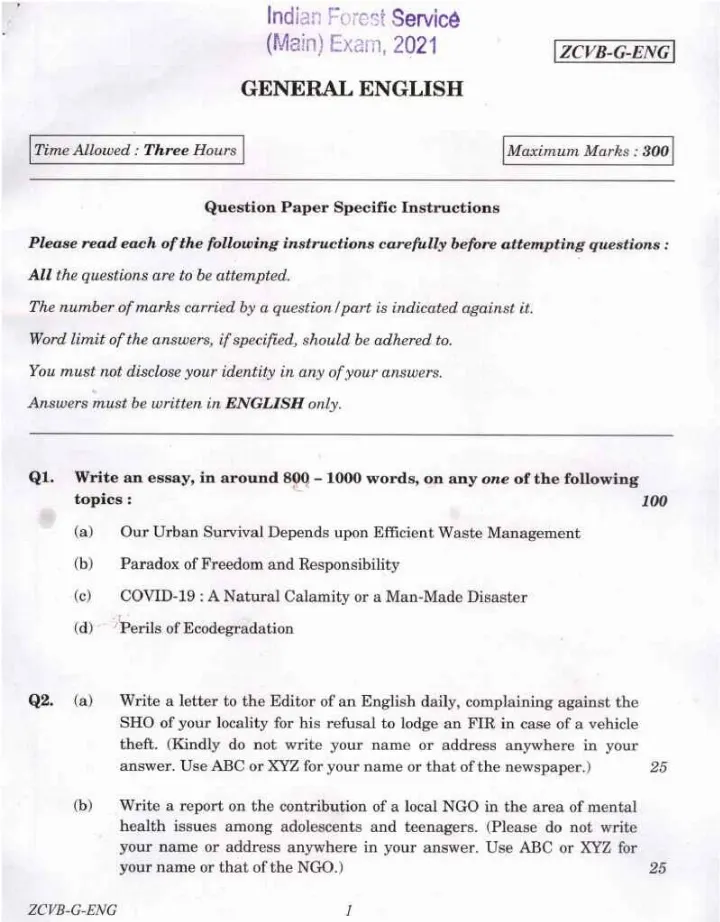
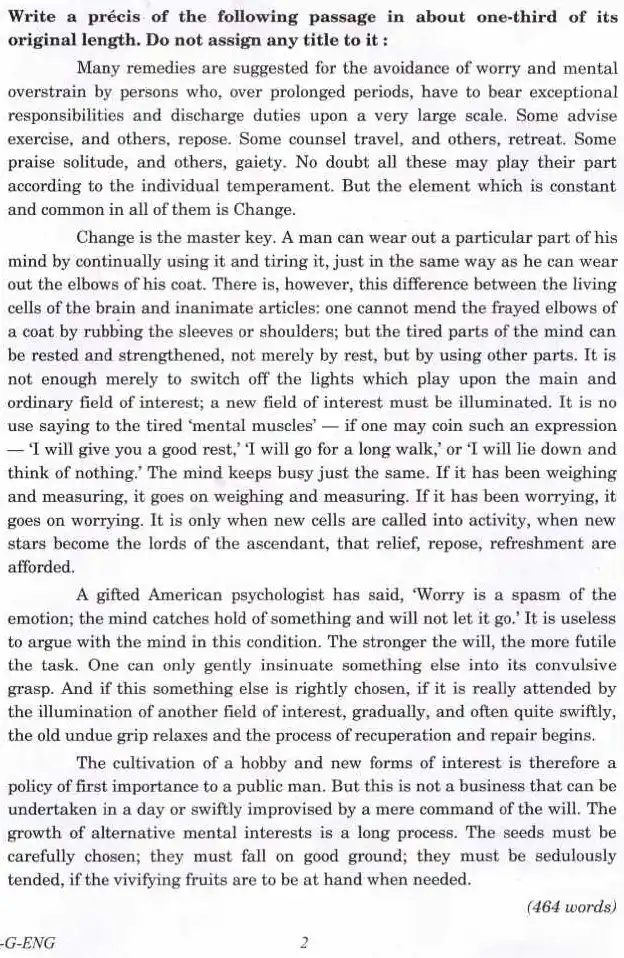
Q3. Write a précis of the following passage in about one-third of its original length. Do not assign any title to it :
(passage) Many remedies are suggested for the avoidance of worry and mental overstrain by persons who, over prolonged periods, have to bear exceptional responsibilities and discharge duties upon a very large scale. Some advise exercise, and others, repose. Some counsel travel, and others, retreat. Some praise solitude, and others, gaiety. No doubt all these may play their part according to the individual temperament. But the element which is constant and common in all of them is Change. Change is the master key. A man can wear out a particular part of his mind by continually using it and tiring it, just in the same way as he can wear out the elbows of his coat. There is, however, this difference between the living cells of the brain and inanimate articles: one cannot mend the frayed elbows of a coat by rubbing the sleeves or shoulders; but the tired parts of the mind can be rested and strengthened, not merely by rest, but by using other parts. It is not enough merely to switch off the lights which play upon the main and ordinary field of interest; a new field of interest must be illuminated. It is no use saying to the tired 'mental muscles' — if one may coin such an expression — 'I will give you a good rest,' 'I will go for a long walk,' or 'I will lie down and think of nothing.' The mind keeps busy just the same. If it has been weighing and measuring, it goes on weighing and measuring. If it has been worrying, it goes on worrying. It is only when new cells are called into activity, when new stars become the lords of the ascendant, that relief, repose, refreshment are afforded. A gifted American psychologist has said, 'Worry is a spasm of the emotion; the mind catches hold of something and will not let it go.' It is useless to argue with the mind in this condition. The stronger the will, the more futile the task. One can only gently insinuate something else into its convulsive grasp. And if this something else is rightly chosen, if it is really attended by the illumination of another field of interest, gradually, and often quite swiftly, the old undue grip relaxes and the process of recuperation and repair begins. The cultivation of a hobby and new forms of interest is therefore a policy of first importance to a public man. But this is not a business that can be undertaken in a day or swiftly improvised by a mere command of the will. The growth of alternative mental interests is a long process. The seeds must be carefully chosen; they must fall on good ground; they must be sedulously tended, if the vivifying fruits are to be at hand when needed. (464 words)