Section A
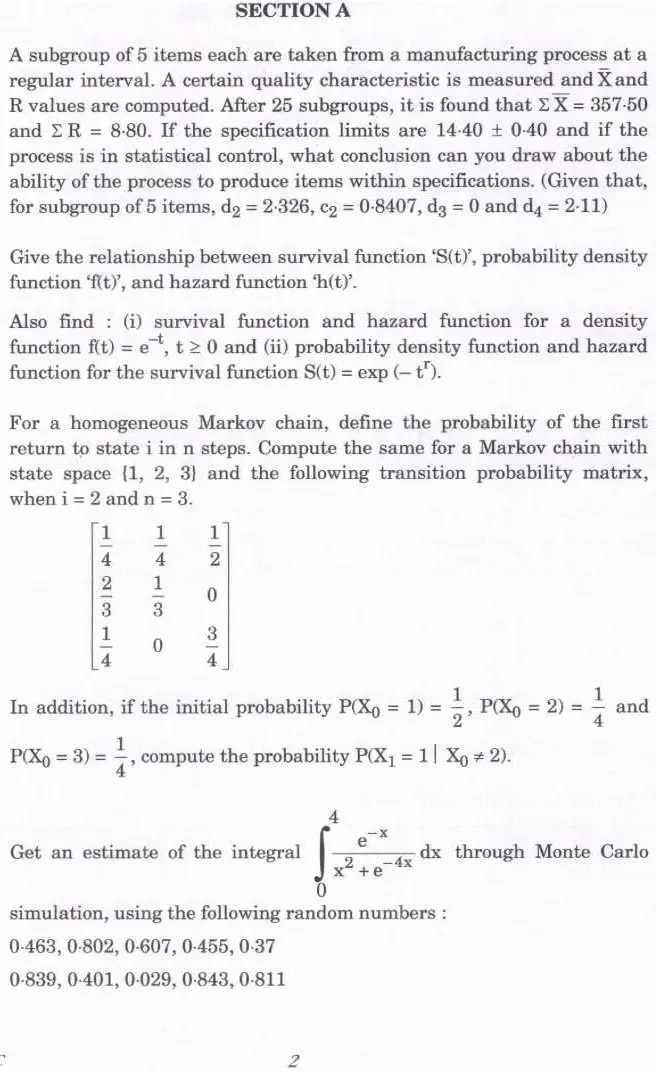
Q1. A subgroup of 5 items each are taken from a manufacturing process at a regular interval. A certain quality characteristic is measured and \overlineX and R values are computed. After 25 subgroups, it is found that \Sigma X = 357.50 and \Sigma R = 8.80. If the specification limits are 14.40 ± 0.40 and if the process is in statistical control, what conclusion can you draw about the ability of the process to produce items within specifications. (Given that, for subgroup of 5 items, d2 = 2.326, c2 = 0.8407, d3 = 0 and d4 = 2.11) Give the relationship between survival function 'S(t)', probability density function 'f(t)', and hazard function 'h(t)'. For a homogeneous Markov chain, define the probability of the first return to state i in n steps. Compute the same for a Markov chain with state space 1, 2, 3 and the following transition probability matrix, when i = 2 and n = 3. Get an estimate of the integral ∫04 (e^-x)/(x2 + e^-4x) dx through Monte Carlo simulation, using the following random numbers:
(b) Also find : (i) survival function and hazard function for a density function f(t) = e-t, t ≥ 0 and (ii) probability density function and hazard function for the survival function S(t) = exp(-tr).
(c) In addition, if the initial probability P(X0 = 1) = 1/2, P(X0 = 2) = 1/4 and P(X0 = 3) = 1/4, compute the probability P(X1 = 1 | X0 ≠ 2).
(d) 463, 0. 802, 0. 607, 0. 455, 0. 37
0. 839, 0. 401, 0. 029, 0. 843, 0.