Indian Forest Service Physics Paper I 2024 UPSC Question Paper PDF

Central Government Jobs Other Jobs 2024

  • Year 2024
  • Conducted By UPSC
  • Questions 8
  • Maximum Marks 200
  • Duration Three Hours
  • Languages English

Exam Details

Detail Information
Examination Indian Forest Service (Main) Examination
Year 2024
Conducting Body UPSC
Paper Physics Paper - I
Subject Physics
Duration Three Hours
Maximum Marks 200
Number of Questions 8
Question Type Mixed

This is the Physics Paper I from the Indian Forest Service (Main) Examination conducted by UPSC in 2024. The paper consists of 8 questions, of which 5 are to be attempted, with questions 1 and 5 being compulsory. Candidates must select at least one question from each of the two sections (A and B) from the remaining six questions. All questions carry equal marks, and answers must be written in English. This paper is crucial for aspirants aiming for the Indian Forest Service, providing a clear understanding of the subject matter and difficulty level expected.

Major Topics Covered

  • Generalized Coordinates
  • Lagrangian Mechanics
  • Hamiltonian Mechanics
  • Relativistic Particle Dynamics
  • Double Refraction
  • He-Ne Laser
  • Moment of Inertia Tensor
  • Coriolis Force

Why This Paper is Important

  • Useful for Indian Forest Service (Main) Examination preparation
  • Helps understand the latest exam pattern
  • Useful for practice and self-assessment
  • Covers frequently asked General Studies topics
  • Helpful for analysing question trends

Related Resources

  • Indian Forest Service (Main) Examination 2023 Physics Paper I
  • Indian Forest Service (Main) Examination 2024 Physics Paper II
  • Civil Services Examination 2024 Physics Optional Paper I
  • Indian Forest Service (Main) Examination 2024 Physics Paper I Answer Key
  • Indian Forest Service (Main) Examination Physics Syllabus
  • UPSC Physics Optional Syllabus
  • Indian Forest Service (Main) Examination Pattern
  • UPSC Exam Pattern for Main Examinations

Instructions

  • There are EIGHT questions in all, out of which FIVE are to be attempted.
  • Out of the remaining SIX questions, THREE are to be attempted selecting at least ONE question from each of the two Sections A and B.
  • Attempts of questions shall be counted in sequential order.
  • Unless struck off, attempt of a question shall be counted even if attempted partly.
  • Any page or portion of the page left blank in the Question-cum-Answer Booklet must be clearly struck off.
  • The number of marks carried by a question/part is indicated against it.
  • Unless otherwise mentioned, symbols and notations have their usual standard meanings.
  • Assume suitable data, if necessary and indicate the same clearly.
  • Neat sketches may be drawn, wherever required.
  • Answers must be written in ENGLISH only.
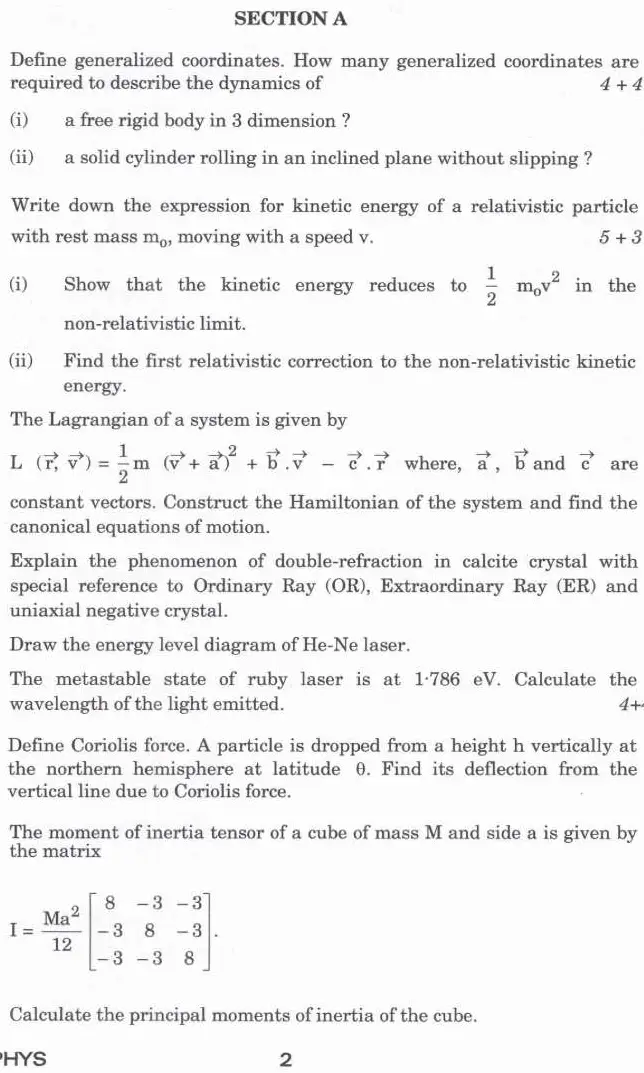
  • Useful Constants: = 1.602 \times 10^{-19} C Electron charge (e) = 9.109 \times 10^{-31} kg Electron rest mass (m_{\rho}) = 1.672 \times 10^{-27} kg Proton mass (m_n) = 8.854 \times 10^{-12} farad/m Vacuum permittivity (\varepsilon_0) = 4\pi \times 10^{-7} T m/A Vacuum permeability (\mu_0) Velocity of light in free space (c) = 3 \times 10^8 m/s = 1.380 \times 10^{-23} J/K Boltzmann constant (k) = 1.602 \times 10^{-19} J Electronvolt (eV) = 6.626 \times 10^{-34} J s Planck constant (h) = 5.67 \times 10^{-8} W m-2 K-4 Stefan constant(\sigma) = 6.022 \times 10^{26} kmol-1 Avogadro number (N) = 8.31 \times 10^3 J kmol-1 K-1 Gas constant (R) = 2.718 \exp(1)

Questions (page 2)

Section A

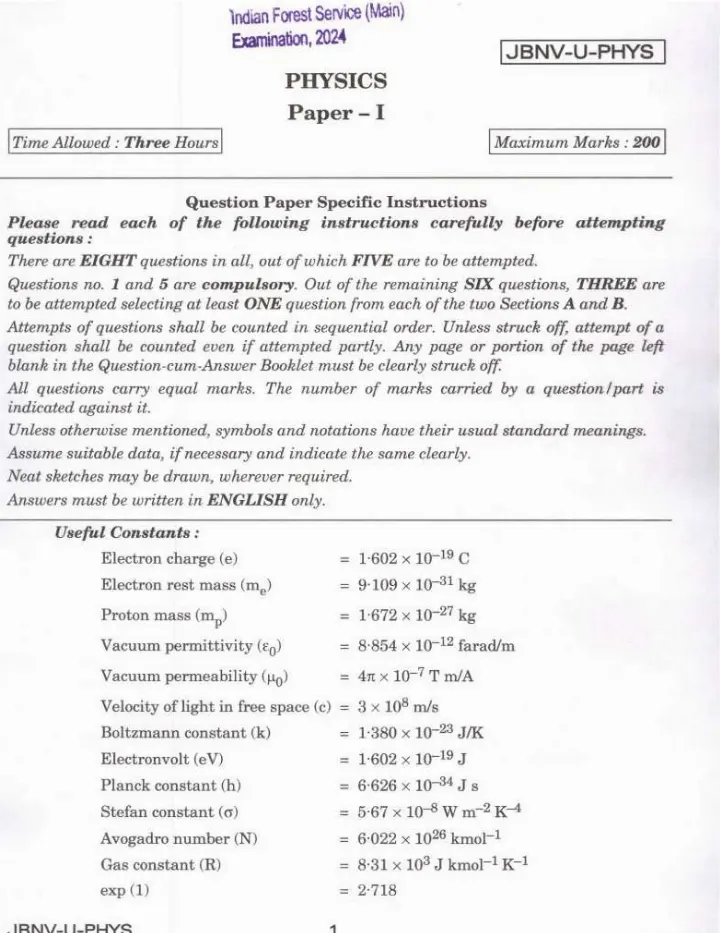
Q1. Define generalized coordinates. How many generalized coordinates are required to describe the dynamics of Write down the expression for kinetic energy of a relativistic particle with rest mass m0, moving with a speed v. The Lagrangian of a system is given by L (\vecr, \vecv) = 1/2m (\vecv + \veca)2 + \vecb \cdot \vecv - \vecc \cdot \vecr where, \veca, \vecb and \vecc are constant vectors. Construct the Hamiltonian of the system and find the canonical equations of motion. Explain the phenomenon of double-refraction in calcite crystal with special reference to Ordinary Ray (OR), Extraordinary Ray (ER) and uniaxial negative crystal. Draw the energy level diagram of He-Ne laser. The metastable state of ruby laser is at 1.786 eV. Calculate the wavelength of the light emitted.

(a) a free rigid body in 3 dimension ?

(b) a solid cylinder rolling in an inclined plane without slipping ?

(a) Show that the kinetic energy reduces to 1/2 m0 v2 in the non-relativistic limit.

(b) Find the first relativistic correction to the non-relativistic kinetic energy.
Section A

Q2. Define Coriolis force. A particle is dropped from a height h vertically at the northern hemisphere at latitude θ. Find its deflection from the vertical line due to Coriolis force. The moment of inertia tensor of a cube of mass M and side a is given by the matrix

(a) I = (Ma2)/(12) \beginvmatrix 8 & -3 & -3 \\ -3 & 8 & -3 \\ -3 & -3 & 8 \endvmatrix.

(b) Calculate the principal moments of inertia of the cube.

Question paper preview

Scanned pages 1–2 for reference. Download the official PDF for the full paper.

Page 1
Indian Forest Service (Main) Examination 2024 Physics Paper I question paper page 1 instructions scan PDF download UPSC
Page 2
Indian Forest Service (Main) Examination 2024 Physics Paper I question paper page 1 instructions scan PDF download UPSC

Free question paper download

Download question paper PDF

  • 2.3 MB
  • 8 pages
  • PDF format

Frequently asked questions

What is the name of the exam?

The exam is the Indian Forest Service (Main) Examination.

Which paper is this?

This is Physics Paper - I.

What is the conducting body?

The conducting body is UPSC (Union Public Service Commission).

What is the year of the examination?

The examination year is 2024.

How many questions are in the paper?

There are a total of 8 questions.

How many questions need to be attempted?

Candidates need to attempt 5 questions.

← Back to Other Jobs papers