Section A
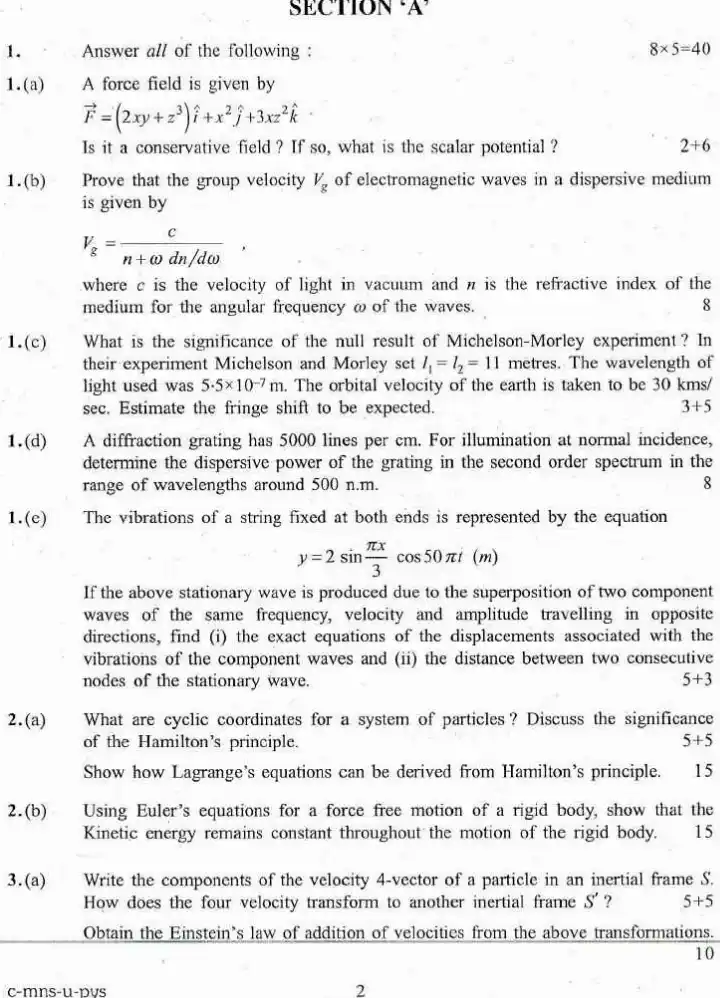
Q1. Answer all of the following :
(a) A force field is given by \vecF = (2xy + z3)\hati + x2\hatj + 3xz2\hatk. Is it a conservative field? If so, what is the scalar potential?
(b) Prove that the group velocity Vg of electromagnetic waves in a dispersive medium is given by Vg = (c)/(n + ω \, dn / dω) where c is the velocity of light in vacuum and n is the refractive index of the medium for the angular frequency ω of the waves.
(c) What is the significance of the null result of Michelson-Morley experiment? In their experiment Michelson and Morley set l1 = l2 = 11 metres. The wavelength of light used was 5.5 × 10⁻⁷ m. The orbital velocity of the earth is taken to be 30 kms/ sec. Estimate the fringe shift to be expected.
(d) A diffraction grating has 5000 lines per cm. For illumination at normal incidence, determine the dispersive power of the grating in the second order spectrum in the range of wavelengths around 500 n.m.
(e) The vibrations of a string fixed at both ends is represented by the equation y = 2 sin (π x)/(3) cos 50 π t (m). If the above stationary wave is produced due to the superposition of two component waves of the same frequency, velocity and amplitude travelling in opposite directions, find (i) the exact equations of the displacements associated with the vibrations of the component waves and (ii) the distance between two consecutive nodes of the stationary wave.