Q1.
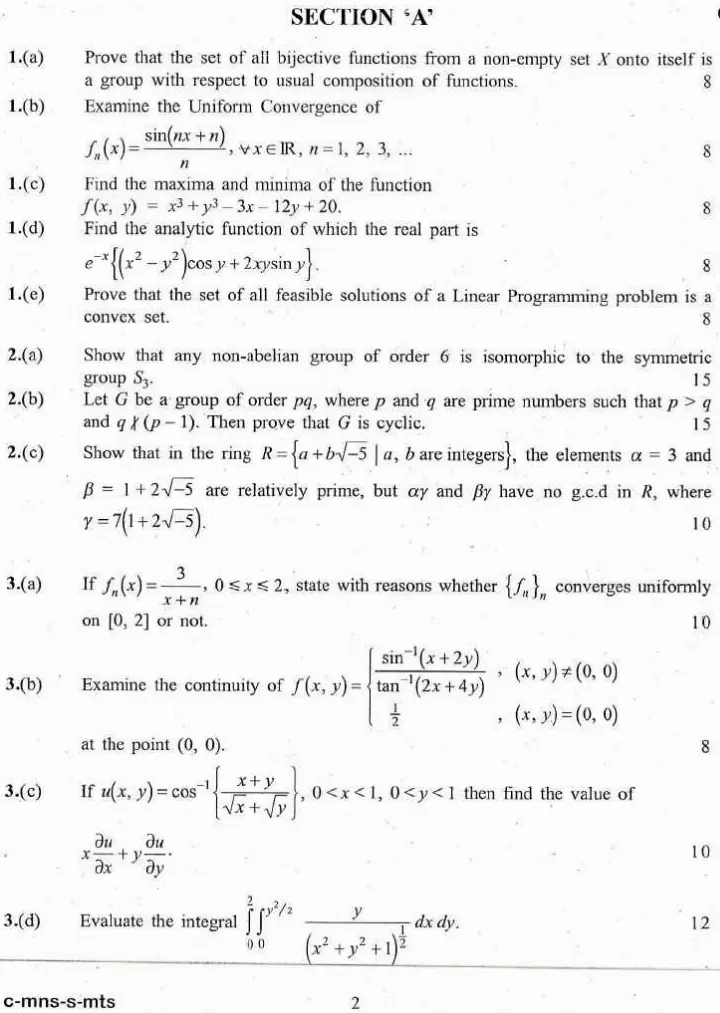
(a) SECTION 'A' Prove that the set of all bijective functions from a non-empty set X onto itself is 1. a group with respect to usual composition of functions. 8 1.
(c) Find the maxima and minima of the function 1. f(x, y) = x3 + y3 - 3x - 12y + 20.
(d) Find the analytic function of which the real part is 1. e-x\(x2-y2) cos y + 2xysin y\. 8 1.
(e) Prove that the set of all feasible solutions of a Linear Programming problem is a convex set. Show that any non-abelian group of order 6 is isomorphic to the symmetric
Q2.
(a) group S3. Let G be a group of order pq, where p and q are prime numbers such that p > q 2.
(b) and q \nmid (p-1). Then prove that G is cyclic.
(c) Show that in the ring R = \{a + b√(-5) \mid a, b \text are integers\}, the elements α = 3 and 2. β = 1 + 2√(-5) are relatively prime, but αγ and βγ have no g.c.d in R, where γ = 7(1 + 2√(-5)). If fn
(x) = (3)/(x + n), 0 ≤ x ≤ 2, state with reasons whether \fn\_n converges uniformly 3(a) on [0, 2] or not.
(d) Examine the continuity of f(x, y) = \begincases (sin^-1(x + 2y))/(tan^-1(2x + 4y)) , (x, y) ≠ (0, 0) \\ 1/2 , (x, y) = (0, 0) \endcases 3
(6) at the point (0, 0). If u(x, y) = cos^-1\(x + y)/(√(x) + √(y))\, 0 < x < 1, 0 < y < 1 then find the value of
3. (c) x(\partial u)/(\partial x) + y(\partial u)/(\partial y). Evaluate the integral ∫02 ∫0y2/2 (y)/((x2 + y2 + 1)^1/2) dx dy.
3. c-mns-s-mts √(2)