CISF AC (EXE) LDCE 2017 General Ability Intelligence Question Paper PDF

Central Government Jobs Other Jobs 2017

  • Year 2017
  • Conducted By UPSC
  • Questions 150
  • Maximum Marks 300
  • Duration Two Hours
  • Languages English & Hindi

Exam Details

Detail Information
Examination CISF AC (EXE) LDCE
Year 2017
Conducting Body UPSC
Paper General Ability, Intelligence and Professional Skills
Subject General Ability, Intelligence and Professional Skills
Duration Two Hours
Maximum Marks 300
Number of Questions 150
Question Type Mixed

This is the official question paper for the CISF AC (EXE) LDCE examination held in 2017, conducted by UPSC. The paper, titled 'General Ability, Intelligence and Professional Skills', comprises 150 objective-type questions carrying a total of 300 marks. Candidates are allowed two hours and thirty minutes to complete the exam. This paper is crucial for aspirants preparing for the CISF Assistant Commandant (Executive) Limited Departmental Competitive Examination, offering valuable insights into the exam pattern and difficulty level.

Major Topics Covered

  • Fundamental Rights
  • Constitution of India
  • Union and State Lists
  • Right to Constitutional Remedies
  • Article 32
  • Article 17
  • Article 19
  • Citizenship Act, 1955
  • Regulating Act of 1773
  • Permanent Settlement
  • Abolition of Sati
  • Bhakti Movement
  • Hindu Temple Architecture

Why This Paper is Important

  • Useful for CISF AC (EXE) LDCE preparation
  • Helps understand the latest exam pattern
  • Useful for practice and self-assessment
  • Covers frequently asked General Studies topics
  • Helpful for analysing question trends

Related Resources

  • CISF AC (EXE) LDCE 2016 Question Paper
  • CISF AC (EXE) LDCE 2018 Question Paper
  • UPSC CAPF AC 2017 Question Paper
  • CISF AC (EXE) LDCE 2017 Answer Key
  • CISF AC (EXE) LDCE Syllabus
  • General Ability and Intelligence Syllabus
  • Professional Skills Syllabus
  • CISF AC (EXE) LDCE Exam Pattern

Instructions

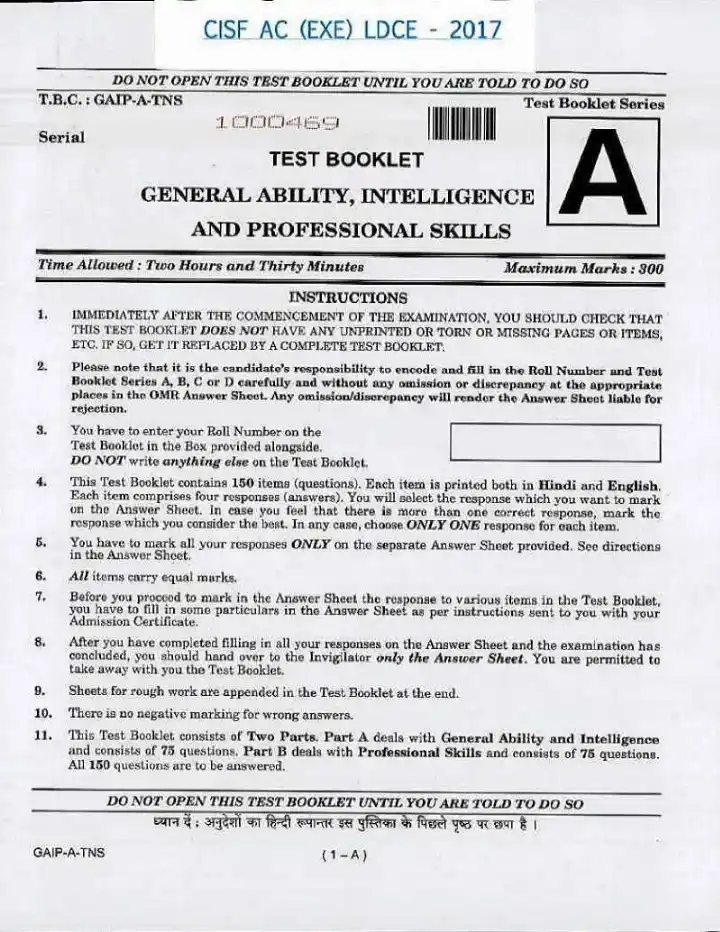
  • and consists of 75 questions. Part B deals with Professional Skills and consists of 75 questions. All 150 questions are to be answered. DO NOT OPEN THIS TEST BOOKLET UNTIL YOU ARE TOLD TO DO SO घ्यान दें : अनुदेशों का हिन्दी रूपान्तर इस पुस्तिका के पिछले पृष्ठ पर छपा है ।

  • THIS TEST BOOKLET DOES NOT HAVE ANY UNPRINTED OR TORN OR MISSING PAGES OR ITEMS.
  • IF SO, GET IT REPLACED BY A COMPLETE TEST BOOKLET.
  • Please note that it is the candidate's responsibility to encode and fill in the Roll Number and Test
  • Booklet Series A, B, C or D carefully and without any omission or discrepancy at the appropriate places in the OMR Answer Sheet.
  • Any omission/discrepancy will render the Answer Sheet liable for rejection.
  • You have to enter your Roll Number on the Test Booklet in the Box provided alongside.
  • DO NOT write anything else on the Test Booklet.
  • This Test Booklet contains 150 items (questions).
  • Each item is printed both in Hindi and English.
  • Each item comprises four responses (answers).
  • You will select the response which you want to mark on the Answer Sheet.
  • In case you feel that there is more than one correct response, mark the response which you consider the best.
  • In any case, choose ONLY ONE response for each item.
  • You have to mark all your responses ONLY on the separate Answer Sheet provided.
  • Before you proceed to mark in the Answer Sheet the response to various items in the Test Booklet,
  • you have to fill in some particulars in the Answer Sheet as per instructions sent to you with your Admission Certificate.
  • After you have completed filling in all your responses on the Answer Sheet and the examination has
  • concluded, you should hand over to the Invigilator only the Answer Sheet.
  • You are permitted to take away with you the Test Booklet.
  • Sheets for rough work are appended in the Test Booklet at the end.
  • There is no negative marking for wrong answers.
  • This Test Booklet consists of Two Parts. Part A deals with General Ability and Intelligence

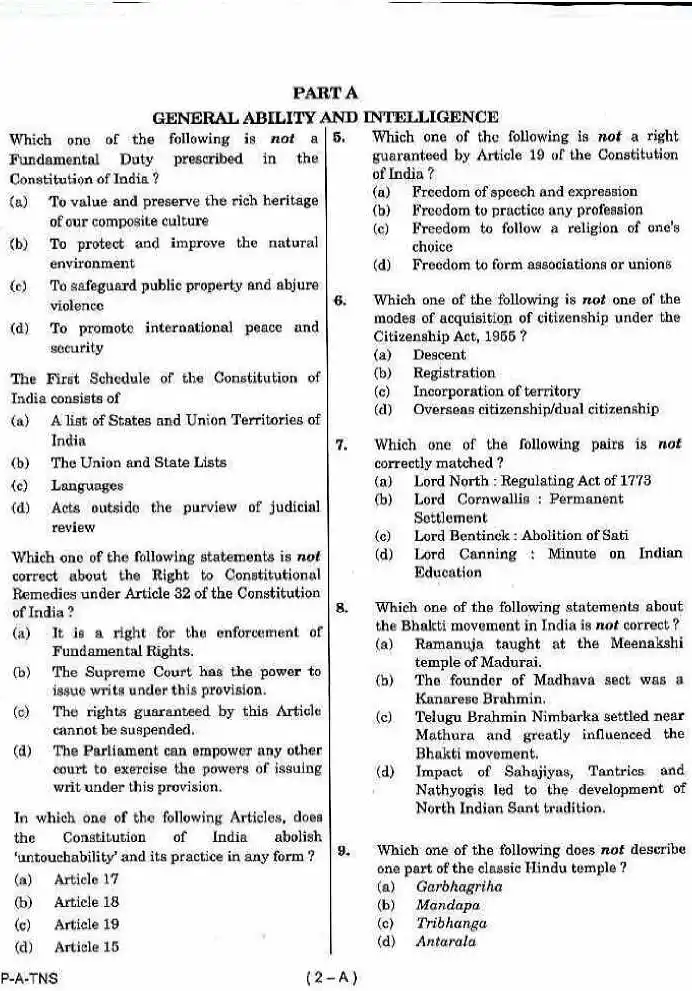
Questions (page 2)

Q1. Which one of the following is not a Fundamental Duty prescribed in the Constitution of India?

(a) To value and preserve the rich heritage of our composite culture

(b) To protect and improve the natural environment

(c) To safeguard public property and abjure violence

(d) To promote international peace and security

Q2. The First Schedule of the Constitution of India consists of

(a) A list of States and Union Territories of India

(b) The Union and State Lists

(c) Languages

(d) Acts outside the purview of judicial review

Q3. Which one of the following statements is not correct about the Right to Constitutional Remedies under Article 32 of the Constitution of India?

(a) It is a right for the enforcement of Fundamental Rights.

(b) The Supreme Court has the power to issue writs under this provision.

(c) The rights guaranteed by this Article cannot be suspended.

(d) The Parliament can empower any other court to exercise the powers of issuing writ under this provision.

Q4. In which one of the following Articles, does the Constitution of India abolish the 'untouchability' and its practice in any form?

(a) Article 17

(b) Article 18

(c) Article 19

(d) Article 15

Q5. Which one of the following is not a right guaranteed by Article 19 of the Constitution of India?

(a) Freedom of speech and expression

(b) Freedom to practice any profession

(c) Freedom to follow a religion of one's choice

(d) Freedom to form associations or unions

Q6. Which one of the following is not one of the modes of acquisition of citizenship under the Citizenship Act, 1955?

(a) Descent

(b) Registration

(c) Incorporation of territory

(d) Overseas citizenship/dual citizenship

Q7. Which one of the following pairs is not correctly matched?

(a) Lord North : Regulating Act of 1773

(b) Lord Cornwallis : Permanent Settlement

(c) Lord Bentinck : Abolition of Sati

(d) Lord Canning : Minute on Indian Education

Q8. Which one of the following statements about the Bhakti movement in India is not correct?

(a) Ramanuja taught at the Meenakshi temple of Madurai.

(b) The founder of Madhava sect was a Kanarese Brahmin.

(c) Telugu Brahmin Nimbarka settled near Mathura and greatly influenced the Bhakti movement.

(d) Impact of Sahajiyas, Tantrics and Nathyogis led to the development of North Indian Sant tradition.

Q9. Which one of the following does not describe one part of the classic Hindu temple?

(a) Garbhagriha

(b) Mandapa

(c) Tribhanga

(d) Antarala

Question paper preview

Scanned pages 1–2 for reference. Download the official PDF for the full paper.

Page 1
CISF AC (EXE) LDCE 2017 General Ability, Intelligence and Professional Skills question paper page 1 instructions scan PDF download UPSC
Page 2
CISF AC (EXE) LDCE 2017 General Ability, Intelligence and Professional Skills question paper page 1 instructions scan PDF download UPSC

Free question paper download

Download question paper PDF

  • 9.5 MB
  • 48 pages
  • PDF format

Frequently asked questions

What is the full name of the exam for which this question paper is from?

The full name of the exam is CISF AC (EXE) LDCE, which stands for Central Industrial Security Force Assistant Commandant (Executive) Limited Departmental Competitive Examination.

Which year is this CISF AC (EXE) LDCE question paper from?

This question paper is from the year 2017.

Who conducts the CISF AC (EXE) LDCE examination?

The CISF AC (EXE) LDCE examination is conducted by the Union Public Service Commission (UPSC).

What is the subject of this question paper?

The subject of this question paper is General Ability, Intelligence and Professional Skills.

How many questions are there in the CISF AC (EXE) LDCE 2017 paper?

There are a total of 150 questions in this paper.

What is the maximum marks for the CISF AC (EXE) LDCE 2017 exam paper?

The maximum marks for this paper are 300.

← Back to Other Jobs papers