
IES ISS Exam 2017 General Economics Paper III Question Paper PDF
- Year 2017
- Conducted By UPSC
- Maximum Marks 200
- Duration Three Hours
- Languages English
Exam Details
| Detail | Information |
|---|---|
| Examination | IES/ISS EXAM |
| Year | 2017 |
| Conducting Body | UPSC |
| Paper | GENERAL ECONOMICS PAPER-III |
| Subject | General Economics |
| Duration | Three Hours |
| Maximum Marks | 200 |
| Question Type | Mixed |
This is the General Economics Paper III from the IES/ISS Exam conducted by UPSC in 2017. The paper is designed to test candidates' in-depth knowledge of economics, with a maximum of 200 marks and a time limit of three hours. It comprises multiple sections with compulsory and optional questions, requiring concise and legible answers in English. Aspirants can use this paper to understand the exam structure, question complexity, and key economic concepts tested, aiding their preparation for future examinations. This previous year IES/ISS EXAM, 2017 question paper (2017) is useful for Other Jobs aspirants preparing for Central government recruitment. The paper was conducted by UPSC and reflects the official exam pattern, marking scheme and difficulty level seen in recent cycles. Use it for timed practice, topic-wise revision and understanding how questions are framed in the real examination. Download the free PDF on QuizCurrent to read instructions, attempt MCQs and compare your answers with the study notes provided on this page. Key syllabus areas include Commodity Taxation, Green Climate Fund, Entry Preventing Pricing Strategy, Carbon Trading, Decentralized Planning, Social Discount Rate, Private Discount Rate, Revenue Deficit. Useful for IES/ISS EXAM preparation. Helps understand the latest exam pattern. Useful for practice and self-assessment.
Major Topics Covered
- Commodity Taxation
- Green Climate Fund
- Entry Preventing Pricing Strategy
- Carbon Trading
- Decentralized Planning
- Social Discount Rate
- Private Discount Rate
- Revenue Deficit
- Effective Revenue Deficit
- Fiscal Deficit
- Primary Deficit
- Principles of Taxation
- Environmental-Economic Accounting
- Planning Models
- Competition Policy
- Community Participation
- Economic Efficiency
- Allocative Efficiency
- Technical Efficiency
- European Union Emission Trading System (EU-ETS)
- Carbon Credit
- Cournot Model
- Bertrand Model
- Duopoly
Why This Paper is Important
- Useful for IES/ISS EXAM preparation
- Helps understand the latest exam pattern
- Useful for practice and self-assessment
- Covers frequently asked General Studies topics
- Helpful for analysing question trends
Related Resources
- IES ISS Exam 2016 General Economics Paper III
- IES ISS Exam 2018 General Economics Paper III
- UPSC Economics Optional Paper
- IES ISS Exam 2017 General Economics Paper III Answer Key
- IES ISS Exam General Economics Syllabus
- UPSC Economics Syllabus
- IES ISS Exam Pattern
- UPSC Exam Pattern
Instructions
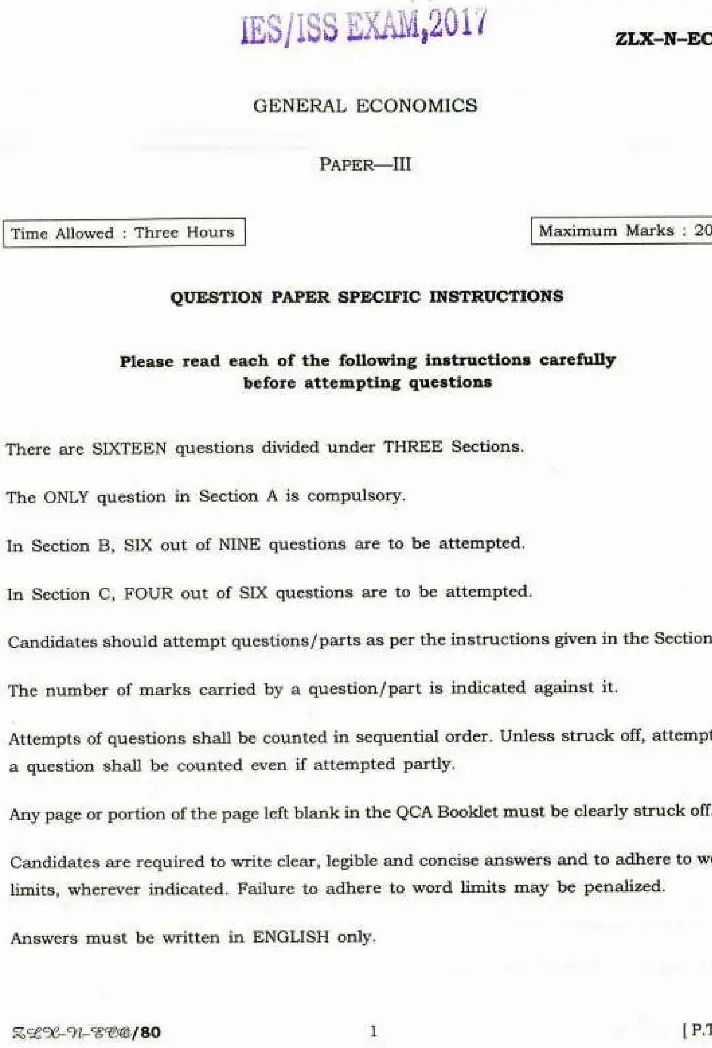
- There are SIXTEEN questions divided under THREE Sections.
- The ONLY question in Section A is compulsory.
- In Section B, SIX out of NINE questions are to be attempted.
- In Section C, FOUR out of SIX questions are to be attempted.
- Candidates should attempt questions/parts as per the instructions given in the Section.
- The number of marks carried by a question/part is indicated against it.
- Attempts of questions shall be counted in sequential order.
- Unless struck off, attempt of a question shall be counted even if attempted partly.
- Any page or portion of the page left blank in the QCA Booklet must be clearly struck off.
- Candidates are required to write clear, legible and concise answers and to adhere to word limits, wherever indicated.
- Failure to adhere to word limits may be penalized.
- Answers must be written in ENGLISH only.
Questions (page 2)
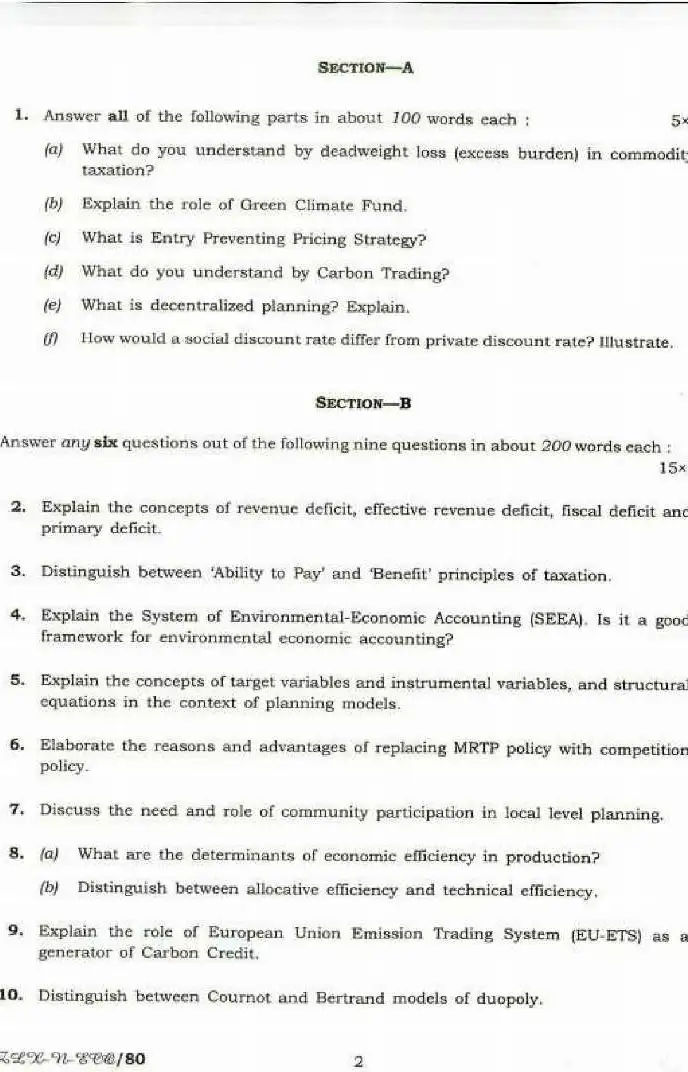
Q2. primary deficit. Distinguish between 'Ability to Pay' and 'Benefit' principles of taxation. З.
Q4. Explain the System of Environmental-Economic Accounting (SEEA). Is it a good framework for environmental economic accounting?
Q5. Explain the concepts of target variables and instrumental variables, and structural equations in the context of planning models. Elaborate the reasons and advantages of replacing MRTP policy with competition
Q7. Discuss the need and role of community participation in local level planning. (a) What are the determinants of economic efficiency in production?
Q8. (b) Distinguish between allocative efficiency and technical efficiency.
Q9. Explain the role of European Union Emission Trading System (EU-ETS) as a generator of Carbon Credit.
Question paper preview
Scanned pages 1–2 for reference. Download the official PDF for the full paper.
Free question paper download
Download question paper PDF
Your download starts in 10s
Preparing your question paper file…
Frequently asked questions
What is the name of the exam?
The exam is the IES/ISS EXAM.
What year is this question paper from?
This question paper is from the year 2017.
Which conducting body organized this exam?
The exam was conducted by UPSC.
What is the subject of this paper?
The subject is General Economics, specifically Paper III.
What is the maximum marks for this paper?
The maximum marks for this paper are 200.
How much time is allowed to complete the paper?
Three hours are allowed to complete the paper.