Section A
Q1.
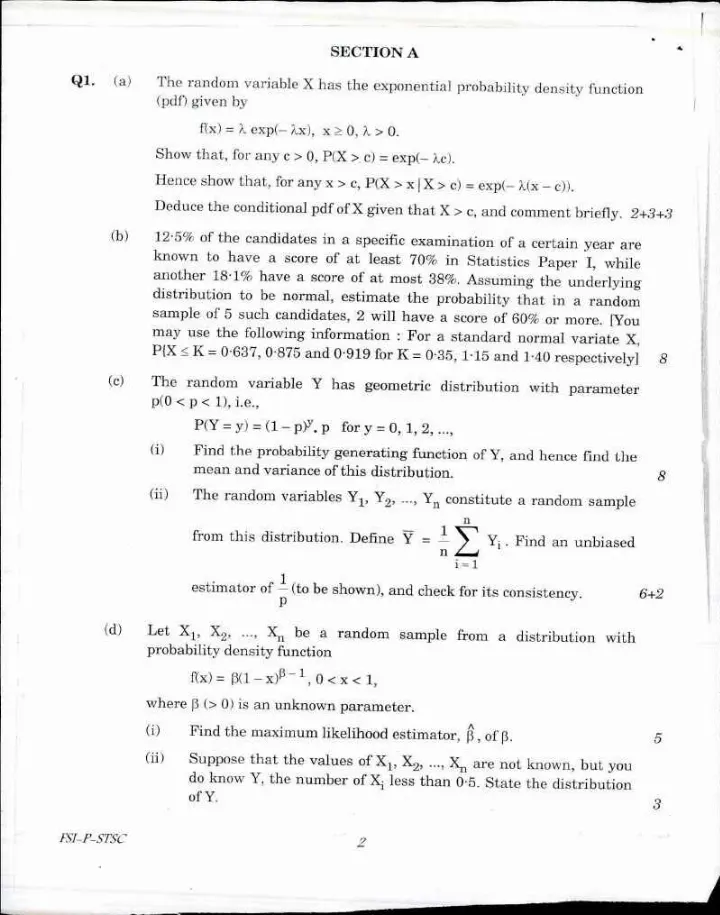
(a) The random variable X has the exponential probability density function (pdf) given by f(x) = λ exp(-λ x), x ≥ 0, λ > 0. Show that, for any c > 0, P(X > c) = exp(-λ c). Hence show that, for any x > c, P(X > x | X > c) = exp(-λ(x - c)). Deduce the conditional pdf of X given that X > c, and comment briefly.
(b) 12.5% of the candidates in a specific examination of a certain year are known to have a score of at least 70% in Statistics Paper I, while another 18.1% have a score of at most 38%. Assuming the underlying distribution to be normal, estimate the probability that in a random sample of 5 such candidates, 2 will have a score of 60% or more. [You may use the following information : For a standard normal variate X, P{X ≤ K = 0.637, 0.875 \text and 0.919 \text for K = 0.35, 1.15 \text and 1.40 \text respectively}.
(c) The random variable Y has geometric distribution with parameter p(0 < p < 1), i.e., P(Y = y) = (1 - p)^y p for y = 0, 1, 2, .... Find the probability generating function of Y, and hence find the (i) mean and variance of this distribution.
(e) Let X1, X2, ..., Xn be a random sample from a distribution with probability density function f(x) = β(1-x)β-1, 0 < x < 1, where β (> 0) is an unknown parameter. (i) Find the maximum likelihood estimator, \hatβ, of β. (ii) Suppose that the values of X1, X2, ..., Xn are not known, but you do know Y, the number of Xi less than 0.5. State the distribution of Y.