IFS (M) 2017 Physics Paper I Question Paper PDF | UPSC

Central Government Jobs Other Jobs 2017

  • Year 2017
  • Conducted By UPSC
  • Questions 8
  • Maximum Marks 200
  • Duration Three Hours
  • Languages English

Exam Details

Detail Information
Examination I.F.S. (M) Examination
Year 2017
Conducting Body UPSC
Paper Physics Paper - I
Subject Physics
Duration Three Hours
Maximum Marks 200
Number of Questions 8
Question Type Descriptive / Subjective

This is the Physics Paper I for the I.F.S. (M) Examination conducted by UPSC in 2017. The paper carried a maximum of 200 marks and allowed three hours for completion. It consists of descriptive questions, with specific instructions on compulsory questions and section-wise attempts. Aspirants can use this paper to understand the exam structure, question types, and marking scheme for Physics subjects in the IFS exam. It is a valuable resource for targeted preparation and practice.

Major Topics Covered

  • Lagrangian Mechanics
  • Equation of Motion
  • Relativistic Invariance
  • Conservation of Momentum
  • Mass-Energy Equivalence
  • Optics
  • Grating
  • Optical Fibers
  • Absorption Mechanisms
  • LASER
  • Ruby Laser
  • System of Point Particles
  • Conservation Theorems
  • Continuous Mass Distribution
  • Hamilton's Principle
  • Hamiltonian Mechanics
  • Planetary Motion
  • Holography

Why This Paper is Important

  • Useful for I.F.S. (M) Examination preparation
  • Helps understand the latest exam pattern
  • Useful for practice and self-assessment
  • Covers frequently asked General Studies topics
  • Helpful for analysing question trends

Related Resources

  • IFS (M) Examination 2016 Physics Paper I
  • IFS (M) Examination 2017 Physics Paper II
  • UPSC ESE Physics Paper
  • IFS (M) Examination 2017 Physics Paper I Answer Key
  • IFS (M) Examination Physics Syllabus
  • UPSC Physics Syllabus for Competitive Exams
  • IFS (M) Examination Pattern
  • UPSC Exam Pattern Physics

Instructions

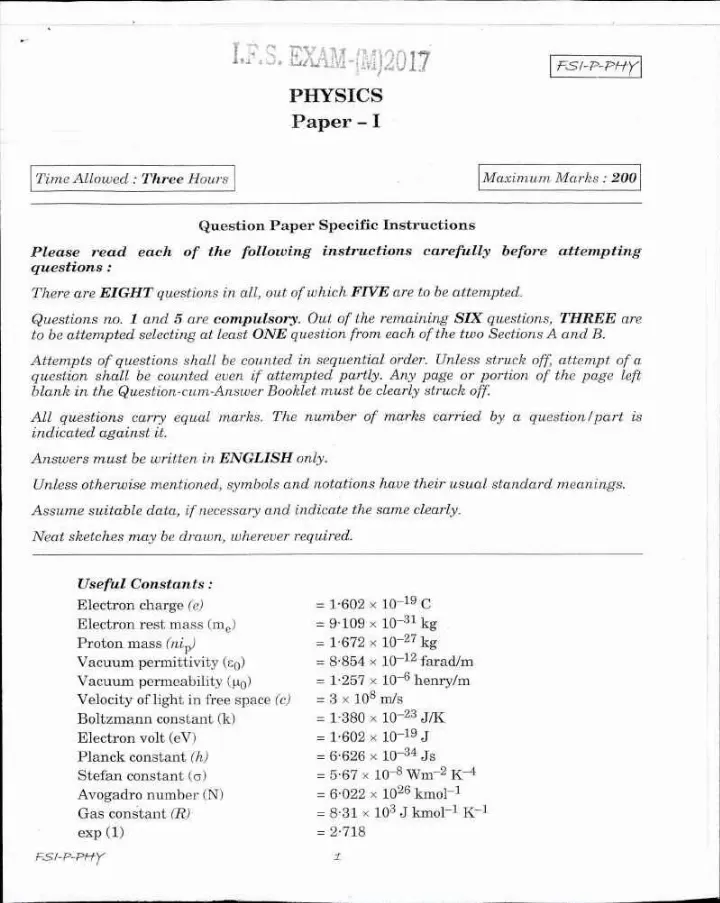
  • There are EIGHT questions in all, out of which FIVE are to be attempted.
  • Out of the remaining SIX questions, THREE are to be attempted selecting at least \overline{ONE} question from each of the two Sections A and B.
  • Attempts of questions shall be counted in sequential order.
  • Unless struck off, attempt of a question shall be counted even if attempted partly.
  • Any page or portion of the page left blank in the Question-cum-Answer Booklet must be clearly struck off.
  • The number of marks carried by a question/part is indicated against it.
  • Answers must be written in ENGLISH only.
  • Unless otherwise mentioned, symbols and notations have their usual standard meanings.
  • Assume suitable data, if necessary and indicate the same clearly.
  • Neat sketches may be drawn, wherever required.
  • Useful Constants: = 1.602 \times 10^{-19} C Electron charge (e) = 9.109 \times 10^{-31} kg Electron rest mass (m_e) = 1.672 \times 10^{-27} kg Proton mass (n_i) = 8.854 \times 10^{-12} farad/m Vacuum permittivity (\varepsilon_0) = 1.257 \times 10^{-6} henry/m Vacuum permeability (\mu_0) = 3 \times 10^8 m/s Velocity of light in free space (c) = 1.380 \times 10^{-23} J/K Boltzmann constant (k) =1{\cdot}602\times10^{-19}\,\mathrm{J} Electron volt (eV) = 6.626 \times 10^{-34} Js Planck constant (h) = 5.67 \times 10^{-8} Wm-2 K-4 Stefan constant (\sigma) = 6.022 \times 10^{26} kmol-1 Avogadro number (N) = 8.31 \times 10^3 J kmol-1 K-1 Gas constant (R) = 2.718 \exp(1)

Questions (page 2)

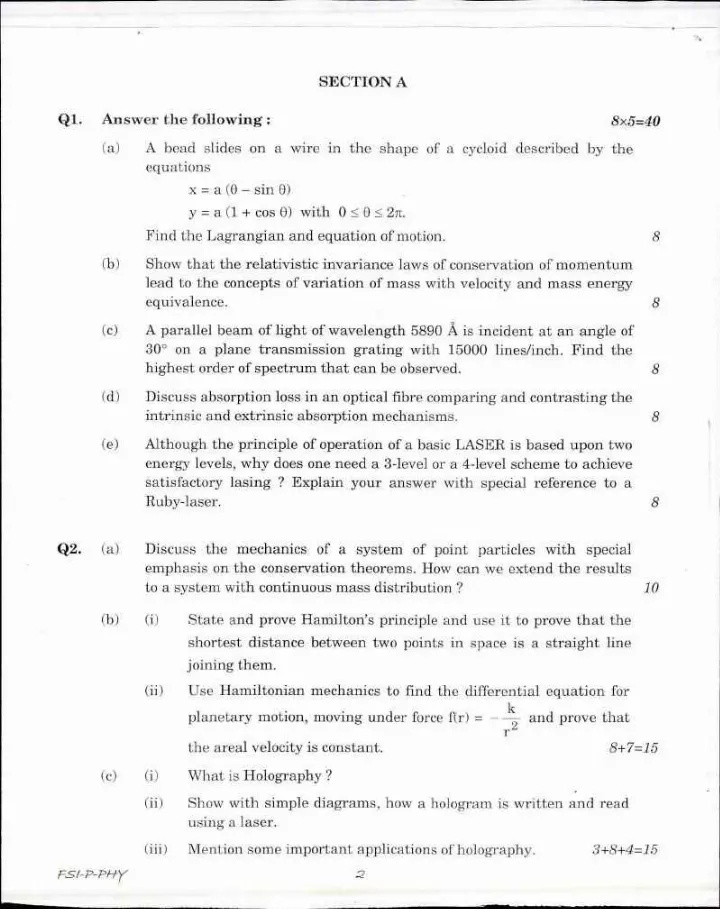
Section A

Q1.

(a) A bead slides on a wire in the shape of a cycloid described by the equations
x = a ( heta - sin heta)
y = a (1 + cos heta)
with 0 le heta le 2pi.
Find the Lagrangian and equation of motion.

(b) Show that the relativistic invariance laws of conservation of momentum lead to the concepts of variation of mass with velocity and mass energy equivalence.

(c) A parallel beam of light of wavelength 5890 Å is incident at an angle of 30^{circ} on a plane transmission grating with 15000 lines/inch. Find the highest order of spectrum that can be observed.

(d) Discuss absorption loss in an optical fibre comparing and contrasting the intrinsic and extrinsic absorption mechanisms.

(e) Although the principle of operation of a basic LASER is based upon two energy levels, why does one need a 3-level or a 4-level scheme to achieve satisfactory lasing ? Explain your answer with special reference to a Ruby-laser.
Section A

Q2.

(a) Discuss the mechanics of a system of point particles with special emphasis on the conservation theorems. How can we extend the results to a system with continuous mass distribution?

(b) (i) State and prove Hamilton's principle and use it to prove that the shortest distance between two points in space is a straight line joining them.
(ii) Use Hamiltonian mechanics to find the differential equation for planetary motion, moving under force f(r) = -rac{k}{r2} and prove that the areal velocity is constant.

(c) (i) What is Holography?
(ii) Show with simple diagrams, how a hologram is written and read using a laser.
(iii) Mention some important applications of holography.

Question paper preview

Scanned pages 1–2 for reference. Download the official PDF for the full paper.

Page 1
IFS (M) 2017 Physics Paper I question paper page 1 instructions scan PDF download UPSC
Page 2
IFS (M) 2017 Physics Paper I question paper page 1 instructions scan PDF download UPSC

Free question paper download

Download question paper PDF

  • 3.4 MB
  • 6 pages
  • PDF format

Frequently asked questions

What is the full name of the exam?

The full name of the exam is I.F.S. (M) Examination.

Which year is this question paper from?

This question paper is from the year 2017.

Who conducts the I.F.S. (M) Examination?

The I.F.S. (M) Examination is conducted by UPSC (Union Public Service Commission).

What is the subject of this paper?

The subject of this paper is Physics, specifically Paper - I.

What is the maximum marks for this paper?

The maximum marks for this paper are 200.

What is the time duration allowed for this paper?

The time allowed for this paper is Three Hours.

← Back to Other Jobs papers