Section A
Q1.
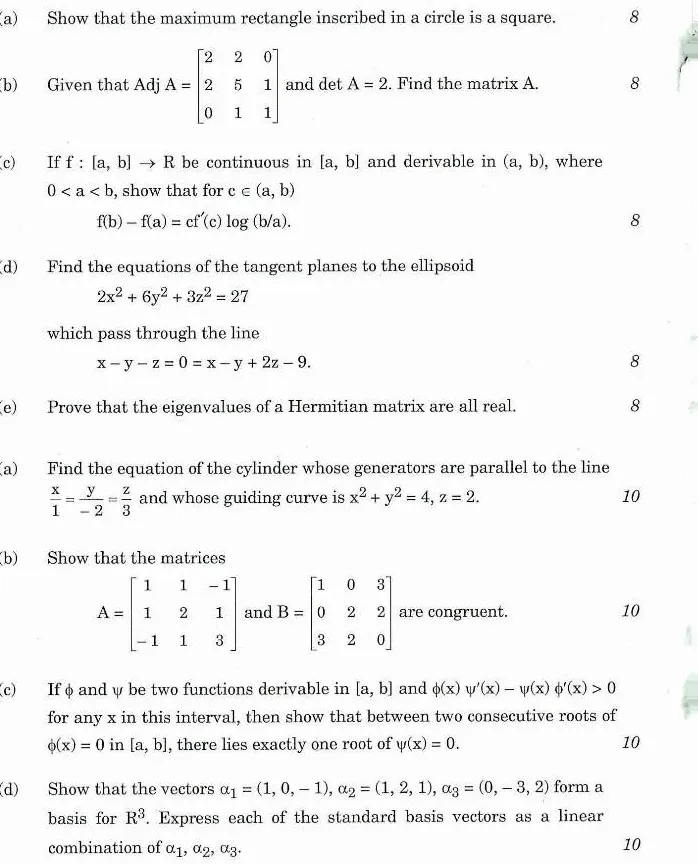
(a) Show that the maximum rectangle inscribed in a circle is a square.
(b) Given that Adj A = $
\beginvmatrix
2 & 2 & 0 \\
2 & 5 & 1 \\
0 & 1 & 1
\endvmatrix
$ and det A = 2. Find the matrix A.
(c) If f : [a, b] u2192 R be continuous in [a, b] and derivable in (a, b), where 0 < a < b, show that for c in (a, b) f(b) - f(a) = cf'(c) log(b/a).
(d) Find the equations of the tangent planes to the ellipsoid 2x2 + 6y2 + 3z2 = 27 which pass through the line x - y - z = 0 = x - y + 2z - 9.
(e) Prove that the eigenvalues of a Hermitian matrix are all real.
Section A
Q2.
(a) Find the equation of the cylinder whose generators are parallel to the line (x)/(1) = (y)/(-2) = (z)/(3) and whose guiding curve is x2 + y2 = 4, z = 2.
(b) Show that the matrices A = \beginbmatrix 1 & 1 & -1 \\ 1 & 2 & 1 \\ -1 & 1 & 3 \endbmatrix and B = \beginbmatrix 1 & 0 & 3 \\ 0 & 2 & 2 \\ 3 & 2 & 0 \endbmatrix are congruent.
(c) If \phi and \psi be two functions derivable in [a, b] and \phi(x) \psi'(x) - \psi(x) \phi'(x) > 0 for any x in this interval, then show that between two consecutive roots of \phi(x) = 0 in [a, b], there lies exactly one root of \psi(x) = 0.
(d) Show that the vectors α_1 = (1, 0, -1), α_2 = (1, 2, 1), α_3 = (0, -3, 2) form a basis for R3. Express each of the standard basis vectors as a linear combination of α_1, α_2, α_3.