IFS CHEMISTRY 2018 Paper I - Question Paper

Central Government Jobs Other Jobs 2018

  • Year 2018
  • Conducted By Indian Forest Service
  • Questions 2
  • Maximum Marks 200
  • Duration Three Hours
  • Languages English

Exam Details

Detail Information
Examination I.F.S. EXAM-(M) 2018
Year 2018
Conducting Body Indian Forest Service
Paper CHEMISTRY Paper - I
Subject Chemistry
Duration Three Hours
Maximum Marks 200
Number of Questions 2
Question Type Descriptive / Subjective

This entry consolidates the IFS 2018 Chemistry Paper I content from Page 1 (exam header and instructions) and Page 2 (Section A questions Q1 and Q2 with subparts). The repaired OCR presents two descriptive questions—Q1 with five subparts (a–e) on topics from eigenfunctions to activation energy, and Q2 with three subparts (a–c) covering de Broglie wavelength calculations, Carnot engine thermodynamics, and photon energetics. The page reflects standard IFS exam rules: eight questions total with five to attempt, Q1 and Q5 compulsory, at least one from each Section A and B, and English answers.

Major Topics Covered

  • Chemistry
  • Physical Chemistry
  • Quantum Mechanics
  • Thermodynamics
  • Statistical Mechanics
  • Chemical Kinetics
  • Photons
  • Wave-Particle Duality
  • De Broglie Relation
  • Ideal Gas
  • Non-Ideal Gas
  • Phase Transitions
  • Sulphur Phases
  • Activation Energy
  • Arrhenius Equation
  • Reaction Kinetics
  • Equilibrium
  • Gibbs Free Energy
  • Entropy
  • Enthalpy

Why This Paper is Important

  • Useful for I.F.S. EXAM-(M) 2018 preparation
  • Helps understand the latest exam pattern
  • Useful for practice and self-assessment
  • Covers frequently asked General Studies topics
  • Helpful for analysing question trends

Related Resources

Instructions

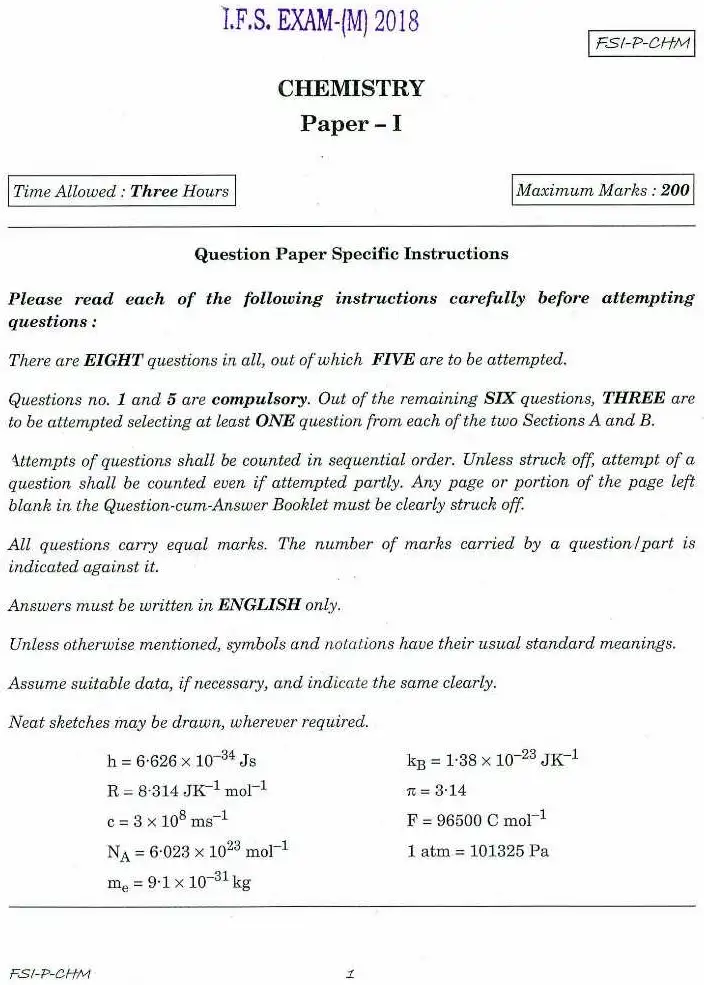
  • There are EIGHT questions in all, out of which FIVE are to be attempted.
  • Out of the remaining SIX questions, THREE are to be attempted selecting at least \overline{ONE} question from each of the two Sections A and B.
  • Attempts of questions shall be counted in sequential order.
  • Unless struck off, attempt of a question shall be counted even if attempted partly.
  • Any page or portion of the page left blank in the Question-cum-Answer Booklet must be clearly struck off.
  • The number of marks carried by a question/part is indicated against it.
  • Answers must be written in ENGLISH only.
  • Unless otherwise mentioned, symbols and notations have their usual standard meanings.
  • Assume suitable data, if necessary, and indicate the same clearly.
  • Neat sketches may be drawn, wherever required. k_B = 1.38 \times 10^{-23} JK-1 h = 6.626 \times 10^{-34} Js R = 8.314 \text{ JK}^{-1} \text{ mol}^{-1} \pi = 3.14 c=3\times 10^8~\mathrm{ms^{-1}} F = 96500 \text{ C mol}^{-1} N_A = 6.023 \times 10^{23} mol-1 1 atm = 101325 Pa m_e = 9.1 \times 10^{-31} kg

Questions (page 2)

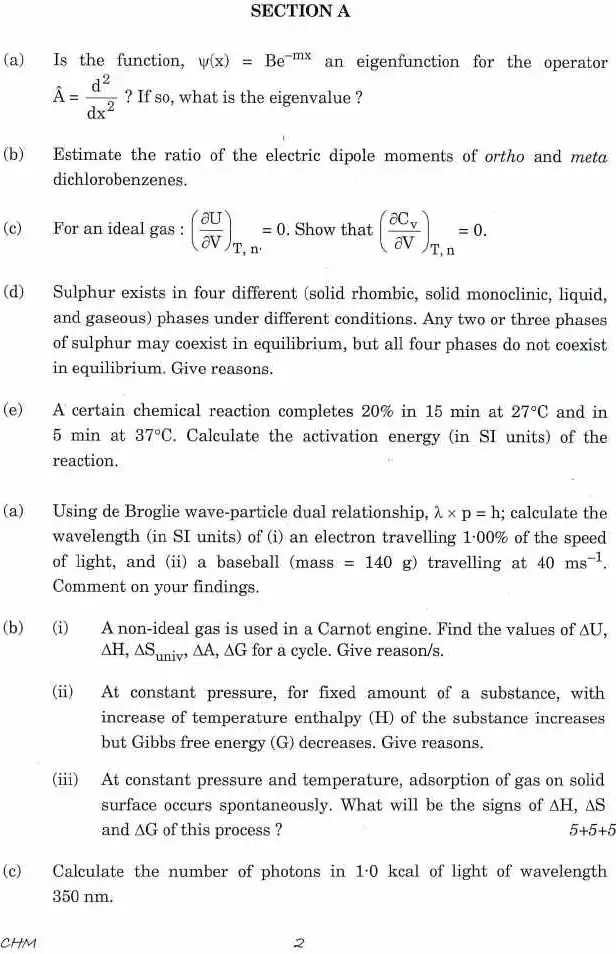
Q1. (a) Q1. Is the function, ψ
(x) = Be-mx an eigenfunction for the operator \hatA = (d2)/(dx2)? If so, what is the eigenvalue?

(a) Q1. Is the function, ψ
(x) = Be-mx an eigenfunction for the operator \hatA = (d2)/(dx2)? If so, what is the eigenvalue?

(b) Estimate the ratio of the electric dipole moments of ortho and meta dichlorobenzenes.
For an ideal gas : (∂U/∂V)_{T, n} = 0.

(c) Show that (∂Cv/∂V)_{T, n} = 0. Sulphur exists in four different (solid rhombic, solid monoclinic, liquid, and gaseous) phases under different conditions. Any two or three phases of sulphur may coexist in equilibrium, but all four phases do not coexist in equilibrium. Give reasons.
(e) A certain chemical reaction completes 20% in min at 27 °C and in min at 37°C. Calculate the activation energy (in SI units) of the reaction.
  • (a) Q1. Is the function, ψ
  • (b) Estimate the ratio of the electric dipole moments of ortho and meta dichlorobenzenes.
    For an ideal gas : (∂U/∂V)_{T, n} = 0.
  • (c) Show that (∂Cv/∂V)_{T, n} = 0. Sulphur exists in four different (solid rhombic, solid monoclinic, liquid, and gaseous) phases under different conditions. Any two or three phases of sulphur may coexist in equilibrium, but all four phases do not coexist in equilibrium. Give reasons.

Q2. (a) Q2. Using de Broglie wave-particle dual relationship, λ × p = h; calculate the wavelength (in SI units) of
(i) an electron travelling 1.00% of the speed of light, and
(ii) a baseball (mass = 140 g) travelling at 40 ms-1. Comment on your findings.

(a) Q2. Using de Broglie wave-particle dual relationship, λ × p = h; calculate the wavelength (in SI units) of
(i) an electron travelling 1.00% of the speed of light, and
(ii) a baseball (mass = 140 g) travelling at 40 ms-1. Comment on your findings.

(b) (i) A non-ideal gas is used in a Carnot engine. Find the values of \Delta U, \Delta H, \Delta Suniv, \Delta A, \Delta G for a cycle. Give reason/s. At constant pressure, for fixed amount of a substance, with
(ii) increase of temperature enthalpy (H) of the substance increases but Gibbs free energy (G) decreases. Give reasons. At constant pressure and temperature, adsorption of gas on solid
(iii) surface occurs spontaneously. What will be the signs of \Delta H, \Delta S and \Delta G of this process? 5 + 5 + 5 = 15

(c) Calculate the number of photons in 1.0 kcal of light of wavelength 350 nm.

  • (a) Q2. Using de Broglie wave-particle dual relationship, λ × p = h; calculate the wavelength (in SI units) of
  • (b) (i) A non-ideal gas is used in a Carnot engine. Find the values of \Delta U, \Delta H, \Delta Suniv, \Delta A, \Delta G for a cycle. Give reason/s. At constant pressure, for fixed amount of a substance, with
  • (c) Calculate the number of photons in 1.0 kcal of light of wavelength 350 nm.

Question paper preview

Scanned pages 1–2 for reference. Download the official PDF for the full paper.

Page 1
IFS CHEMISTRY 2018 Paper I - Question Paper — page 1 instructions scan PDF download
Page 2
IFS CHEMISTRY 2018 Paper I - Question Paper — page 1 instructions scan PDF download

Free question paper download

Download question paper PDF

  • 3.3 MB
  • 6 pages
  • PDF format

Frequently asked questions

How many questions are there in the IFS Chemistry Paper I 2018?

There are eight questions in total; five to be attempted.

Which questions are compulsory?

Questions 1 and 5 are compulsory.

How many questions must a candidate attempt from the remaining questions?

From the remaining six questions, three must be attempted with at least one from Sections A and B.

In which language must the answers be written?

Answers must be written in English only.

Are rough sketches allowed?

Yes, neat sketches may be drawn where required.

Do all questions carry the same marks?

Yes, all questions carry equal marks; the marks for each question/part are indicated against it.

← Back to Other Jobs papers