Section A
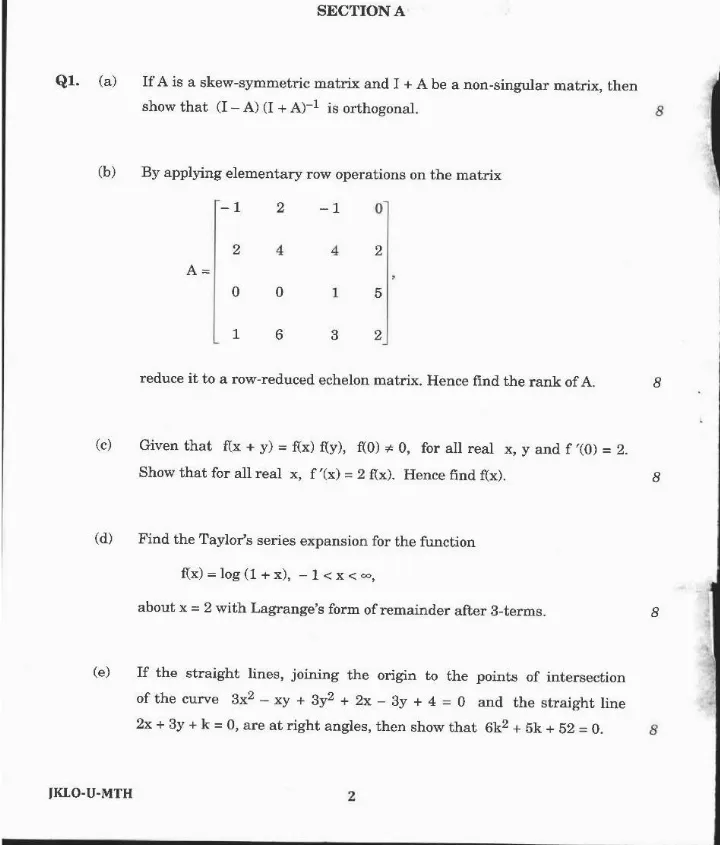
Q1.
(a) If A is a skew-symmetric matrix and I + A be a non-singular matrix, then show that (I - A) (I + A)^{-1} is orthogonal.
(b) By applying elementary row operations on the matrix
A = \beginbmatrix -1 & 2 & -1 & 0 \ 2 & 4 & 4 & 2 \ 0 & 0 & 1 & 5 \ 1 & 6 & 3 & 2 \endbmatrix,reduce it to a row-reduced echelon matrix. Hence find the rank of A.
(c) Given that f(x + y) = f(x) f(y), f(0) ≠ 0, for all real x, y and f'(0) = 2. Show that for all real x, f'(x) = 2 f(x). Hence find f(x).
(d) Find the Taylor's series expansion for the function f(x) = log (1 + x), -1 < x < ∞, about x = 2 with Lagrange's form of remainder after 3-terms.
(e) If the straight lines, joining the origin to the points of intersection of the curve 3x2 - xy + 3y2 + 2x - 3y + 4 = 0 and the straight line 2x + 3y + k = 0, are at right angles, then show that 6k2 + 5k + 52 = 0.