Indian Forest Service 2020 Chemistry Paper-I Question Paper PDF

Central Government Jobs Other Jobs 2020

  • Year 2020
  • Conducted By UPSC
  • Questions 8
  • Maximum Marks 200
  • Duration Three Hours
  • Languages English

Exam Details

Detail Information
Examination Indian Forest Service (Main) Examination
Year 2020
Conducting Body UPSC
Paper Chemistry Paper-I
Subject Chemistry
Duration Three Hours
Maximum Marks 200
Number of Questions 8
Question Type Mixed

This is the Chemistry Paper-I for the Indian Forest Service (Main) Examination 2020, conducted by UPSC. The paper is designed to test candidates' in-depth knowledge of Chemistry, with a total of 8 questions, of which 5 are to be attempted. Compulsory questions are 1 and 5, and candidates must select at least one from each of the two sections (A and B) from the remaining six. The exam duration is three hours, with a maximum of 200 marks. This paper is crucial for aspirants aiming for the Indian Forest Service.

Major Topics Covered

  • Spontaneous Process
  • Crystallization
  • Heat Transfer
  • Molecular Orbital Theory
  • Crystal Structure
  • Lattice Parameter
  • Liquid Junction Potential
  • Phase Diagram
  • Mean Free Path
  • Particle in a Box
  • Electrokinetic Phenomena
  • Thermodynamics
  • Density
  • Enthalpy Change

Why This Paper is Important

  • Useful for Indian Forest Service (Main) Examination preparation
  • Helps understand the latest exam pattern
  • Useful for practice and self-assessment
  • Covers frequently asked General Studies topics
  • Helpful for analysing question trends

Related Resources

  • Indian Forest Service (Main) Examination 2020 Chemistry Paper-II
  • Indian Forest Service (Main) Examination 2019 Chemistry Paper-I
  • Indian Forest Service (Main) Examination 2020 General Studies Paper-I
  • Indian Forest Service (Main) Examination 2020 Chemistry Paper-I Answer Key
  • Indian Forest Service (Main) Chemistry Syllabus
  • UPSC Main Exam Syllabus
  • Indian Forest Service (Main) Exam Pattern
  • UPSC Exam Pattern

Instructions

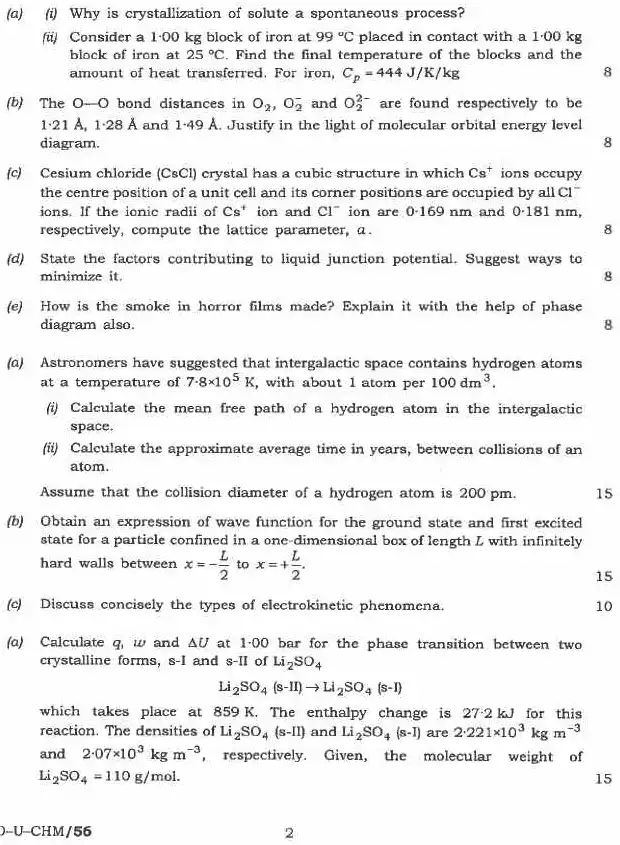
  • There are EIGHT questions in all, out of which FIVE are to be attempted.
  • Out of the remaining SIX questions, THREE are to be attempted selecting at least ONE question from each of the two Sections A and B.
  • The number of marks carried by a question/part is indicated against it.
  • Unless otherwise mentioned, symbols and notations have their usual standard meanings.
  • Assume suitable data, if necessary and indicate the same clearly.
  • Neat sketches may be drawn, wherever required.
  • Attempts of questions shall be counted in sequential order.
  • Unless struck off, attempt of a question shall be counted even if attempted partly.
  • Any page or portion of the page left blank in the Question-cum-Answer Booklet must be clearly struck off.
  • Answers must be written in ENGLISH only. h = 6.626 \times 10^{-34} J s k_{\rm B} = 1.38 \times 10^{-23} J K-1 R = 8.314 \text{ J K}^{-1} \text{ mol}^{-1} \pi = 3.14 c = 3 \times 10^8 m s-1 F = 96500 C mol-1 N_A = 6.023 \times 10^{23} mol-1 1 atm = 101325 Pa m_e = 9.1 \times 10^{-31} kg

Questions (page 2)

Section A

Q1.

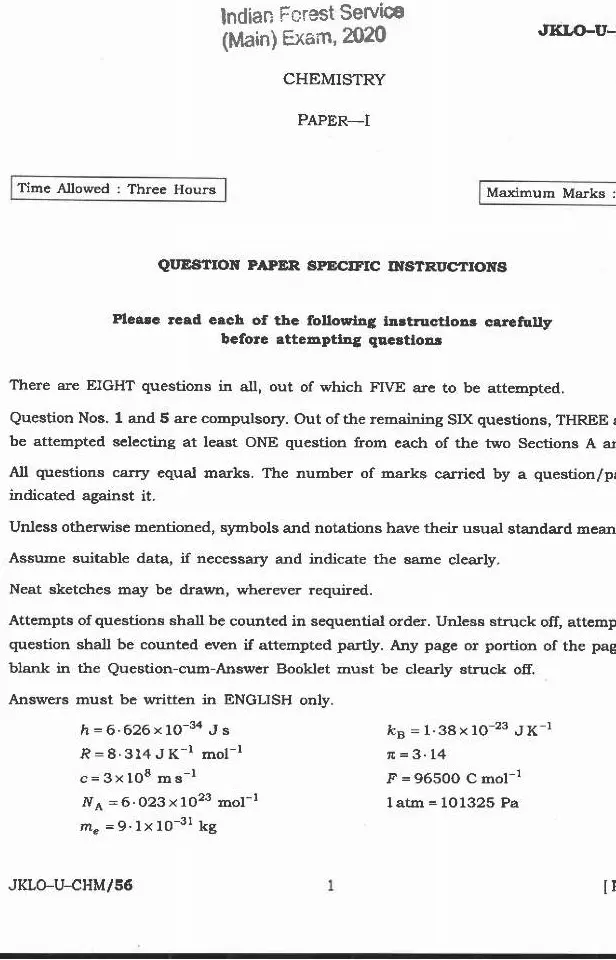
(a) Why is crystallization of solute a spontaneous process?

(a) Consider a 1.00 kg block of iron at 99 °C placed in contact with a 1.00 kg block of iron at 25 °C. Find the final temperature of the blocks and the amount of heat transferred. For iron, Cp = 444 \text J/K/kg

(b) The O-O bond distances in O2, O2^- and O2^{2-} are found respectively to be 1.21 Å, 1.28 Å and 1.49 Å. Justify in the light of molecular orbital energy level diagram.

(c) Cesium chloride (CsCl) crystal has a cubic structure in which Cs^+ ions occupy the centre position of a unit cell and its corner positions are occupied by all Cl^- ions. If the ionic radii of Cs^+ ion and Cl^- ion are 0.169 nm and 0.181 nm, respectively, compute the lattice parameter, a.

(d) State the factors contributing to liquid junction potential. Suggest ways to minimize it.

(e) How is the smoke in horror films made? Explain it with the help of phase diagram also.
Section A

Q2.

(a) Astronomers have suggested that intergalactic space contains hydrogen atoms at a temperature of 7.8 × 10⁵ K, with about 1 atom per 100 dm3. (i) Calculate the mean free path of a hydrogen atom in the intergalactic space. (ii) Calculate the approximate average time in years, between collisions of an atom. Assume that the collision diameter of a hydrogen atom is 200 pm.

(b) Obtain an expression of wave function for the ground state and first excited state for a particle confined in a one-dimensional box of length L with infinitely hard walls between x = -(L)/(2) to x = + (L)/(2).

(c) Discuss concisely the types of electrokinetic phenomena.

Section A

Q3.

(a) Calculate q, w and \Delta U at 1.00 bar for the phase transition between two crystalline forms, s-I and s-II of Li2SO4 Li2SO4 (s-II) → Li2SO4 (s-I) which takes place at 859 K. The enthalpy change is 27.2 kJ for this reaction. The densities of Li2SO4 (s-II) and Li2SO4 (s-I) are 2.221× 10³ kg m-3 and 2.07 × 10³ kg m-3, respectively. Given, the molecular weight of Li2SO4 = 110 g/mol.

Question paper preview

Scanned pages 1–2 for reference. Download the official PDF for the full paper.

Page 1
Indian Forest Service 2020 Chemistry Paper-I question paper page 1 instructions scan PDF download UPSC IFS Main Exam
Page 2
Indian Forest Service 2020 Chemistry Paper-I question paper page 1 instructions scan PDF download UPSC IFS Main Exam

Free question paper download

Download question paper PDF

  • 341 KB
  • 6 pages
  • PDF format

Frequently asked questions

What is the full name of the exam?

The full name of the exam is the Indian Forest Service (Main) Examination.

Which examination board conducts this exam?

The Union Public Service Commission (UPSC) conducts this examination.

What is the year of this question paper?

This question paper is from the 2020 examination.

What is the subject of this paper?

This paper is for Chemistry, specifically Paper-I.

What is the paper code?

The paper code is JKLO-U-CHM.

What is the total duration allowed for the exam?

The time allowed for this paper is Three Hours.

← Back to Other Jobs papers