IFS Exam 2016 Chemical Engineering Paper I Question Paper PDF

Central Government Jobs Engineer 2016

  • Year 2016
  • Conducted By UPSC
  • Questions 8
  • Maximum Marks 200
  • Duration Three Hours
  • Languages English

Exam Details

Detail Information
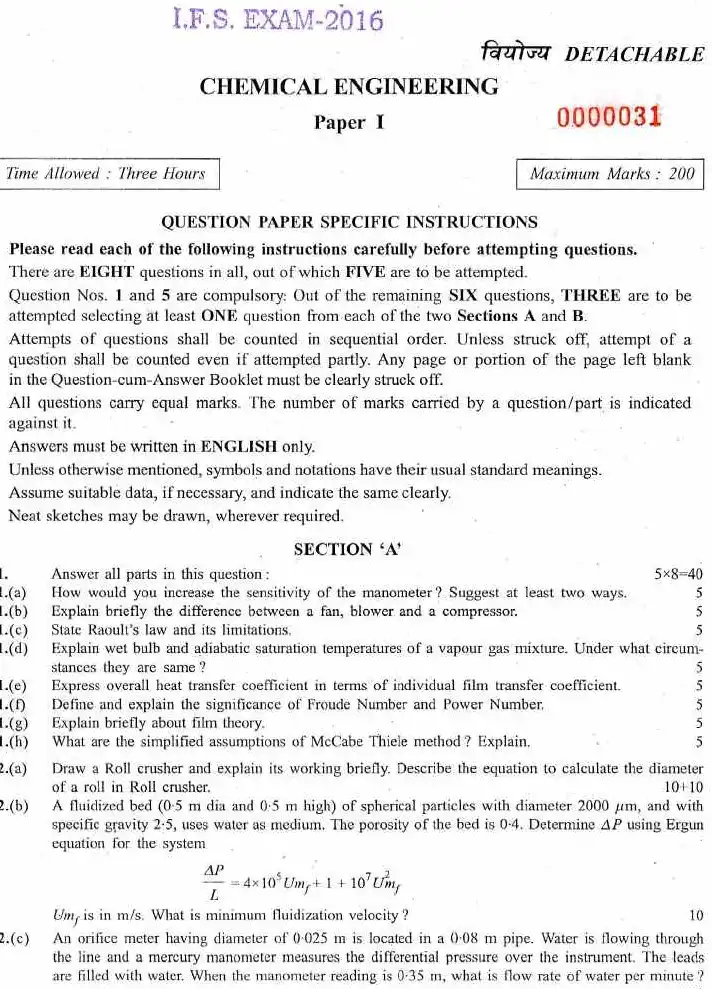
Examination I.F.S. EXAM
Year 2016
Conducting Body UPSC
Paper CHEMICAL ENGINEERING Paper I
Subject Chemical Engineering
Duration Three Hours
Maximum Marks 200
Number of Questions 8
Question Type Mixed

This is the question paper for the Indian Forest Service (IFS) Examination 2016, specifically Paper I for Chemical Engineering. Conducted by UPSC, this paper carries a maximum of 200 marks and is allocated a time duration of three hours. It comprises a mix of objective and descriptive questions, designed to test the in-depth knowledge of Chemical Engineering principles. Aspirants can use this paper to understand the exam pattern, marking scheme, and the types of questions asked, which is crucial for effective preparation.

Major Topics Covered

  • Manometer Sensitivity
  • Fan, Blower, Compressor
  • Raoult's Law
  • Wet Bulb Temperature
  • Adiabatic Saturation Temperature
  • Overall Heat Transfer Coefficient
  • Froude Number
  • Power Number
  • Film Theory
  • McCabe Thiele Method
  • Roll Crusher
  • Fluidized Bed
  • Ergun Equation
  • Orifice Meter
  • Solvent Selection in Absorption
  • Drying of Solids
  • Ammonia Stripping
  • Sieve Trays
  • Heat Load Calculation
  • Evaporator Design
  • Temperature Measuring Instruments
  • Stability Criteria
  • Routh Test
  • Liquid Membrane Process
  • Pervaporation
  • Crossover Frequency
  • Transportation Lag
  • Reverse Osmosis
  • Ultra Filtration
  • Electro-Dialysis
  • Dialysis Operation
  • Hollow-Fibre Permeate
  • Storage Vessels
  • Hydrochloric Acid Handling
  • Head Design (Flat and Elliptical)
  • Spherical Process Vessel Design
  • PID Control Action
  • Bode Diagram
  • Gain and Phase Angle Calculation

Why This Paper is Important

  • Useful for I.F.S. EXAM preparation
  • Helps understand the latest exam pattern
  • Useful for practice and self-assessment
  • Covers frequently asked General Studies topics
  • Helpful for analysing question trends

Related Resources

  • IFS Exam 2015 Chemical Engineering Paper I
  • IFS Exam 2017 Chemical Engineering Paper I
  • UPSC ESE 2016 Chemical Engineering Paper I
  • IFS Exam 2016 Chemical Engineering Paper I Answer Key
  • IFS Chemical Engineering Syllabus
  • UPSC Chemical Engineering Syllabus
  • IFS Exam Pattern
  • UPSC Exam Pattern

Instructions

  • There are EIGHT questions in all, out of which FIVE are to be attempted.
  • Question Nos. 1 and 5 are compulsory.
  • Out of the remaining SIX questions, THREE are to be attempted selecting at least ONE question from each of the two Sections A and B.
  • Attempts of questions shall be counted in sequential order.
  • Unless struck off, attempt of a question shall be counted even if attempted partly.
  • Any page or portion of the page left blank in the Question-cum-Answer Booklet must be clearly struck off.
  • All questions carry equal marks.
  • The number of marks carried by a question/part is indicated against it.
  • Answers must be written in ENGLISH only.
  • Unless otherwise mentioned, symbols and notations have their usual standard meanings.
  • Assume suitable data, if necessary, and indicate the same clearly.
  • Neat sketches may be drawn, wherever required.

Questions (page 2)

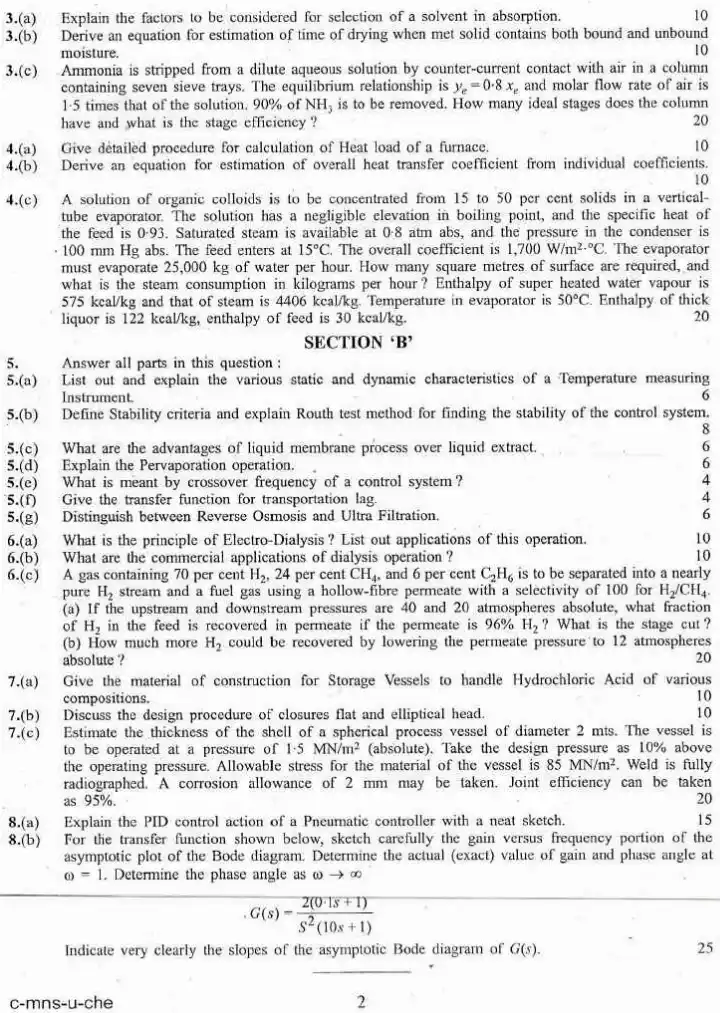
Q3.

(a) Explain the factors to be considered for selection of a solvent in absorption.

(b) Derive an equation for estimation of time of drying when met solid contains both bound and unbound moisture.

(c) Ammonia is stripped from a dilute aqueous solution by counter-current contact with air in a column containing seven sieve trays. The equilibrium relationship is ye = 0.8 xe and molar flow rate of air is 1.5 times that of the solution. 90% of NH3 is to be removed. How many ideal stages does the column have and what is the stage efficiency?

Q4.

(a) Give detailed procedure for calculation of Heat load of a furnace.

(b) Derive an equation for estimation of overall heat transfer coefficient from individual coefficients.

(c) A solution of organic colloids is to be concentrated from 15 to 50 per cent solids in a vertical-tube evaporator. The solution has a negligible elevation in boiling point, and the specific heat of the feed is 0.93. Saturated steam is available at 0.8 atm abs, and the pressure in the condenser is 100 mm Hg abs. The feed enters at 15°C. The overall coefficient is 1,700 W/m^2.oC. The evaporator must evaporate 25,000 kg of water per hour. How many square metres of surface are required, and what is the steam consumption in kilograms per hour? Enthalpy of super heated water vapour is 575 kcal/kg and that of steam is 4406 kcal/kg. Temperature in evaporator is 50°C. Enthalpy of thick liquor is 122 kcal/kg, enthalpy of feed is 30 kcal/kg.

Section B

Q5. Answer all parts in this question :

(a) List out and explain the various static and dynamic characteristics of a Temperature measuring Instrument.

(b) Define Stability criteria and explain Routh test method for finding the stability of the control system.

(c) What are the advantages of liquid membrane process over liquid extract.

(d) Explain the Pervaporation operation.

(e) What is meant by crossover frequency of a control system?

(f) Give the transfer function for transportation lag.

(g) Distinguish between Reverse Osmosis and Ultra Filtration.

Q6.

(a) What is the principle of Electro-Dialysis? List out applications of this operation.

(b) What are the commercial applications of dialysis operation?

(c) A gas containing 70 per cent H2, 24 per cent CH4, and 6 per cent C2H6 is to be separated into a nearly pure H2 stream and a fuel gas using a hollow-fibre permeate with a selectivity of 100 for H2/CH_4. (a) If the upstream and downstream pressures are 40 and 20 atmospheres absolute, what fraction of H2 in the feed is recovered in permeate if the permeate is 96% H2? What is the stage cut? (b) How much more H2 could be recovered by lowering the permeate pressure to 12 atmospheres absolute?

Q7.

(a) Give the material of construction for Storage Vessels to handle Hydrochloric Acid of various compositions.

(b) Discuss the design procedure of closures flat and elliptical head.

(c) Estimate the thickness of the shell of a spherical process vessel of diameter 2 mts. The vessel is to be operated at a pressure of 1.5 MN/m^2 (absolute). Take the design pressure as 10% above the operating pressure. Allowable stress for the material of the vessel is 85 MN/m^2. Weld is fully radiographed. A corrosion allowance of 2 mm may be taken. Joint efficiency can be taken as 95%.

Q8.

(a) Explain the PID control action of a Pneumatic controller with a neat sketch.

(b) For the transfer function shown below, sketch carefully the gain versus frequency portion of the asymptotic plot of the Bode diagram. Determine the actual (exact) value of gain and phase angle at omega = 1. Determine the phase angle as omega ightarrow infty G(s) = rac{2(0.1s + 1)}{S2(10s + 1)}
Indicate very clearly the slopes of the asymptotic Bode diagram of G(s).

Question paper preview

Scanned pages 1–2 for reference. Download the official PDF for the full paper.

Page 1
IFS I 2016 Chemical Engineering Paper I question paper page 1 instructions scan PDF download UPSC
Page 2
IFS I 2016 Chemical Engineering Paper I question paper page 1 instructions scan PDF download UPSC

Free question paper download

Download question paper PDF

  • 1.5 MB
  • 2 pages
  • PDF format

Frequently asked questions

What is the name of the exam?

The exam is the I.F.S. EXAM-2016.

Which paper is this question paper for?

This is for CHEMICAL ENGINEERING Paper I.

Who conducts the IFS Exam?

The IFS Exam is conducted by UPSC.

What is the maximum marks for this paper?

The maximum marks for CHEMICAL ENGINEERING Paper I is 200.

What is the time allowed for this paper?

The time allowed is Three Hours.

What is the subject of this paper?

The subject is Chemical Engineering.

← Back to Engineer papers