Section A
Q1.
(a) Explain source coding. A discrete message source emits seven symbols {m1, m2, m3, dots, m7} with probabilities {0.35, 0.3, 0.2, 0.1, 0.04, 0.005, 0.005} respectively. Give Hulfman codes for these symbols and calculate average bits of information and average binary digits of information per symbol. Calculate code efficiency.
(b) (i) With the help of proper block diagram explain the basic elements of PCM system.
(ii) An Analog voltage signal whose highest significant frequency is 4 KHz is to be digitally encoded with a resolution of 0.01% covering the voltage range of 0-10V using PCM. In order to avoid loss in information and to maintain given resolution determine (A) Minimum sampling rate (B) Number of bits needed for encoded PCM.
(c) A unity negative feedback control system has an open-loop transfer function consisting of two poles, two zeros and a variable gain K. The zeros are located at -2 and -1; and the poles at -0.1 and +1. Using Routh's stability criterion, determine the range of values of K for which the closed-loop system has 0, 1 or 2 poles in the right-half s-plane.
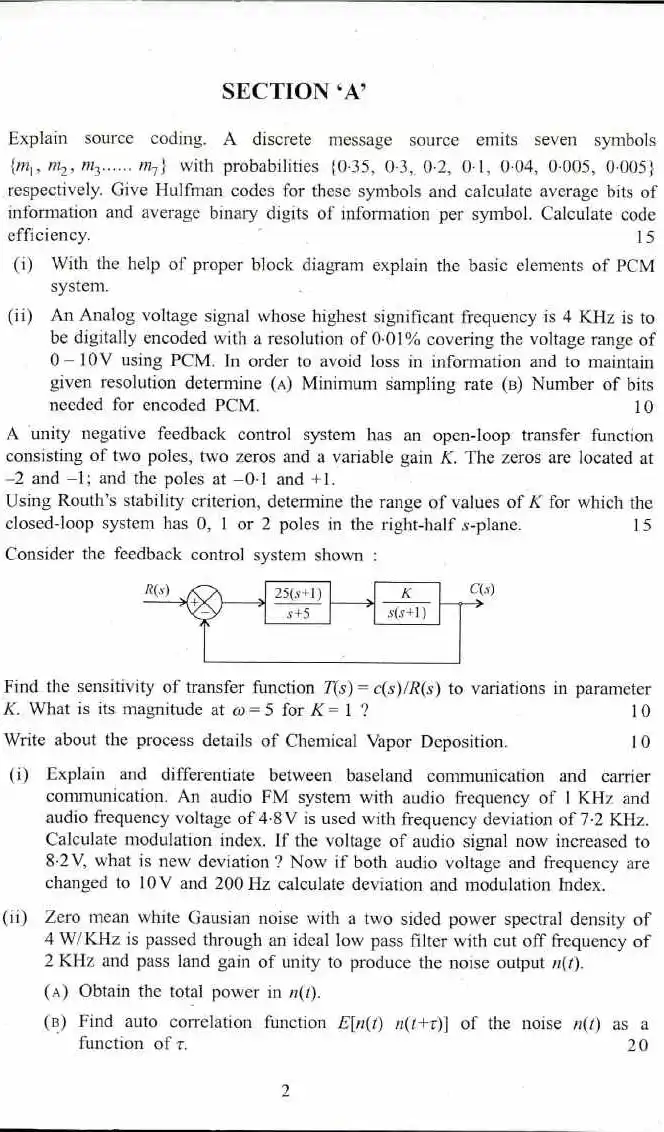
(d) Consider the feedback control system shown : Find the sensitivity of transfer function T(s) = c(s)/R(s) to variations in parameter K. What is its magnitude at omega = 5 for K = 1 ?
(e) Write about the process details of Chemical Vapor Deposition.