Q1.
(a) SECTION-A A refrigerator machine uses R-12 as the working fluid. The temperature of 1. R-12 in the evaporator coil is -5 \degreeC, and the gas leaves the compressor as dry saturated at a temperature of 40 °C. The mean specific heat of liquid R-12 between the above temperatures is 0.963 kJ/kg K. The enthalpy of evaporation at 40 °C is 203.2 kJ/kg. Neglecting losses, find the COP.
(b) Compare the knocking phenomena in SI and CI engines. Explain clearly the factors which tend to prevent knock in SI engines in fact promote knock in CI engines.
(c) A laboratory wind tunnel has a test section that is 305 mm square. Boundary layer velocity profiles are measured at two cross-sections and displacement thicknesses are evaluated from the measured profiles. At section 1, where the free stream speed is u1 = 26 m/s, the displacement thickness is δ_1^* = 1.5 mm. At section 2, the displacement thickness is δ_2^* = 2 \cdot 1 mm. Calculate the change in static pressure between sections 1 and 2 as a fraction of the free stream dynamic pressure at section 1.
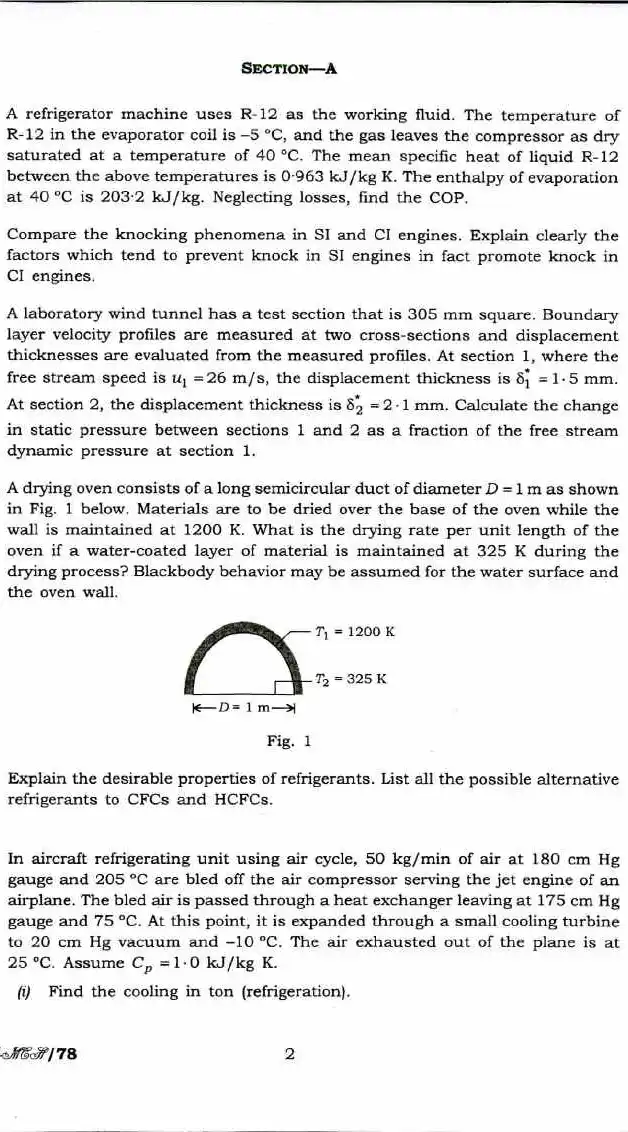
(d) A drying oven consists of a long semicircular duct of diameter D = 1 m as shown in Fig. 1 below. Materials are to be dried over the base of the oven while the wall is maintained at 1200 K. What is the drying rate per unit length of the oven if a water-coated layer of material is maintained at 325 K during the drying process? Blackbody behavior may be assumed for the water surface and the oven wall.
(e) T1 = 1200 K T2 = 325 K \n Q = 1 m → Fig. 1 Explain the desirable properties of refrigerants. List all the possible alternative refrigerants to CFCs and HCFCs. In aircraft refrigerating unit using air cycle, 50 kg/min of air at 180 cm Hg