
IFS 2017 Chemical Engineering Paper II (Paper II) – 200 Marks
- Year 2017
- Questions 8
- Maximum Marks 200
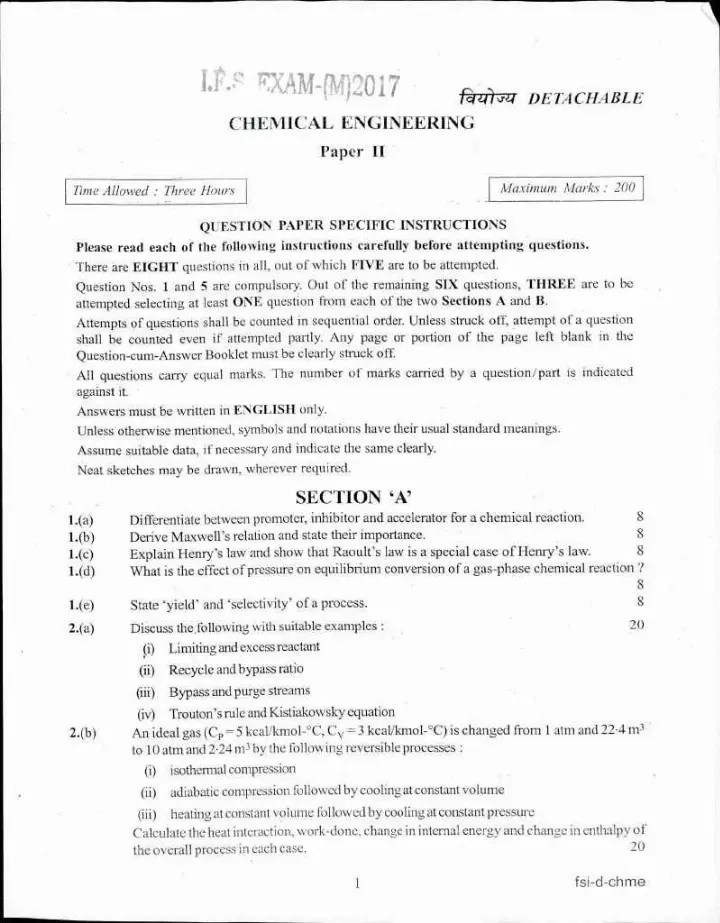
- Duration Three Hours Question Paper Specific Instructions Please Read Each Of The Following Instructions Carefully Before Attempting Questions. There Are Eight Questions In All, Out Of Which Five Are To Be Attempted. Question Nos. 1 And 5 Are Compulsory. Out Of The Remaining Six Questions, Three Are To Be Attempted Selecting At Least One Question From Each Of The Two Sections A And B. Attempts Of Questions Shall Be Counted In Sequential Order. Unless Struck Off, Attempt Of A Question Shall Be Counted Even If Attempted Partly. Any Page Or Portion Of The Page Left Blank In The Question-cum-answer Booklet Must Be Clearly Struck Off. All Questions Carry Equal Marks. The Number Of Marks Carried By A Question/part Is Indicated Against It. Answers Must Be Written In English Only. Unless Otherwise Mentioned, Symbols And Notations Have Their Usual Standard Meanings. Assume Suitable Data, If Necessary And Indicate The Same Clearly. Neat Sketches May Be Drawn, Wherever Required. Section 'a' Differentiate Between Promoter, Inhibitor And Accelerator For A Chemical Reaction. 8 1.(a) Derive Maxwell's Relation And State Their Importance. 8 1.(b) Explain Henry's Law And Show That Raoult's Law Is A Special Case Of Henry's Law. 8 1.(c) What Is The Effect Of Pressure On Equilibrium Conversion Of A Gas-phase Chemical Reaction? 1.(d) 8 State 'yield' And 'selectivity' Of A Process. 8 1.(e) Discuss The Following With Suitable Examples : 20 2.(a) Limiting And Excess Reactant
- Languages Hindi & English
Exam Details
| Detail | Information |
|---|---|
| Examination | I.F.S Exam (Main) 2017 |
| Year | 2017 |
| Paper | Chemical Engineering |
| Subject | Chemical Engineering |
| Duration | Three Hours Question Paper Specific Instructions Please Read Each Of The Following Instructions Carefully Before Attempting Questions. There Are Eight Questions In All, Out Of Which Five Are To Be Attempted. Question Nos. 1 And 5 Are Compulsory. Out Of The Remaining Six Questions, Three Are To Be Attempted Selecting At Least One Question From Each Of The Two Sections A And B. Attempts Of Questions Shall Be Counted In Sequential Order. Unless Struck Off, Attempt Of A Question Shall Be Counted Even If Attempted Partly. Any Page Or Portion Of The Page Left Blank In The Question-cum-answer Booklet Must Be Clearly Struck Off. All Questions Carry Equal Marks. The Number Of Marks Carried By A Question/part Is Indicated Against It. Answers Must Be Written In English Only. Unless Otherwise Mentioned, Symbols And Notations Have Their Usual Standard Meanings. Assume Suitable Data, If Necessary And Indicate The Same Clearly. Neat Sketches May Be Drawn, Wherever Required. Section 'a' Differentiate Between Promoter, Inhibitor And Accelerator For A Chemical Reaction. 8 1.(a) Derive Maxwell's Relation And State Their Importance. 8 1.(b) Explain Henry's Law And Show That Raoult's Law Is A Special Case Of Henry's Law. 8 1.(c) What Is The Effect Of Pressure On Equilibrium Conversion Of A Gas-phase Chemical Reaction? 1.(d) 8 State 'yield' And 'selectivity' Of A Process. 8 1.(e) Discuss The Following With Suitable Examples : 20 2.(a) Limiting And Excess Reactant |
| Maximum Marks | 200 |
| Number of Questions | 8 |
| Question Type | Mixed: descriptive and objective-style |
This JSON aggregates the IFS 2017 Chemical Engineering Paper II content from Page 1 and Page 2 OCR. It repairs OCR artifacts to present section A and B questions with sub-parts (a–e) and numbered items (2., 3., 4., 5., 6., 7., 8.) across both pages. It includes descriptive prompts on foundational topics (Maxwell relations, Henry's law, Raoult's law, yield vs. selectivity), reactor design (CSTR), phase equilibria (VLE, fugacity, activity, chemical potential), process economics (discounted cash flow, break-even, depreciation methods), and safety/industrial topics (HAZOP, ozone layer, biodiesel via transesterification, dispersion of starch in LDPE, Portland cement), as well as the requested SEO components. This previous year Indian Forest Service (Main) Examination question paper (2017) is useful for Engineer aspirants preparing for Central government recruitment. The paper was conducted by UPSC and reflects the official exam pattern, marking scheme and difficulty level seen in recent cycles. Use it for timed practice, topic-wise revision and understanding how questions are framed in the real examination. Download the free PDF on QuizCurrent to read instructions, attempt MCQs and compare your answers with the study notes provided on this page. Key syllabus areas include Maxwell's relations, Henry's law, Raoult's law, Yield and selectivity, Gas-phase equilibrium, Reactor design, CSTR design, VLE criteria. Useful for I.F.S Exam (Main) 2017 preparation. Helps understand the latest exam pattern. Useful for practice and self-assessment.
Major Topics Covered
- Maxwell's relations
- Henry's law
- Raoult's law
- Yield and selectivity
- Gas-phase equilibrium
- Reactor design
- CSTR design
- VLE criteria
- Fugacity
- Activity
- Chemical potential
- Ozone layer depletion
- Break-even point analysis
- Adiabatic lapse rate
- Pollutant dispersion
- Biodiesel production
- Heterogeneous transesterification
- Electrostatic precipitator
- HAZOP
- Portland cement (wet process)
Why This Paper is Important
- Useful for I.F.S Exam (Main) 2017 preparation
- Helps understand the latest exam pattern
- Useful for practice and self-assessment
- Covers frequently asked General Studies topics
- Helpful for analysing question trends
Related Resources
- Indian Forest Service 2025 Mechanical Engineering Paper I Question Paper PDF
- Indian Forest Service Civil Engineering Paper II 2025 Question Paper PDF
- Indian Forest Service 2025 Chemical Engineering Paper II Question Paper PDF
- IFS 2025 Chemical Engg Paper-I - Paper Details
- Indian Forest Service 2025 Agricultural Engineering Paper I Question Paper PDF
Instructions
- I.F.S EXAM-(M)2017 वियोज्य DETACHABLE CHEMICAL ENGINEERING Paper II Maximum Marks: 200
- There are EIGHT questions in all, out of which FIVE are to be attempted.
- Out of the remaining SIX questions, THREE are to be attempted selecting at least ONE question from each of the two Sections A and B.
- Attempts of questions shall be counted in sequential order.
- Unless struck off, attempt of a question shall be counted even if attempted partly.
- Any page or portion of the page left blank in the Question-cum-Answer Booklet must be clearly struck off.
- The number of marks carried by a question/part is indicated against it.
- Answers must be written in ENGLISH only.
- Unless otherwise mentioned, symbols and notations have their usual standard meanings.
- Assume suitable data, if necessary and indicate the same clearly.
- Neat sketches may be drawn, wherever required.
Questions (page 2)
Q2. 1.(b) Explain Henry's law and show that Raoult's law is a special case of Henry's law.
Q3. 1.
(c) What is the effect of pressure on equilibrium conversion of a gas-phase chemical reaction?
Q4. 1.(d) State 'yield' and 'selectivity' of a process.
Q5. 1.(e) Discuss the following with suitable examples :
Q6. 2.(a) Limiting and excess reactant
(i) Recycle and bypass ratio
(ii) Bypass and purge streams
(iii) Trouton's rule and Kistiakowsky equation
(iv) An ideal gas (Cp = 5 kcal/kmol-K, Cv = 3 kcal/kmol-K) is changed from 1 atm and 22.4 m3 to 10 atm and 2.24 m3.
Q7. 2.(b) The following reversible processes: isothermal compression
(i) ; adiabatic compression followed by cooling at constant volume
(ii) ; heating at constant volume followed by cooling at constant pressure
(iii) . Calculate the heat interaction, work-done, change in internal energy and change in enthalpy of the overall process in each case.
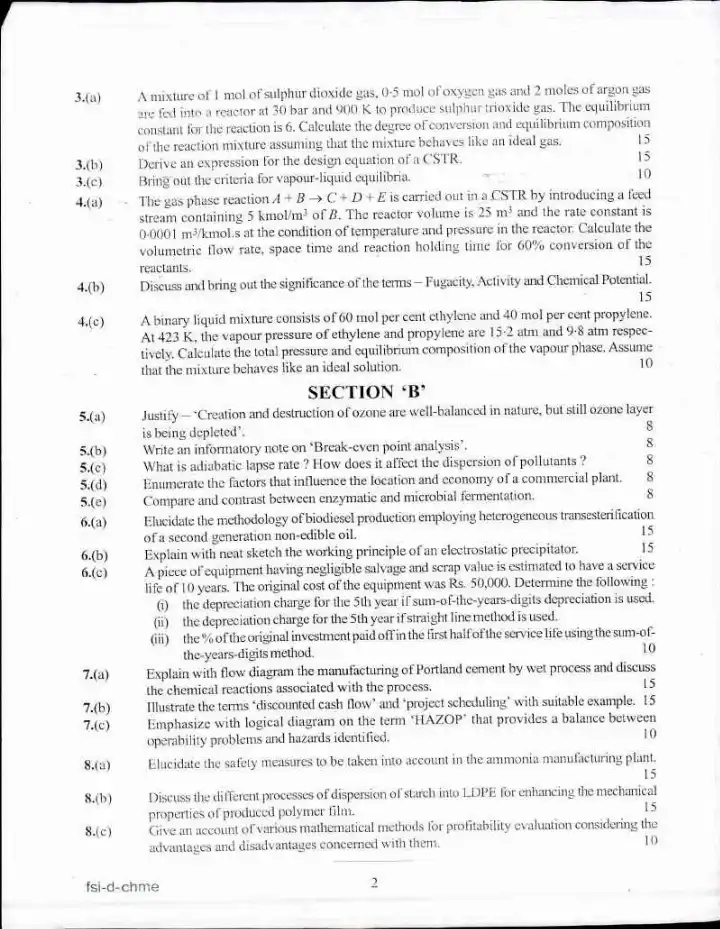
Q8. 3.(a) A mixture of 1 mol of sulphur dioxide gas, 0.5 mol of oxygen gas and 2 moles of argon gas are fed into a reactor at 30 bar and 900 K to produce sulphur trioxide gas. The equilibrium constant for the reaction is 6. Calculate the degree of conversion and equilibrium composition of the reaction mixture assuming that the mixture behaves like an ideal gas.
Q9. 3.(b) Derive an expression for the design equation of a CSTR.
Q10. 3.
(c) The gas phase reaction A + B → C + D + E is carried out in a CSTR by introducing a feed stream containing 5 kmol/m^3 of B. The reactor volume is 25 m3 and the rate constant is 0.0001 m3/kmol·s at the condition of temperature and pressure in the reactor. Calculate the volumetric flow rate, space time and reaction holding time for 60% conversion of the reactants. Discuss the significance of the terms - Fugacity, Activity and Chemical Potential.
Q11. 4.(a) A binary liquid mixture consists of 60 mol per cent ethylene and 40 mol per cent propylene.
Q12. 4.(b) At 423 K, the vapour pressure of ethylene and propylene are 15.2 atm and 9.8 atm respectively. Calculate the total pressure and equilibrium composition of the vapour phase. Assume that the mixture behaves like an ideal solution.
Question paper preview
Scanned pages 1–2 for reference. Download the official PDF for the full paper.
Free question paper download
Download question paper PDF
Your download starts in 10s
Preparing your question paper file…
Frequently asked questions
What is the exam and year for this paper?
Indian Forest Service (Main) Examination, Chemical Engineering Paper II, 2017.
How many questions are in the paper and how many must be attempted?
There are eight questions in total; five must be attempted. Question Nos. 1 and 5 are compulsory; at least one question from Section A and one from Section B must be attempted.
In which languages is the paper available or answered?
The paper content includes Hindi and English text, but answers are written in English.
What is the maximum marks and duration?
Maximum marks are 200; duration is three hours.
What subjects or topics are covered in this paper?
Topics include Maxwell's relations, Henry's law, Raoult's law, gas-phase equilibrium, yield vs. selectivity, CSTR design, fugacity/activity/chemical potential, ozone depletion, break-even analysis, adiabatic lapse rate, biodiesel via heterogeneous transesterification, HAZOP, polymer dispersion, Portland cement, etc.
Are there any objective-type questions in this paper?
The OCR contains a section labeled objective_questions_preview, but the actual questions are presented in descriptive form; the document is a mix of descriptive and problem-type items.