UPSC Civil Services Mechanical Engineering Paper II 2025 Question Paper PDF

Central Government Jobs Engineer 2025

  • Year 2025
  • Conducted By UPSC
  • Questions 8
  • Maximum Marks 250
  • Duration Three Hours
  • Languages Hindi & English

Exam Details

Detail Information
Examination Civil Services (Main) Examination
Year 2025
Conducting Body UPSC
Paper Mechanical Engineering Paper - II
Subject Mechanical Engineering
Duration Three Hours
Maximum Marks 250
Number of Questions 8
Question Type Descriptive / Subjective

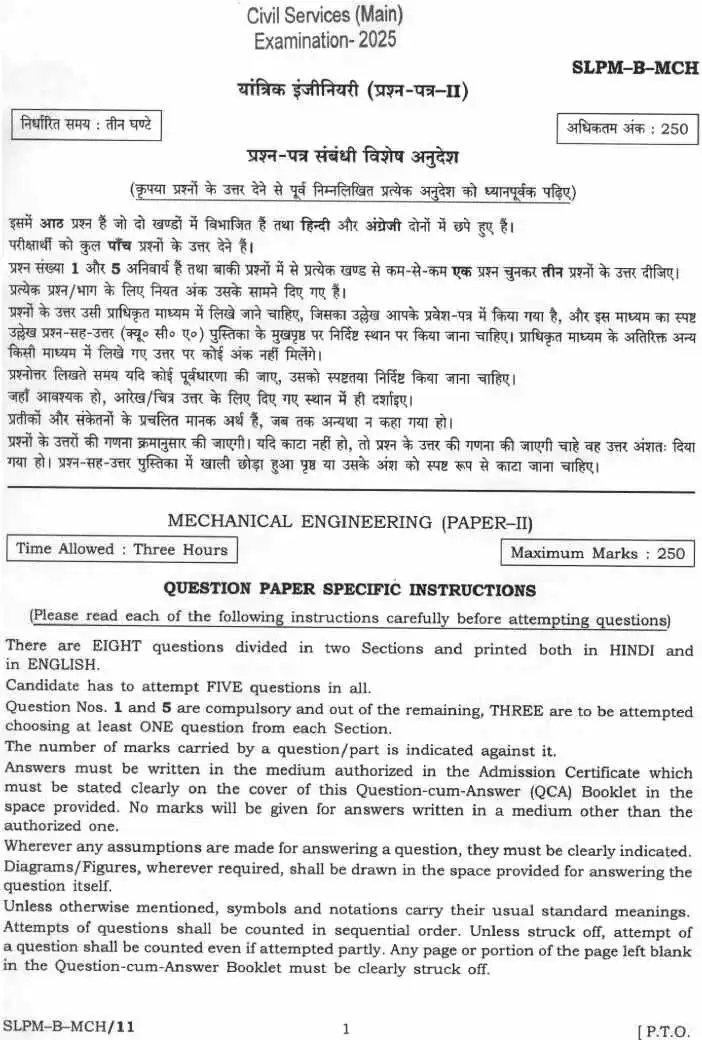
This is the Mechanical Engineering Paper II for the Civil Services (Main) Examination 2025, conducted by UPSC. The paper is designed to assess candidates' in-depth knowledge in Mechanical Engineering. It consists of eight questions divided into two sections, with candidates required to answer five questions in total. Questions 1 and 5 are compulsory, and at least one question must be attempted from each section. The exam duration is three hours, and the maximum marks are 250. This paper is crucial for aspirants aiming to secure a position in the Civil Services.

Major Topics Covered

  • Mechanical Engineering
  • Thermodynamics
  • Fluid Mechanics
  • Shock Waves
  • Heat Transfer
  • Entropy

Why This Paper is Important

  • Useful for Civil Services (Main) Examination preparation
  • Helps understand the latest exam pattern
  • Useful for practice and self-assessment
  • Covers frequently asked General Studies topics
  • Helpful for analysing question trends

Related Resources

  • Civil Services (Main) Examination 2024 Mechanical Engineering Paper II
  • Civil Services (Main) Examination 2025 Mechanical Engineering Paper I
  • IES Mechanical Engineering Paper II Previous Year Papers
  • Civil Services (Main) Examination 2025 Mechanical Engineering Paper II Answer Key
  • Civil Services (Main) Examination Mechanical Engineering Syllabus
  • Mechanical Engineering Thermodynamics Syllabus
  • Mechanical Engineering Fluid Mechanics Syllabus
  • Civil Services (Main) Examination Pattern

Instructions

  • इसमें आठ प्रश्न हैं जो दो खण्डों में विभाजित हैं तथा हिन्दी और अंग्रेजी दोनों में छपे हुए हैं।
  • परीक्षार्थी को कुल पाँच प्रश्नों के उत्तर देने हैं।
  • प्रश्न संख्या 1 और 5 अनिवार्य हैं तथा बाकी प्रश्नों में से प्रत्येक खण्ड से कम-से-कम एक प्रश्न चुनकर तीन प्रश्नों के उत्तर दीजिए।
  • प्रत्येक प्रश्न/भाग के लिए नियत अंक उसके सामने दिए गए हैं।
  • प्रश्नों के उत्तर उसी प्राधिकृत माध्यम में लिखे जाने चाहिए, जिसका उल्लेख आपके प्रवेश-पत्र में किया गया है, और इस माध्यम का स्पष्ट उल्लेख प्रश्न-सह-उत्तर (क्यू॰ सी॰ ए॰) पुस्तिका के मुखपृष्ठ पर निर्दिष्ट स्थान पर किया जाना चाहिए।
  • प्राधिकृत माध्यम के अतिरिक्त अन्य किसी माध्यम में लिखे गए उत्तर पर कोई अंक नहीं मिलेंगे।
  • प्रश्नोत्तर लिखते समय यदि कोई पूर्वधारणा की जाए, उसको स्पष्टतया निर्दिष्ट किया जाना चाहिए।
  • जहाँ आवश्यक हो, आरेख/चित्र उत्तर के लिए दिए गए स्थान में ही दर्शाइए।
  • प्रतीकों और संकेतनों के प्रचलित मानक अर्थ हैं, जब तक अन्यथा न कहा गया हो।
  • प्रश्नों के उत्तरों की गणना क्रमानुसार की जाएगी।
  • यदि काटा नहीं हो, तो प्रश्न के उत्तर की गणना की जाएगी चाहे वह उत्तर अंशतः दिया गया हो।
  • प्रश्न-सह-उत्तर पुस्तिका में खाली छोड़ा हुआ पृष्ठ या उसके अंश को स्पष्ट रूप से काटा जाना चाहिए।

  • There are EIGHT questions divided in two Sections and printed both in HINDI and in ENGLISH.
  • Candidate has to attempt FIVE questions in all.
  • Question Nos. 1 and 5 are compulsory and out of the remaining, THREE are to be attempted choosing at least ONE question from each Section.
  • The number of marks carried by a question/part is indicated against it.
  • Answers must be written in the medium authorized in the Admission Certificate which must be stated clearly on the cover of this Question-cum-Answer (QCA) Booklet in the space provided.
  • No marks will be given for answers written in a medium other than the authorized one.
  • Wherever any assumptions are made for answering a question, they must be clearly indicated.
  • Diagrams/Figures, wherever required, shall be drawn in the space provided for answering the question itself.
  • Unless otherwise mentioned, symbols and notations carry their usual standard meanings.
  • Attempts of questions shall be counted in sequential order.
  • Unless struck off, attempt of a question shall be counted even if attempted partly.
  • Any page or portion of the page left blank in the Question-cum-Answer Booklet must be clearly struck off.

Questions (page 2)

Section A

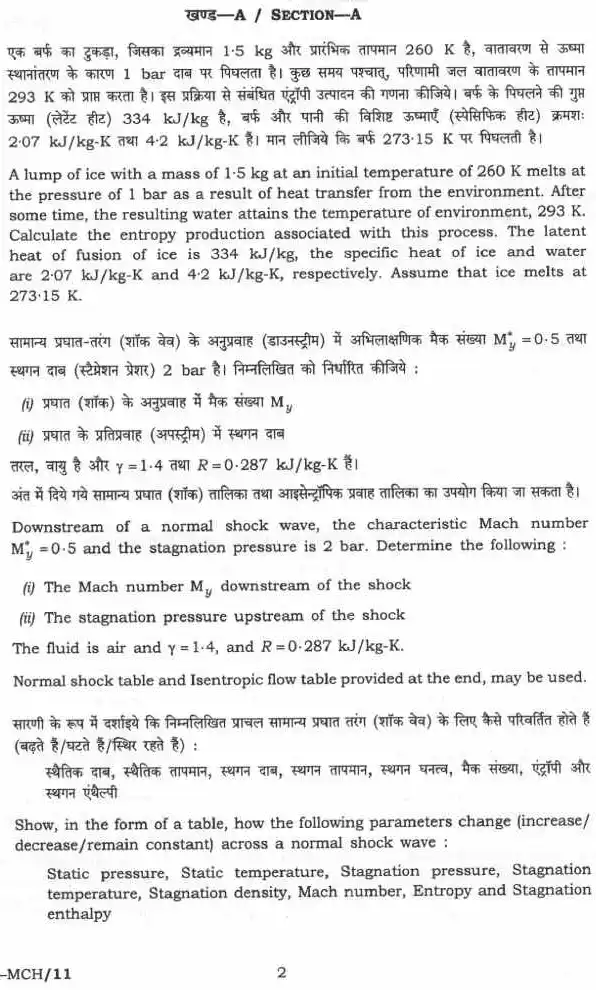
Q1. एक बर्फ का टुकड़ा, जिसका द्रव्यमान 1.5 kg और प्रारंभिक तापमान 260 K है, वातावरण से ऊष्मा स्थानांतरण के कारण 1 bar दाब पर पिघलता है। कुछ समय पश्चात्, परिणामी जल वातावरण के तापमान 293 K को प्राप्त करता है। इस प्रक्रिया से संबंधित एंट्रॉपी उत्पादन की गणना कीजिये। बर्फ के पिघलने की गुप्त ऊष्मा (लेटेंट हीट) 334 kJ/kg है, बर्फ और पानी की विशिष्ट ऊष्माएँ (स्पेसिफिक हीट) क्रमशः 2.07 kJ/kg-K तथा 4.2 kJ/kg-K हैं। मान लीजिये कि बर्फ 273.15 K पर पिघलती है।

(a) A lump of ice with a mass of 1.5 kg at an initial temperature of 260 K melts at the pressure of 1 bar as a result of heat transfer from the environment. After some time, the resulting water attains the temperature of environment, 293 K. Calculate the entropy production associated with this process. The latent heat of fusion of ice is 334 kJ/kg, the specific heat of ice and water are 2.07 kJ/kg-K and 4.2 kJ/kg-K, respectively. Assume that ice melts at 273.15 K.

(b) सामान्य प्रघात-तरंग (शॉक वेव) के अनुप्रवाह (डाउनस्ट्रीम) में अभिलाक्षणिक मैक संख्या \textM^*_y = 0.5 तथा स्थगन दाब (स्टैम्रेशन प्रेशर) 2 bar है। निम्नलिखित को निर्धारित कीजिये :

(i) प्रघात (शॉक) के अनुप्रवाह में मैक संख्या My (ii) प्रघात के प्रतिप्रवाह (अपस्ट्रीम) में स्थगन दाब तरल, वायु है और γ = 1.4 तथा R = 0.287 kJ/kg-K हैं। अंत में दिये गये सामान्य प्रघात (शॉक) तालिका तथा आइसेन्ट्रॉपिक प्रवाह तालिका का उपयोग किया जा सकता है। Downstream of a normal shock wave, the characteristic Mach number My^* = 0.5 and the stagnation pressure is 2 bar. Determine the following :
Section A

Q2. सामान्य प्रघात-तरंग (शॉक वेव) के अनुप्रवाह (डाउनस्ट्रीम) में अभिलाक्षणिक मैक संख्या My^* = 0.5 तथा स्थगन दाब (स्टैम्रेशन प्रेशर) 2 bar है। निम्नलिखित को निर्धारित कीजिये : Downstream of a normal shock wave, the characteristic Mach number My^* = 0.5 and the stagnation pressure is 2 bar. Determine the following :

(b) (i) प्रघात (शॉक) के अनुप्रवाह में मैक संख्या My
(ii) प्रघात के प्रतिप्रवाह (अपस्ट्रीम) में स्थगन दाब
तरल, वायु है और gamma = 1.4 तथा R = 0.287 kJ/kg-K हैं। अंत में दिये गये सामान्य प्रघात (शॉक) तालिका तथा आइसेन्ट्रॉपिक प्रवाह तालिका का उपयोग किया जा सकता है।

(c) सारणी के रूप में दर्शाइये कि निम्नलिखित प्राचल सामान्य प्रघात तरंग (शॉक वेव) के लिए कैसे परिवर्तित होते हैं (बढ़ते हैं/घटते हैं/स्थिर रहते हैं) :
स्थैतिक दाब, स्थैतिक तापमान, स्थगन दाब, स्थगन तापमान, स्थगन घनत्व, मैक संख्या, एंट्रॉपी और स्थगन एथैल्पी

(b) (i) The Mach number My downstream of the shock
(ii) The stagnation pressure upstream of the shock
The fluid is air and gamma = 1.4, and R = 0.287 kJ/kg-K. Normal shock table and Isentropic flow table provided at the end, may be used.

(c) Show, in the form of a table, how the following parameters change (increase/ decrease/remain constant) across a normal shock wave :
Static pressure, Static temperature, Stagnation pressure, Stagnation temperature, Stagnation density, Mach number, Entropy and Stagnation enthalpy

Question paper preview

Scanned pages 1–2 for reference. Download the official PDF for the full paper.

Page 1
UPSC Civil Services Main Mechanical Engineering Paper II 2025 question paper page 1 instructions and exam header scan PDF download
Page 2
UPSC Civil Services Main Mechanical Engineering Paper II 2025 question paper page 1 instructions and exam header scan PDF download

Free question paper download

Download question paper PDF

  • 8.3 MB
  • 24 pages
  • PDF format

Frequently asked questions

What is the name of the exam?

The exam is the Civil Services (Main) Examination.

What is the year of this question paper?

The year is 2025.

Which paper is this?

This is Mechanical Engineering Paper - II.

Who conducts the Civil Services Examination?

The Union Public Service Commission (UPSC) conducts the Civil Services Examination.

What is the maximum marks for this paper?

The maximum marks for this paper are 250.

What is the time allowed for this paper?

The time allowed for this paper is Three Hours.

← Back to Engineer papers