Section A
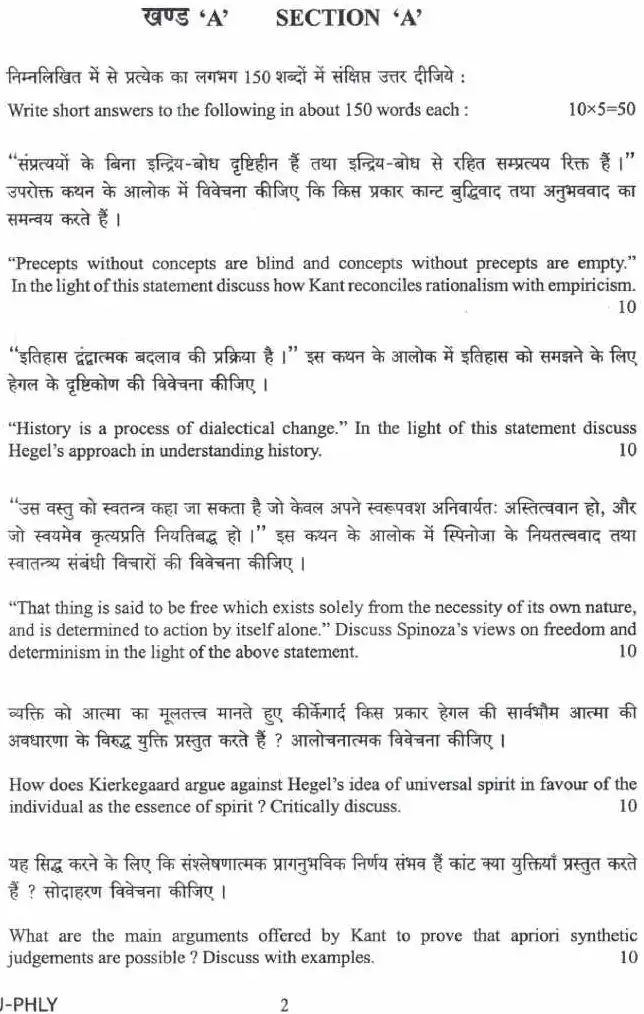
Q1. निम्नलिखित में से प्रत्येक का लगभग 150 शब्दों में संक्षिप्त उत्तर दीजिये:
Write short answers to the following in about 150 words each :
(a) “संप्रत्ययों के बिना इन्द्रिय-बोध दृष्टिहीन हैं तथा इन्द्रिय-बोध से रहित सम्प्रत्यय रिक्त हैं।” उपरोक्त कथन के आलोक में विवेचना कीजिए कि किस प्रकार कान्ट बुद्धिवाद तथा अनुभववाद का समन्वय करते हैं।
"Precepts without concepts are blind and concepts without precepts are empty." In the light of this statement discuss how Kant reconciles rationalism with empiricism.
(b) “इतिहास द्वंद्वात्मक बदलाव की प्रक्रिया है ।” इस कथन के आलोक में इतिहास को समझने के लिए हेगल के दृष्टिकोण की विवेचना कीजिए ।
"History is a process of dialectical change." In the light of this statement discuss Hegel's approach in understanding history.
(c) “उस वस्तु को स्वतन्त्र कहा जा सकता है जो केवल अपने स्वरूपवश अनिवार्यतः अस्तित्ववान हो, और जो स्वयमेव कृत्यप्रति नियतिबद्ध हो ।” इस कथन के आलोक में स्पिनोजा के नियतत्ववाद तथा स्वातन्त्र्य संबंधी विचारों की विवेचना कीजिए ।
"That thing is said to be free which exists solely from the necessity of its own nature, and is determined to action by itself alone." Discuss Spinoza's views on freedom and determinism in the light of the above statement.
(d) व्यक्ति को आत्मा का मूलतत्त्व मानते हुए कीर्केगार्द किस प्रकार हेगल की सार्वभौम आत्मा की अवधारणा के विरुद्ध युक्ति प्रस्तुत करते हैं ? आलोचनात्मक विवेचना कीजिए ।
How does Kierkegaard argue against Hegel's idea of universal spirit in favour of the individual as the essence of spirit? Critically discuss.
(e) यह सिद्ध करने के लिए कि संश्लेषणात्मक प्रागनुभविक निर्णय संभव हैं कांट क्या युक्तियाँ प्रस्तुत करते हैं ? सोदाहरण विवेचना कीजिए ।
What are the main arguments offered by Kant to prove that apriori synthetic judgements are possible ? Discuss with examples.