UPSC Civil Services Main 2023 Geology Paper II PDF

Central Government Jobs Administrative / Civil Services 2023

  • Year 2023
  • Conducted By UPSC
  • Questions 8
  • Maximum Marks 250
  • Duration Three Hours
  • Languages Hindi & English

Exam Details

Detail Information
Examination CIVIL SERVICES (MAIN) EXAMINATION
Year 2023
Conducting Body UPSC
Paper GEOLOGY (PAPER-II)
Subject Geology
Duration Three Hours
Maximum Marks 250
Number of Questions 8
Question Type Mixed

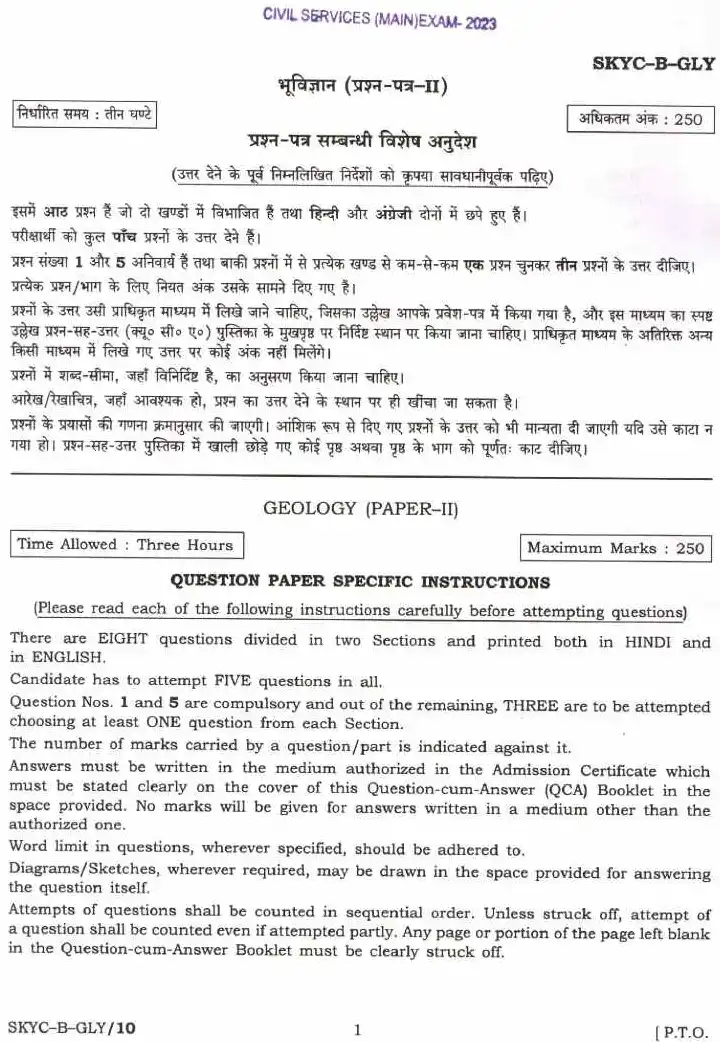
This is the question paper for Geology Paper II of the UPSC Civil Services Main Examination held in 2023. The paper is divided into two sections and contains a total of eight questions, with candidates required to answer five. Compulsory questions are number 1 and 5, and at least one question must be attempted from each section. The paper allows a time duration of three hours and carries a maximum of 250 marks. It is designed to assess the in-depth knowledge of candidates in various aspects of Geology, including crystallography, mineralogy, petrology, and structural geology, with specific word limits for answers.

Major Topics Covered

  • Crystallography
  • Mineralogy
  • Petrology
  • Structural Geology
  • X-ray Diffraction
  • Silicate Minerals
  • Clay Minerals
  • Magma Composition
  • Metamorphism
  • Diagenesis
  • Bragg's Law

Why This Paper is Important

  • Useful for CIVIL SERVICES (MAIN) EXAMINATION preparation
  • Helps understand the latest exam pattern
  • Useful for practice and self-assessment
  • Covers frequently asked General Studies topics
  • Helpful for analysing question trends

Related Resources

  • UPSC Civil Services Main 2023 Geology Paper I
  • UPSC Civil Services Main 2022 Geology Paper II
  • UPSC Civil Services Main 2023 General Studies Paper I
  • UPSC Civil Services Main 2023 Geology Paper II Answer Key
  • UPSC Civil Services Main Geology Syllabus
  • Geology Optional Subject Syllabus for UPSC Mains
  • UPSC Civil Services Main Exam Pattern
  • Geology Optional Exam Pattern UPSC

Instructions

  • इसमें आठ प्रश्न हैं जो दो खण्डों में विभाजित हैं तथा हिन्दी और अंग्रेजी दोनों में छपे हुए हैं।
  • परीक्षार्थी को कुल पाँच प्रश्नों के उत्तर देने हैं।
  • प्रश्न संख्या 1 और 5 अनिवार्य हैं तथा बाकी प्रश्नों में से प्रत्येक खण्ड से कम-से-कम एक प्रश्न चुनकर तीन प्रश्नों के उत्तर दीजिए।
  • प्रत्येक प्रश्न/भाग के लिए नियत अंक उसके सामने दिए गए हैं।
  • प्रश्नों के उत्तर उसी प्राधिकृत माध्यम में लिखे जाने चाहिए, जिसका उल्लेख आपके प्रवेश-पत्र में किया गया है, और इस माध्यम का स्पष्ट उल्लेख प्रश्न-सह-उत्तर (क्यू॰ सी॰ ए॰) पुस्तिका के मुखपृष्ठ पर निर्दिष्ट स्थान पर किया जाना चाहिए।
  • प्राधिकृत माध्यम के अतिरिक्त अन्य किसी माध्यम में लिखे गए उत्तर पर कोई अंक नहीं मिलेंगे।
  • प्रश्नों में शब्द-सीमा, जहाँ विनिर्दिष्ट है, का अनुसरण किया जाना चाहिए।
  • आरेख/रेखाचित्र, जहाँ आवश्यक हो, प्रश्न का उत्तर देने के स्थान पर ही खींचा जा सकता है।
  • प्रश्नों के प्रयासों की गणना क्रमानुसार की जाएगी।
  • आंशिक रूप से दिए गए प्रश्नों के उत्तर को भी मान्यता दी जाएगी यदि उसे काटा न गया हो।
  • प्रश्न-सह-उत्तर पुस्तिका में खाली छोड़े गए कोई पृष्ठ अथवा पृष्ठ के भाग को पूर्णतः काट दीजिए।

  • There are EIGHT questions divided in two Sections and printed both in HINDI and in ENGLISH.
  • Candidate has to attempt FIVE questions in all.
  • Question Nos. 1 and 5 are compulsory and out of the remaining, THREE are to be attempted choosing at least ONE question from each Section.
  • The number of marks carried by a question/part is indicated against it.
  • Answers must be written in the medium authorized in the Admission Certificate which must be stated clearly on the cover of this Question-cum-Answer (QCA) Booklet in the space provided.
  • No marks will be given for answers written in a medium other than the authorized one.
  • Word limit in questions, wherever specified, should be adhered to.
  • Diagrams/Sketches, wherever required, may be drawn in the space provided for answering the question itself.
  • Attempts of questions shall be counted in sequential order.
  • Unless struck off, attempt of a question shall be counted even if attempted partly.
  • Any page or portion of the page left blank in the Question-cum-Answer Booklet must be clearly struck off.

Questions (page 2)

Section A

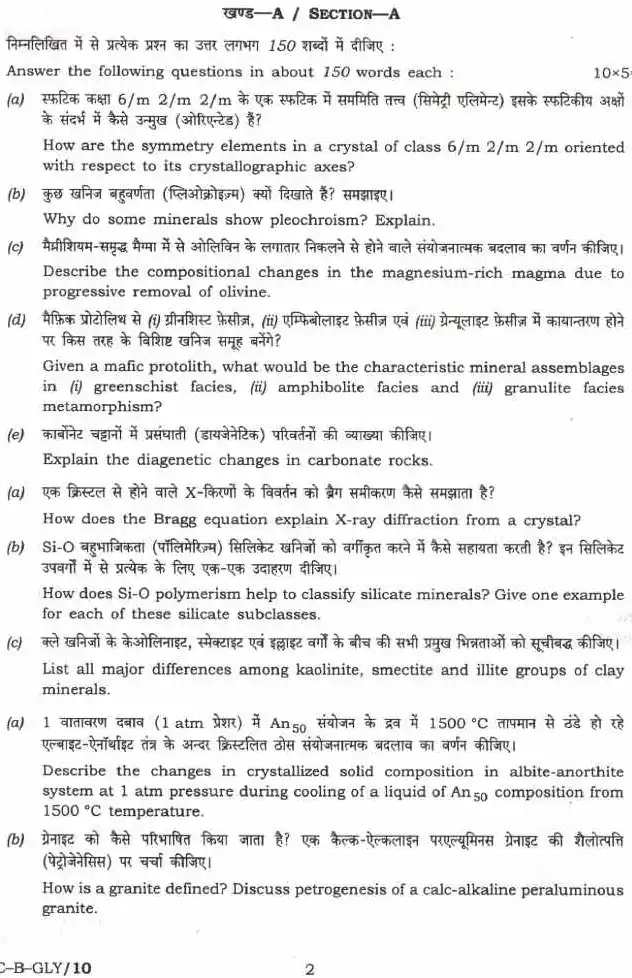
Q1. निम्नलिखित में से प्रत्येक प्रश्न का उत्तर लगभग 150 शब्दों में दीजिए: Answer the following questions in about 150 words each :

(a) स्फटिक कक्षा 6/m rac2m rac2m के एक स्फटिक में सममिति तत्त्व (सिमेट्री एलिमेन्ट) इसके स्फटिकीय अक्षों (a) के संदर्भ में कैसे उन्मुख (ओरिएन्टेड) हैं? How are the symmetry elements in a crystal of class 6/m rac2m rac2m oriented with respect to its crystallographic axes?

(b) कुछ खनिज बहवर्णता (प्लिओक्रोइज़्म) क्यों दिखाते हैं? समझाइए। Why do some minerals show pleochroism? Explain.

(c) मैग्नीशियम-समृद्ध मैग्मा में से ओलिविन के लगातार निकलने से होने वाले संयोजनात्मक बदलाव का वर्णन कीजिए। Describe the compositional changes in the magnesium-rich magma due to progressive removal of olivine.

(d) मैफ़िक प्रोटोलिथ से (i) ग्रीनशिस्ट फ़ेसीज़, (ii) एम्फिबोलाइट फ़ेसीज़ एवं (iii) ग्रेन्यूलाइट फ़ेसीज़ में कायान्तरण होने पर किस तरह के विशिष्ट खनिज समूह बनेंगे? Given a mafic protolith, what would be the characteristic mineral assemblages in (i) greenschist facies, (ii) amphibolite facies and (iii) granulite facies metamorphism?

(e) कार्बोनेट चट्टानों में प्रसंघाती (डायजेनेटिक) परिवर्तनों की व्याख्या कीजिए। Explain the diagenetic changes in carbonate rocks.
Section A

Q2.

(a) एक क्रिस्टल से होने वाले X-किरणों के विवर्तन को ब्रैग समीकरण कैसे समझाता है? How does the Bragg equation explain X-ray diffraction from a crystal?

(b) Si-O बहुभाजिकता (पॉलिमेरिज़्म) सिलिकेट खनिजों को वर्गीकृत करने में कैसे सहायता करती है? इन सिलिकेट उपवर्गों में से प्रत्येक के लिए एक-एक उदाहरण दीजिए। How does Si-O polymerism help to classify silicate minerals? Give one example for each of these silicate subclasses.

(c) क्ले खनिजों के केओलिनाइट, स्मेक्टाइट एवं इल्लाइट वर्गों के बीच की सभी प्रमुख भिन्नताओं को सूचीबद्ध कीजिए। List all major differences among kaolinite, smectite and illite groups of clay minerals.

Section A

Q3.

(a) वातावरण दबाव (1 atm प्रेशर) में An50 संयोजन के द्रव में 1500 °C तापमान से ठंडे हो रहे एल्बाइट-ऐनॉर्थाइट तंत्र के अन्दर क्रिस्टलित ठोस संयोजनात्मक बदलाव का वर्णन कीजिए। Describe the changes in crystallized solid composition in albite-anorthite system at 1 atm pressure during cooling of a liquid of An50 composition from 1500 °C temperature.

(b) ग्रेनाइट को कैसे परिभाषित किया जाता है? एक कैल्क-ऐल्कलाइन परएल्यूमिनस ग्रेनाइट की शैलोत्पत्ति (पेट्रोजेनेसिस) पर चर्चा कीजिए। How is a granite defined? Discuss petrogenesis of a calc-alkaline peraluminous granite.

Question paper preview

Scanned pages 1–2 for reference. Download the official PDF for the full paper.

Page 1
UPSC Civil Services Main 2023 Geology Paper II question paper page 1 instructions scan PDF download
Page 2
UPSC Civil Services Main 2023 Geology Paper II question paper page 1 instructions scan PDF download

Free question paper download

Download question paper PDF

  • 1.9 MB
  • 4 pages
  • PDF format

Frequently asked questions

What is the name of the exam for which this paper is intended?

This paper is for the CIVIL SERVICES (MAIN) EXAMINATION.

Which year is this question paper from?

This question paper is from the year 2023.

Who conducts the Civil Services Main Examination?

The Civil Services Main Examination is conducted by UPSC.

What is the subject and paper code for this question paper?

The subject is GEOLOGY and the paper is PAPER-II, with the code SKYC-B-GLY/10.

What is the maximum marks for this paper?

The maximum marks for this paper are 250.

What is the time allowed to complete this paper?

The time allowed to complete this paper is Three Hours.

← Back to Administrative / Civil Services papers