RPSC Sr. Demonstrator 2015 Pharmacology Question Paper PDF

Rajasthan Government Jobs Other Jobs 2015

  • Year 2015
  • Conducted By RPSC
  • Questions 16
  • Languages English

Exam Details

Detail Information
Examination Senior Demonstrator
Year 2015
Conducting Body RPSC
Paper Pharmacology
Subject Pharmacology
Number of Questions 16
Question Type Objective (MCQ)

This document contains the Senior Demonstrator 2015 Pharmacology question paper conducted by RPSC. It features objective-type questions designed to test candidates' knowledge in Pharmacology. Aspirants preparing for the RPSC Senior Demonstrator examination can use this paper for practice and to understand the exam pattern, difficulty level, and important topics. Analyzing previous years' question papers is a crucial step in effective exam preparation.

Major Topics Covered

  • Pharmacology
  • Drug Interactions
  • Pharmacogenetics
  • Adverse Drug Reactions
  • Sympathomimetics
  • Neuromuscular Blockers
  • Beta-blockers
  • Antiplatelet Agents

Why This Paper is Important

  • Useful for SR. DEMONSTRATOR preparation
  • Helps understand the latest exam pattern
  • Useful for practice and self-assessment
  • Covers frequently asked General Studies topics
  • Helpful for analysing question trends

Related Resources

Instructions

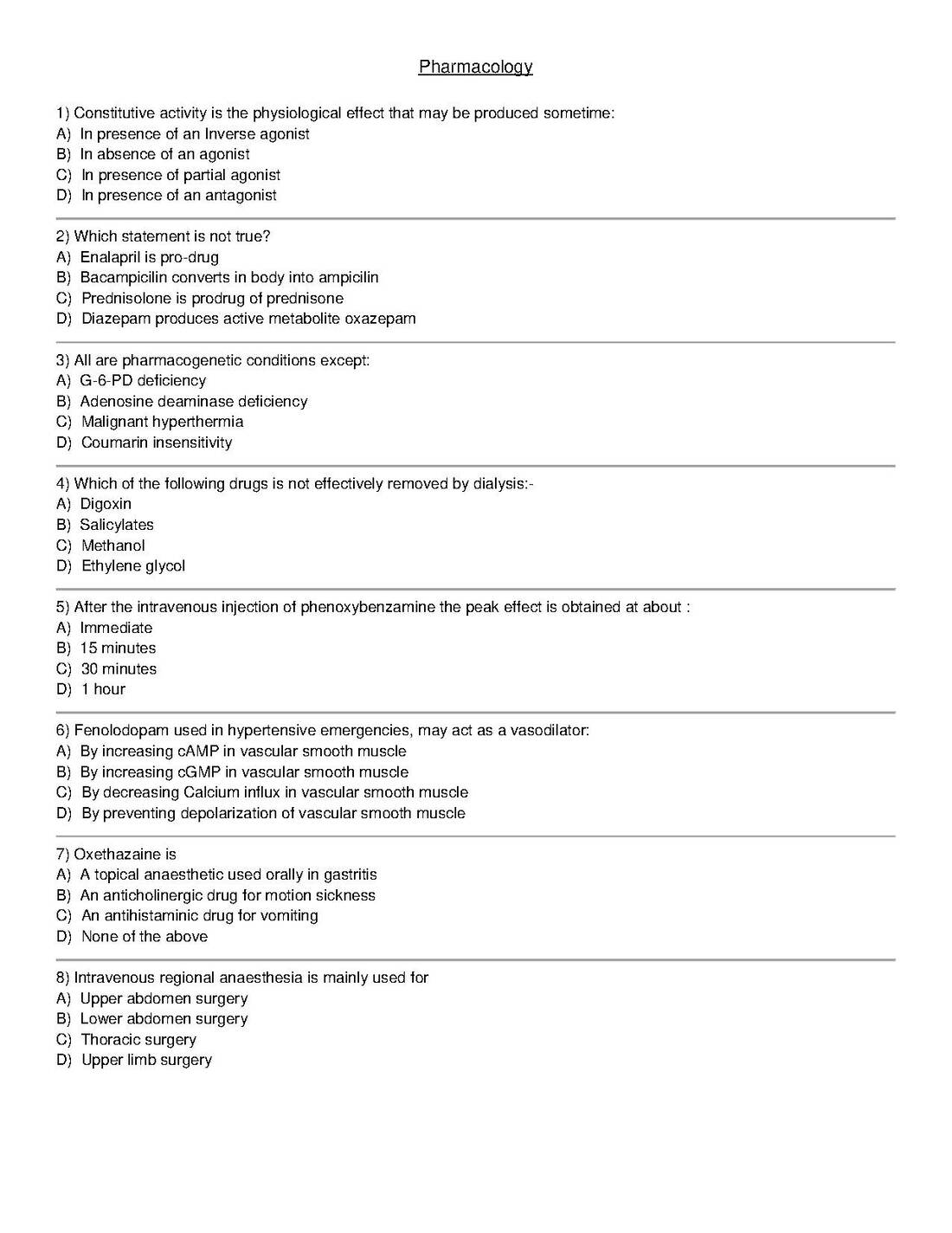
  • Constitutive activity is the physiological effect that may be produced sometime: A) In presence of an Inverse agonist B) In absence of an agonist C) In presence of partial agonist D) In presence of an antagonist

Questions (page 2)

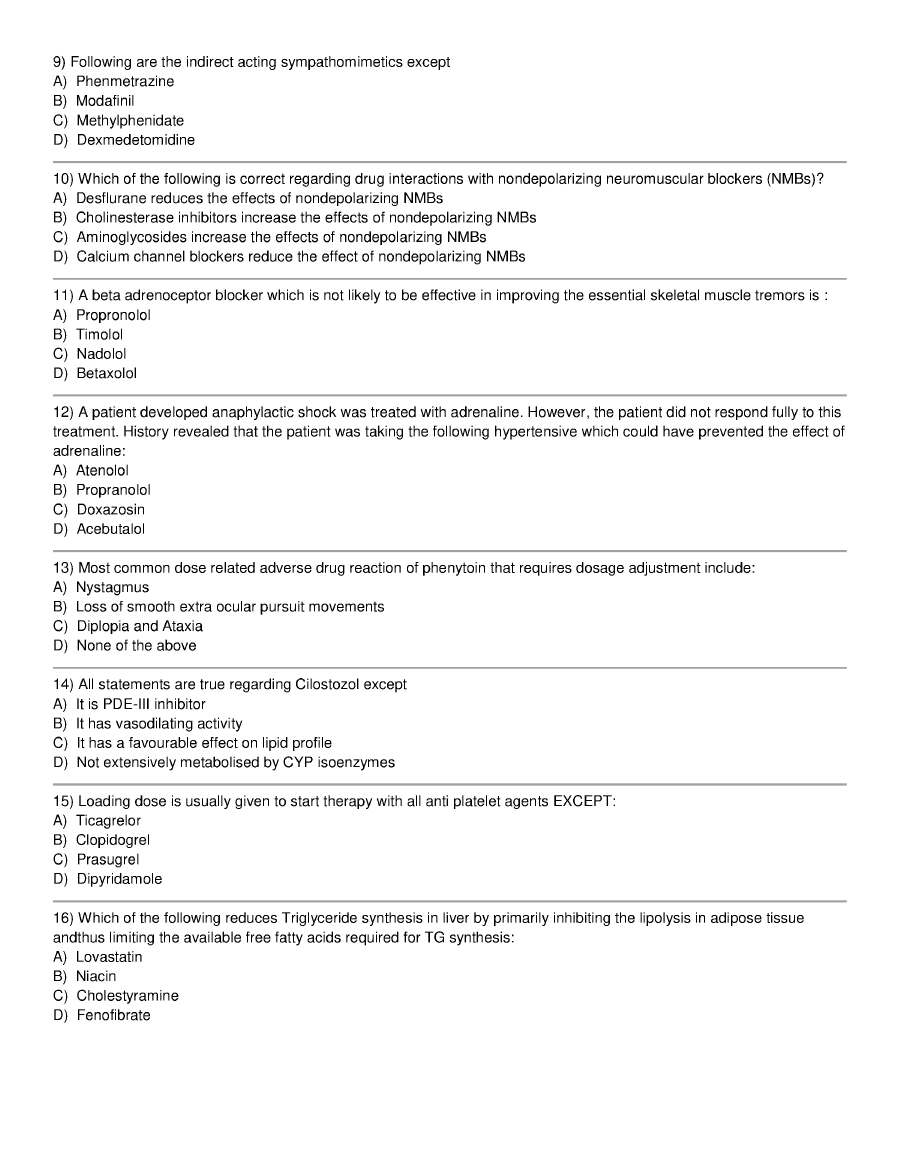
Q9. Following are the indirect acting sympathomimetics except

  • (a) Phenmetrazine
  • (b) Modafinil
  • (c) Methylphenidate
  • (d) Dexmedetomidine

Q10. Which of the following is correct regarding drug interactions with nondepolarizing neuromuscular blockers (NMBs)?

  • (a) Desflurane reduces the effects of nondepolarizing NMBs
  • (b) Cholinesterase inhibitors increase the effects of nondepolarizing NMBs
  • (c) Aminoglycosides increase the effects of nondepolarizing NMBs
  • (d) Calcium channel blockers reduce the effect of nondepolarizing NMBs

Q11. A beta adrenoceptor blocker which is not likely to be effective in improving the essential skeletal muscle tremors is :

  • (a) Propronolol
  • (b) Timolol
  • (c) Nadolol
  • (d) Betaxolol

Q12. A patient developed anaphylactic shock was treated with adrenaline. However, the patient did not respond fully to this treatment. History revealed that the patient was taking the following hypertensive which could have prevented the effect of adrenaline:

  • (a) Atenolol
  • (b) Propranolol
  • (c) Doxazosin
  • (d) Acebutalol

Q13. Most common dose related adverse drug reaction of phenytoin that requires dosage adjustment include:

  • (a) Nystagmus
  • (b) Loss of smooth extra ocular pursuit movements
  • (c) Diplopia and Ataxia
  • (d) None of the above

Q14. All statements are true regarding Cilostozol except

  • (a) It is PDE-III inhibitor
  • (b) It has vasodilating activity
  • (c) It has a favourable effect on lipid profile
  • (d) Not extensively metabolised by CYP isoenzymes

Q15. Loading dose is usually given to start therapy with all anti platelet agents EXCEPT:

  • (a) Ticagrelor
  • (b) Clopidogrel
  • (c) Prasugrel
  • (d) Dipyridamole

Q16. Which of the following reduces Triglyceride synthesis in liver by primarily inhibiting the lipolysis in adipose tissue and thus limiting the available free fatty acids required for TG synthesis:

  • (a) Lovastatin
  • (b) Niacin
  • (c) Cholestyramine
  • (d) Fenofibrate

Question paper preview

Scanned pages 1–2 for reference. Download the official PDF for the full paper.
Page 1
RPSC Sr. Demonstrator 2015 Pharmacology question paper page 1 instructions scan PDF download
Page 2
RPSC Sr. Demonstrator 2015 Pharmacology question paper page 1 instructions scan PDF download

Free question paper download

Download question paper PDF

  • 57 KB
  • 12 pages
  • PDF format

Frequently asked questions

What is the exam name for this question paper?

The exam name is Senior Demonstrator.

What year is this RPSC question paper from?

This question paper is from the year 2015.

Which conducting body released this paper?

This paper was released by RPSC (Rajasthan Public Service Commission).

What subject does this question paper cover?

This question paper covers the subject of Pharmacology.

What type of questions are included in this paper?

This paper consists of objective-type questions.

How many questions are there in this paper?

There are 16 questions in this paper.

← Back to Other Jobs papers