RPSC Chemist 2014 Question Paper PDF | Chemistry

Rajasthan Government Jobs Other Jobs 2014

  • Year 2014
  • Conducted By RPSC
  • Languages English

Exam Details

Detail Information
Examination Chemist
Year 2014
Conducting Body RPSC
Paper Chemist 2014 Question Paper
Subject Chemistry
Question Type Objective (MCQ)

This is the official question paper for the RPSC Chemist examination held in 2014. The paper focuses on the subject of Chemistry and contains objective-type questions. Aspirants preparing for the RPSC Chemist recruitment can use this paper to understand the exam pattern, question difficulty, and important topics. Analyzing previous year papers like this one is crucial for effective exam preparation, helping candidates identify key areas and refine their study strategy. The paper is provided by the Rajasthan Public Service Commission (RPSC).

Major Topics Covered

  • Quantum Numbers
  • Hund's Rule
  • Periodic Table
  • Electronic Configuration
  • Atomic Radii
  • Electronegativity
  • Ionization Enthalpy
  • Chemical Bonding
  • Hybridization
  • Ligand Field Strength
  • Bond Order
  • Transition Elements

Why This Paper is Important

  • Useful for Chemist preparation
  • Helps understand the latest exam pattern
  • Useful for practice and self-assessment
  • Covers frequently asked General Studies topics
  • Helpful for analysing question trends

Related Resources

  • RPSC Chemist 2016 Question Paper
  • RPSC Chemist 2018 Question Paper
  • RPSC Chemist 2020 Question Paper
  • RPSC Chemist 2014 Answer Key
  • RPSC Chemist Syllabus
  • Chemistry Syllabus for Competitive Exams
  • RPSC Chemist Exam Pattern
  • RPSC Exam Pattern Overview

Instructions

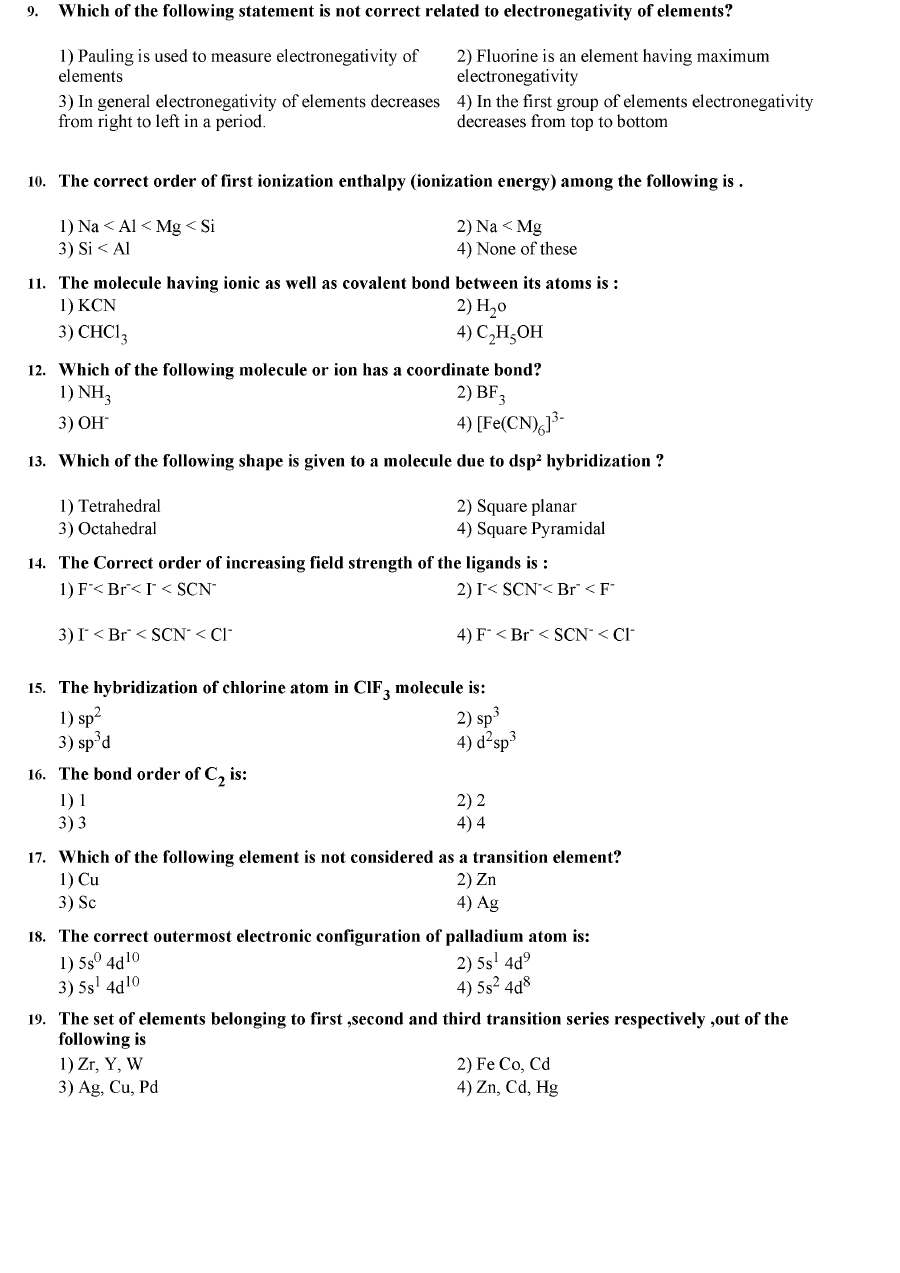
  • 2 and 3 Magnetic orbital quantum number for azimuthal quantum 2 are:
  • -2, -1, 0, +1, +2 (4) + 2, +1, -2, -1 According to Hund's rule the number of unpaired electrons in the atoms of nitrogen ,oxygen and
  • fluorine are respectively: 1) 7, 8, 9 2) 5, 6, 7
  • 9, 8, 7 (4) 3, 2, 1 The maximum possible similar quantum numbers of two electrons present in an orbital of an atom
  • The group having the same number of electrons is: Li+, Na+, K+ Α.
  • N^{3-}, O^{2-}, F^-, Ne C.
  • Which of the following set of elements is not in the correct sequence according to long form of periodic
  • Cr, Mn, Fe, Co which of the following electronic configuration does not belong to a d-block element?
  • 1s^2 2s^2 2p^6 3s^2 3p^6 3d^{10} 4s^2 4p^1
  • 1s^2 2s^2 2p^6 3s^2 3p^6 3d^{10} 4s^2 The Values of atomic radii (in pm) of Na, Be, B and Mg lie in the range of 88 to 186, The value of atomic
  • radii for B(in pm) is : 2) 160 1) 186 4) 88 3) 111

Questions (page 2)

Q9. Which of the following statement is not correct related to electronegativity of elements?

  • (1) Pauling is used to measure electronegativity of elements
  • (2) Fluorine is an element having maximum electronegativity
  • (3) In general electronegativity of elements decreases from right to left in a period.
  • (4) In the first group of elements electronegativity decreases from top to bottom
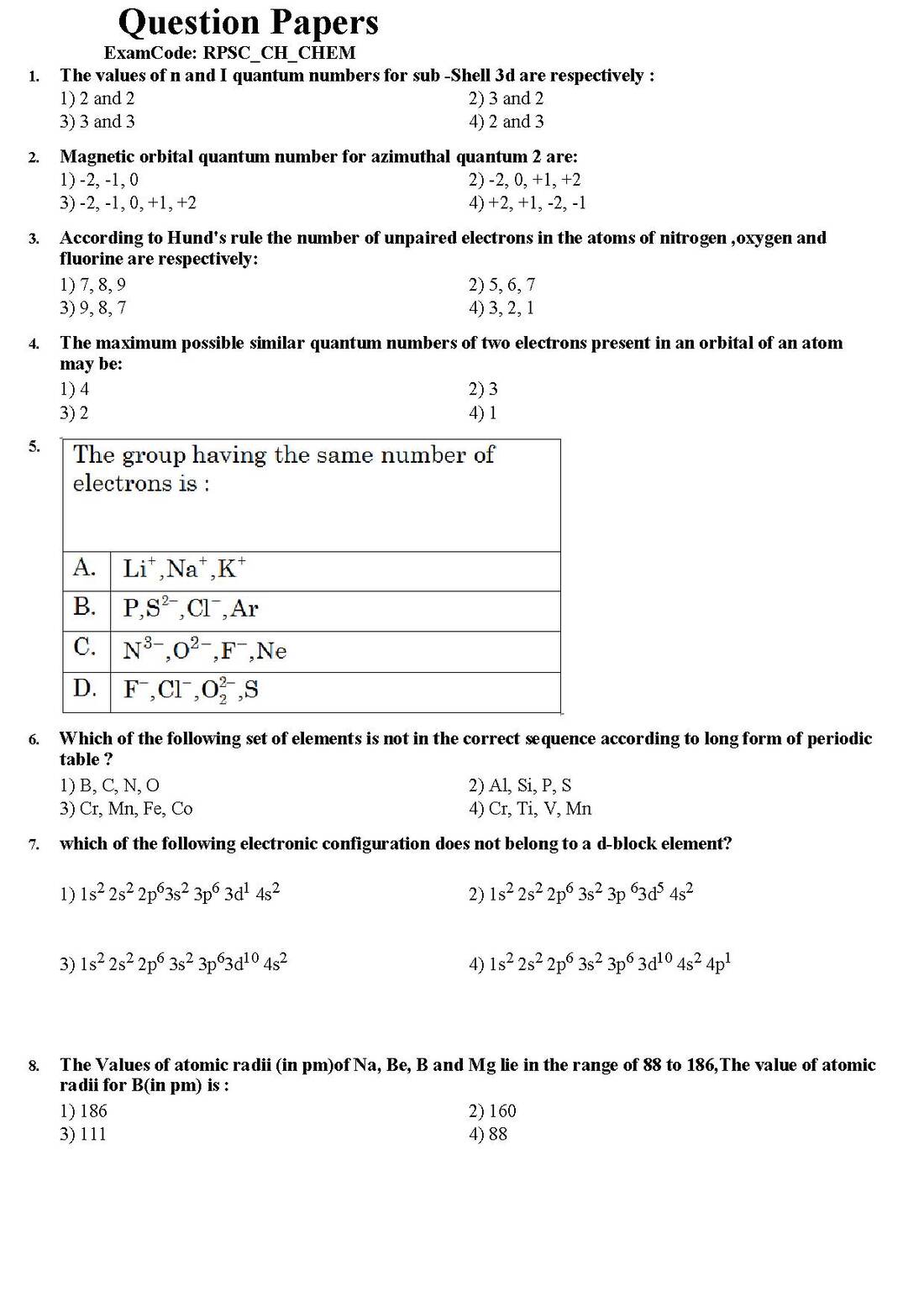
Q10. The correct order of first ionization enthalpy (ionization energy) among the following is .

  • (1) Na < Al < Mg < Si
  • (2) Na < Mg
  • (3) Si < Al
  • (4) None of these

Q11. The molecule having ionic as well as covalent bond between its atoms is:

  • (1) KCN
  • (2) H_{2}O
  • (3) CHCl3
  • (4) C2H5OH

Q12. Which of the following molecule or ion has a coordinate bond?

  • (1) NH3
  • (2) BF3
  • (3) OH^-
  • (4) [Fe(CN)_6]^{3-}

Q13. Which of the following shape is given to a molecule due to dsp2 hybridization ?

  • (1) Tetrahedral
  • (2) Square planar
  • (3) Octahedral
  • (4) Square Pyramidal

Q14. The Correct order of increasing field strength of the ligands is :

  • (1) F < Br < I < SCN
  • (2) I < SCN < Br < F
  • (3) Gamma < Br^- < SCN^- < Cl^-
  • (4) F^- < Br^- < SCN^- < Cl^-

Q15. The hybridization of chlorine atom in ClF3 molecule is:

  • (1) sp2
  • (2) sp3
  • (3) sp^3d
  • (4) d^2sp3

Q16. The bond order of C2 is:

  • (1) 1
  • (2) 2
  • (3) 3
  • (4) 4

Q17. Which of the following element is not considered as a transition element?

  • (1) Cu
  • (2) Zn
  • (3) Sc
  • (4) Ag

Q18. The correct outermost electronic configuration of palladium atom is:

  • (1) 5s0 4d^{10}
  • (2) 5s1 4d9
  • (3) 5s1 4d^{10}
  • (4) 5s2 4d8

Q19. The set of elements belonging to first ,second and third transition series respectively ,out of the following is

  • (1) Zr, Y, W
  • (2) Fe Co, Cd
  • (3) Ag, Cu, Pd
  • (4) Zn, Cd, Hg

Question paper preview

Scanned pages 1–2 for reference. Download the official PDF for the full paper.

Page 1
RPSC Chemist 2014 question paper page 1 scan PDF download, showing exam header and initial chemistry questions.
Page 2
RPSC Chemist 2014 question paper page 1 scan PDF download, showing exam header and initial chemistry questions.

Free question paper download

Download question paper PDF

  • 517 KB
  • 13 pages
  • PDF format

Frequently asked questions

What is the name of the exam?

The exam is for the post of Chemist.

Which year is this question paper from?

This question paper is from the year 2014.

Which conducting body organized this exam?

The exam was conducted by RPSC (Rajasthan Public Service Commission).

What subject does this paper cover?

This paper covers the subject of Chemistry.

What is the question type in this paper?

The paper consists of objective-type questions.

Can I download the RPSC Chemist 2014 question paper?

Yes, the question paper is available for download.

← Back to Other Jobs papers