Maharashtra Engineering Civil Services Main Exam 2011 Civil Engineering Paper III
- Year 2011
- Conducted By IRM
- Maximum Marks 200
- Duration 3 Hours
- Languages English
Exam Details
| Detail | Information |
|---|---|
| Examination | Maharashtra Engineering (Civil) Services Main Examination |
| Year | 2011 |
| Conducting Body | IRM |
| Paper | Civil Engineering - Paper - III |
| Subject | Civil Engineering |
| Duration | 3 Hours |
| Maximum Marks | 200 |
| Question Type | Descriptive and objective |
This document contains the question paper for the Maharashtra Engineering (Civil) Services Main Examination held in 2011. Specifically, it is Paper III for Civil Engineering, conducted by IRM, with a maximum mark of 200 and a time duration of 3 hours. The paper includes a mix of descriptive and objective questions, covering topics such as fluid mechanics, hydraulics, and hydrology. Candidates were instructed to solve one question from each section and not to reproduce questions. The paper also permitted the use of non-programmable calculators but disallowed I.S. Codes and Steel Tables. Key topics covered include Newton's Law of Viscosity, fluid flow dynamics, channel hydraulics, turbine and pump design, capillarity, Bernoulli's theorem, infiltration, and runoff analysis. The questions require detailed explanations, derivations, calculations, and sketches, testing the candidates' comprehensive understanding of civil engineering principles relevant to water resources and fluid mechanics.
Major Topics Covered
- Fluid Mechanics
- Hydraulics
- Hydrology
- Newton's Law of Viscosity
- Viscosity
- Surface Tension
- Fluid Dynamics
- Channel Hydraulics
- Turbines
- Pumps
- Capillarity
- Hydrostatic Pressure
- Bernoulli's Theorem
- Dimensionless Numbers
- Infiltration
- Runoff
- Water Resources Engineering
- Civil Engineering
- Maharashtra Engineering Services
- Question Papers
Why This Paper is Important
- Useful for Maharashtra Engineering (Civil) Services preparation
- Helps understand the latest exam pattern
- Useful for practice and self-assessment
- Covers frequently asked General Studies topics
- Helpful for analysing question trends
Related Resources
Instructions
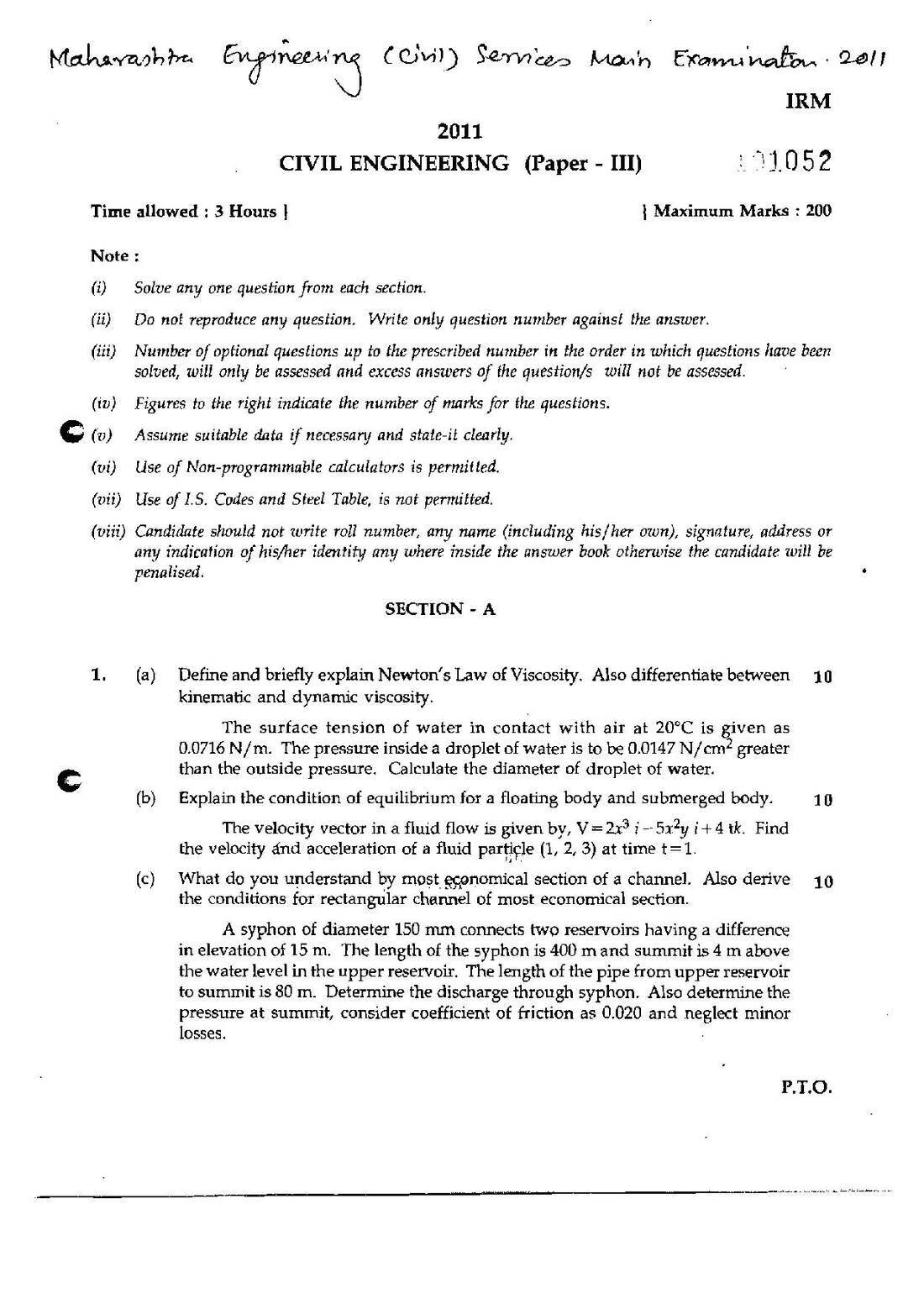
- Maharashtra Engineering (Civil) Services Marin Examination-2011 IRM 2011 191052 CIVIL ENGINEERING (Paper - III) { Maximum Marks: 200 Time allowed : 3 Hours }
- Note: (i) Solve any one question from each section.
Questions (page 2)
Q2.
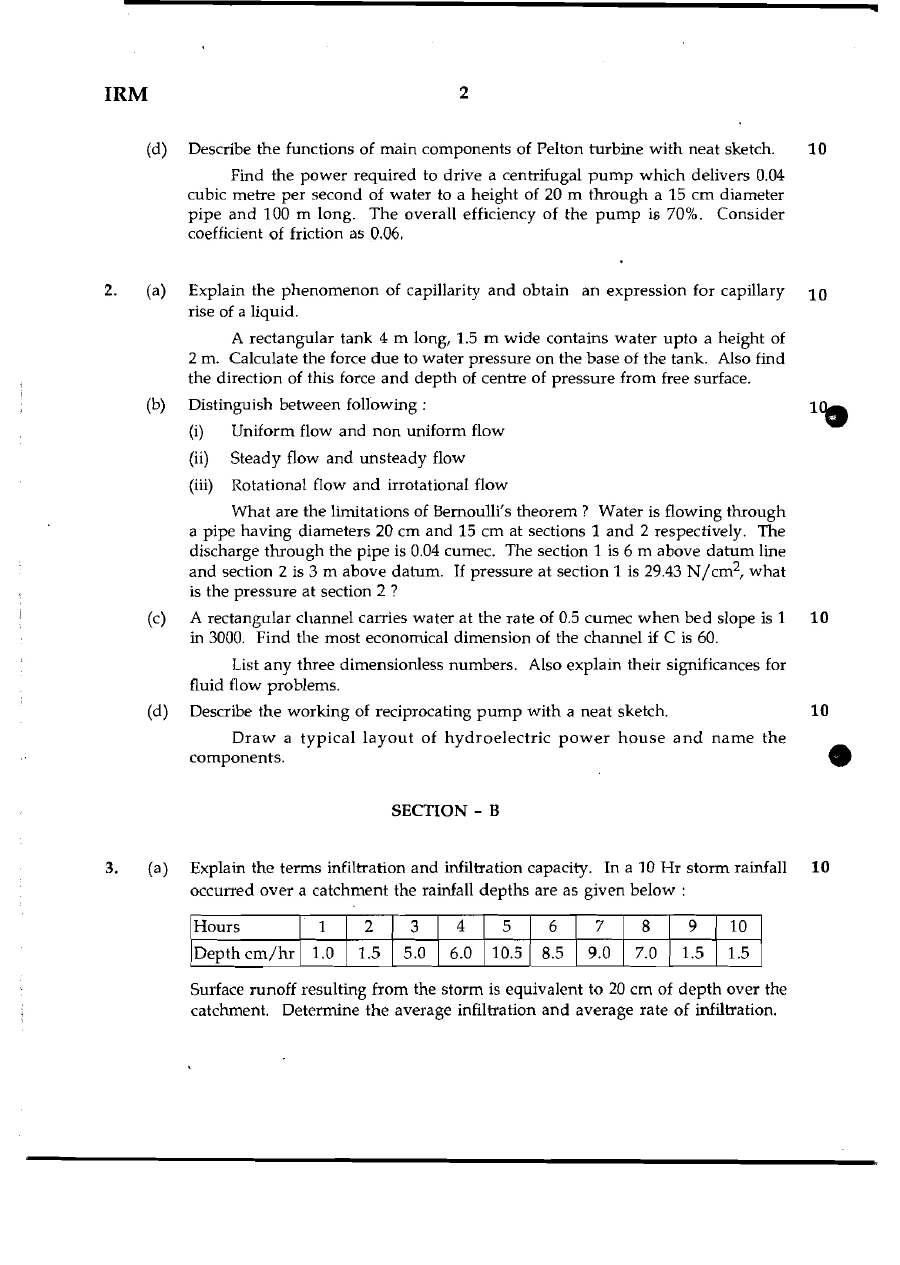
- (a) Explain the phenomenon of capillarity and obtain an expression for capillary rise of a liquid. A rectangular tank 4 m long, 1.5 m wide contains water upto a height of 2 m. Calculate the force due to water pressure on the base of the tank. Also find the direction of this force and depth of centre of pressure from free surface.
-
(b)
Distinguish between following:
(i) Uniform flow and non uniform flow Steady flow and unsteady flow
(ii)
(iii) Rotational flow and irrotational flow What are the limitations of Bernoulli's theorem? Water is flowing through a pipe having diameters cm and cm at sections 1 and 2 respectively. The discharge through the pipe is 0.04 cumec. The section 1 is 6 m above datum line and section 2 is 3 m above datum. If pressure at section 1 is 29.43 N/cm2, what is the pressure at section 2? - (c) A rectangular channel carries water at the rate of 0.5 cumec when bed slope is 1 in 3000. Find the most economical dimension of the channel if C is 60.
- (d) List any three dimensionless numbers. Also explain their significances for fluid flow problems. Describe the working of reciprocating pump with a neat sketch. Draw a typical layout of hydroelectric power house and name the components. SECTION - B 10 3. Explain the terms infiltration and infiltration capacity. In a Hr storm rainfall (a) occurred over a catchment the rainfall depths are as given below : 2 3 9 4 6 7 Hours 1 5 10 1.5 5.0 6.0 10.5 8.5 9.0 7.0 1.5 Depth cm/hr 1.0 1.5 Surface runoff resulting from the storm is equivalent to cm of depth over the catchment. Determine the average infiltration and average rate of infiltration.
Q3. The surface tension of water in contact with air at 20circC is given as 0.0716 N/m. The pressure inside a droplet of water is to be 0.0147 N/cm2 greater than the outside pressure. Calculate the diameter of droplet of water.
Q4. Explain the condition of equilibrium for a floating body and submerged body.
Q5. The velocity vector in a fluid flow is given by, V = 2x3 i - 5x2y i + 4 tk. Find the velocity and acceleration of a fluid particle (1, 2, 3) at time t = 1.
Q6. What do you understand by most economical section of a channel. Also derive the conditions for rectangular channel of most economical section.
Q7. A syphon of diameter 150 mm connects two reservoirs having a difference in elevation of 15 m. The length of the syphon is 400 m and summit is 4 m above the water level in the upper reservoir. The length of the pipe from upper reservoir to summit is 80 m. Determine the discharge through syphon. Also determine the pressure at summit, consider coefficient of friction as 0.020 and neglect minor losses.
Q8. Describe the functions of main components of Pelton turbine with neat sketch.
Q9. Find the power required to drive a centrifugal pump which delivers 0. 04 cubic metre per second of water to a height of 20 m through a 15 cm diameter pipe and 100 m long. The overall efficiency of the pump is 70%. Consider coefficient of friction as 0.
Q10. Explain the phenomenon of capillarity and obtain an expression for capillary rise of a liquid.
Q11. A rectangular tank 4 m long, 1.5 m wide contains water upto a height of 2 m. Calculate the force due to water pressure on the base of the tank. Also find the direction of this force and depth of centre of pressure from free surface.
Q12.
Distinguish between following:
(i) Uniform flow and non uniform flow
(ii) Steady flow and unsteady flow
(iii) Rotational flow and irrotational flow
Question paper preview
Scanned pages 1–2 for reference. Download the official PDF for the full paper.
Free question paper download
Download question paper PDF
Your download starts in 10s
Preparing your question paper file…
Frequently asked questions
What is the exam name and year?
The exam is the Maharashtra Engineering (Civil) Services Main Examination, held in 2011.
Which paper is this question set for?
This is for Civil Engineering - Paper - III.
What is the maximum marks and time allowed?
The maximum marks are 200, and the time allowed is 3 hours.
Who conducted the examination?
The examination was conducted by IRM.
What type of questions are included in the paper?
The paper includes both descriptive and objective questions.
What are some key topics covered in Fluid Mechanics?
Key topics include Newton's Law of Viscosity, kinematic and dynamic viscosity, surface tension, fluid flow velocity and acceleration, most economical channel sections, syphon discharge, Pelton turbines, centrifugal pumps, capillarity, hydrostatic force, Bernoulli's theorem, and dimensionless numbers.