JPSC Drug Inspector 2013 Pharmacology Question Paper PDF
- Year 2013
- Conducted By JPSC
- Questions 100
- Maximum Marks 100
- Duration 2 Hours
- Languages English
Exam Details
| Detail | Information |
|---|---|
| Examination | DRUG INSPECTOR RECRUITMENT EXAM |
| Year | 2013 |
| Conducting Body | JPSC |
| Paper | Pharmacology |
| Subject | Pharmacology |
| Duration | 2 Hours |
| Maximum Marks | 100 |
| Number of Questions | 100 |
| Question Type | Objective (MCQ) |
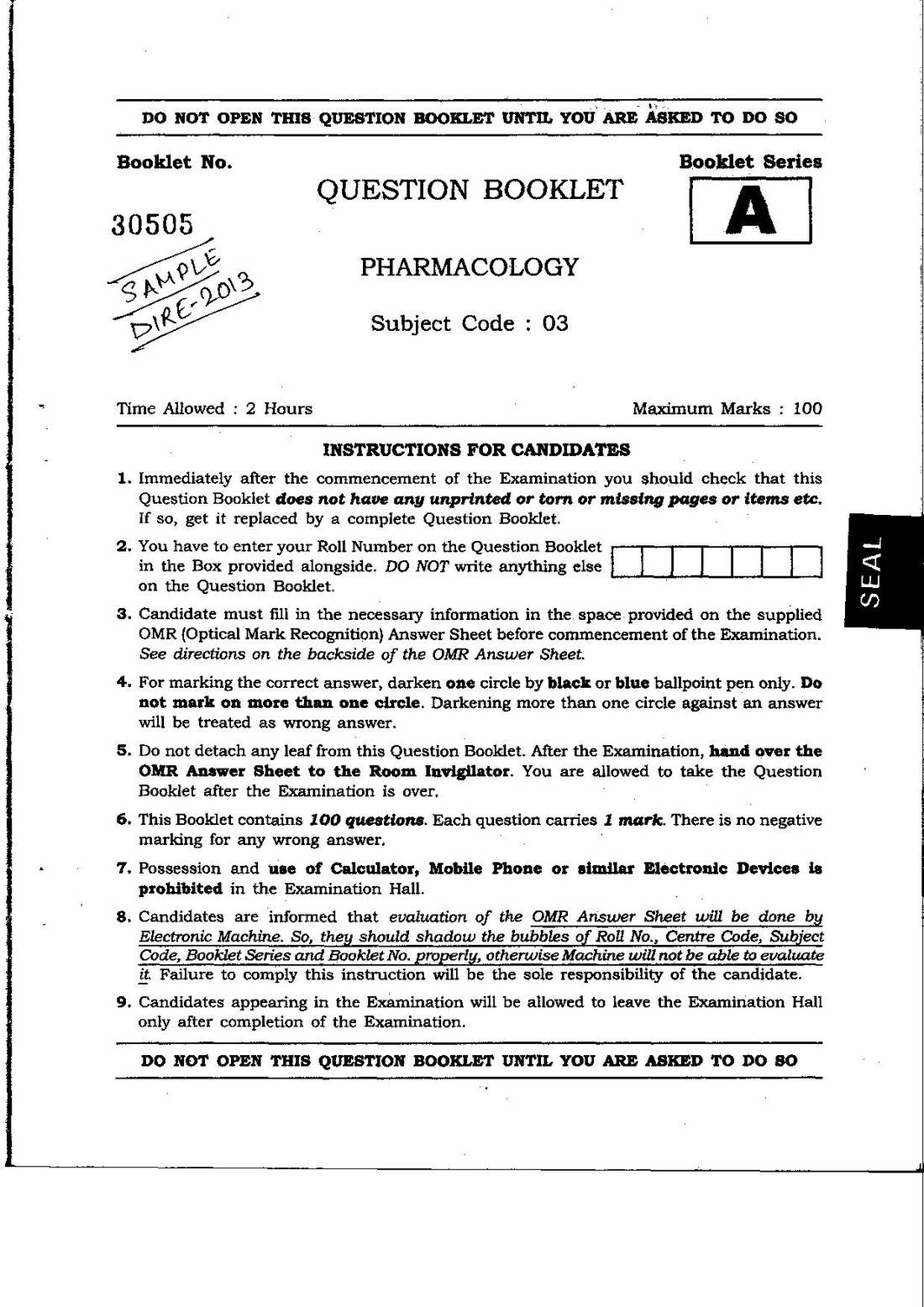
This document contains the official question paper for the JPSC Drug Inspector Recruitment Exam held in 2013. The paper focuses on Pharmacology (Subject Code 03), carrying a maximum of 100 marks and allowing 2 hours for completion. It consists of 100 objective-type questions, each worth 1 mark, with no negative marking. This paper is an invaluable resource for aspirants preparing for the Drug Inspector examination, offering insights into the exam pattern, difficulty level, and key topics covered. Practicing with this paper can significantly enhance preparation and boost confidence.
Major Topics Covered
- Pharmacology
- Toxicology
- Drug Administration
- Adverse Effects
- Anaphylaxis
- Adrenoceptor Antagonists
- Body Mass Index
Why This Paper is Important
- Useful for DRUG INSPECTOR RECRUITMENT EXAM preparation
- Helps understand the latest exam pattern
- Useful for practice and self-assessment
- Covers frequently asked General Studies topics
- Helpful for analysing question trends
Related Resources
- JPSC Drug Inspector 2015 Pharmacology Question Paper
- JPSC Drug Inspector 2011 Pharmacology Question Paper
- Pharmacology Previous Year Papers for Other Exams
- JPSC Drug Inspector 2013 Pharmacology Answer Key
- JPSC Drug Inspector Syllabus
- Pharmacology Syllabus for Competitive Exams
- JPSC Drug Inspector Exam Pattern
- Objective Exam Pattern for Drug Inspector
Instructions
- Immediately after the commencement of the Examination you should check that this Question Booklet does not have any unprinted or torn or missing pages or items etc.
- If so, get it replaced by a complete Question Booklet.
- You have to enter your Roll Number on the Question Booklet in the Box provided alongside.
- DO NOT write anything else on the Question Booklet.
- Candidate must fill in the necessary information in the space provided on the supplied OMR (Optical Mark Recognition) Answer Sheet before commencement of the Examination.
- See directions on the backside of the OMR Answer Sheet.
- For marking the correct answer, darken one circle by black or blue ballpoint pen only.
- Darkening more than one circle against an answer will be treated as wrong answer.
- Do not detach any leaf from this Question Booklet.
- After the Examination, hand over the OMR Answer Sheet to the Room Invigilator.
- You are allowed to take the Question Booklet after the Examination is over.
- This Booklet contains 100 questions. Each question carries 1 mark. There is no negative marking for any wrong answer.
- Possession and use of Calculator, Mobile Phone or similar Electronic Devices is prohibited in the Examination Hall.
- Candidates are informed that evaluation of the OMR Answer Sheet will be done by Electronic Machine.
- So, they should shadow the bubbles of Roll No., Centre Code, Subject Code, Booklet Series and Booklet No. properly, otherwise Machine will not be able to evaluate it.
- Failure to comply this instruction will be the sole responsibility of the candidate.
- Candidates appearing in the Examination will be allowed to leave the Examination Hall only after completion of the Examination.
- DO NOT OPEN THIS OUESTION BOOKLET UNTIL YOU ARE ASKED TO DO SO
Questions (page 2)
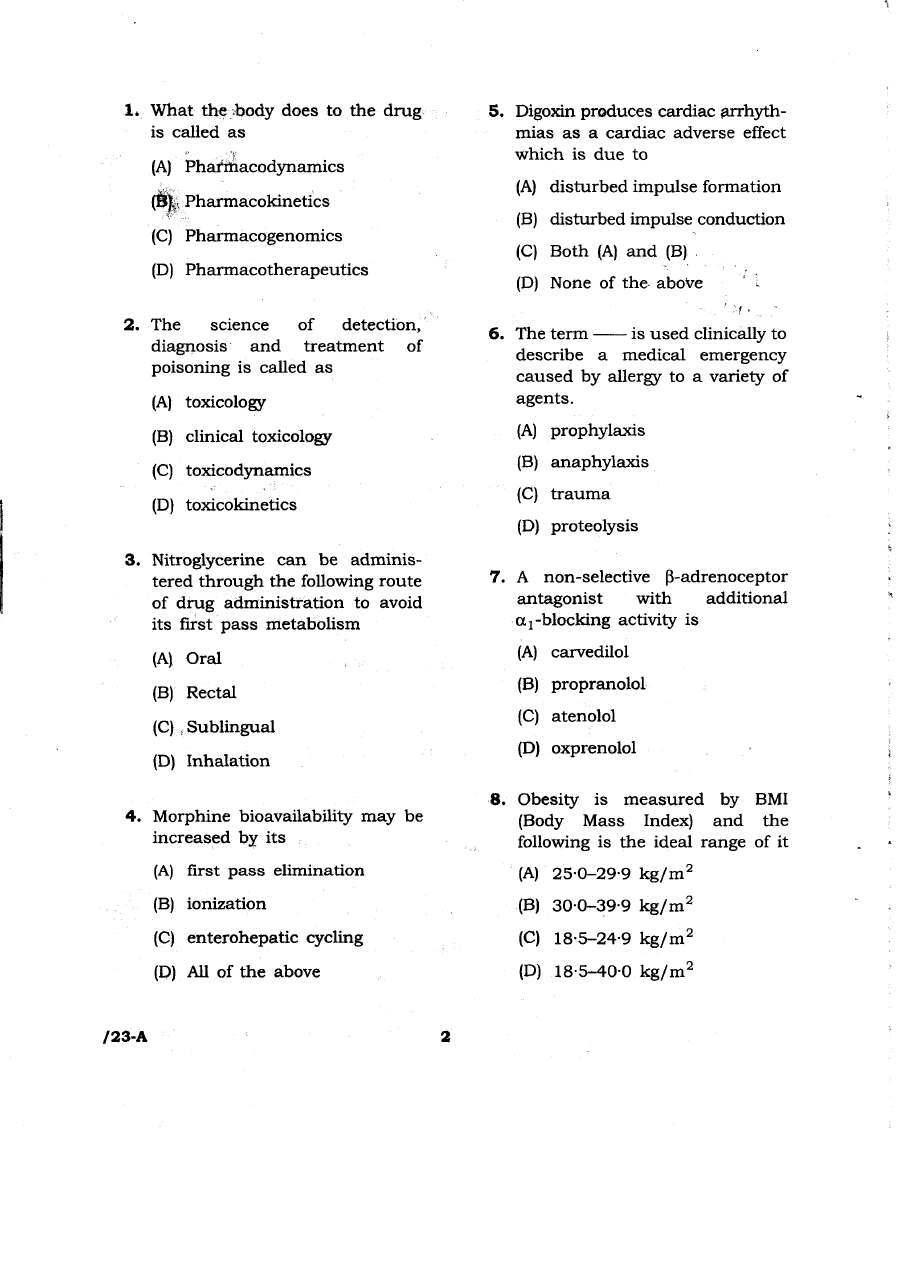
Q2. The science of detection, diagnosis and treatment of poisoning is called as
Q3. Nitroglycerine can be administered through the following route of drug administration to avoid its first pass metabolism
Q4. Morphine bioavailability may be increased by its
Q5. Digoxin produces cardiac arrhythmias as a cardiac adverse effect which is due to
Q6. The term ______ is used clinically to describe a medical emergency caused by allergy to a variety of agents.
Q7. A non-selective β-adrenoceptor antagonist with additional α₁-blocking activity is
Q8. Obesity is measured by BMI (Body Mass Index) and the following is the ideal range of it
Question paper preview
Scanned pages 1–2 for reference. Download the official PDF for the full paper.
Free question paper download
Download question paper PDF
Your download starts in 10s
Preparing your question paper file…
Frequently asked questions
What is the name of the exam?
The exam is the DRUG INSPECTOR RECRUITMENT EXAM.
Which year is this question paper from?
This question paper is from the year 2013.
Who is the conducting body for this exam?
The conducting body is JPSC.
What is the subject of this question paper?
The subject is Pharmacology, with Subject Code 03.
What is the total time allowed for the exam?
The time allowed for the exam is 2 Hours.
What are the maximum marks for this paper?
The maximum marks for this paper are 100.