Section B
JPSC Forestry Paper-II Main Exam 2024 Question Paper PDF
- Conducted By JPSC
- Maximum Marks 200
- Duration 3 Hours
- Languages Hindi & English
Exam Details
| Detail | Information |
|---|---|
| Examination | FOREST RANGE OFFICER, MAIN EXAMINATION |
| Conducting Body | JPSC |
| Paper | Forestry Paper-II |
| Subject | Forestry |
| Duration | 3 Hours |
| Maximum Marks | 200 |
| Question Type | Descriptive / Subjective |
This document contains the JPSC Forest Range Officer Main Examination question paper for Forestry Paper-II. The exam, conducted by JPSC, has a maximum mark of 200 and is allocated 3 hours. The paper is divided into two sections: Section A with compulsory subjective questions (10 marks each) and Section B with optional subjective questions (40 marks each). Aspirants preparing for the Forest Range Officer recruitment can use this paper to understand the exam structure, question types, and important topics in Forestry.
Major Topics Covered
- Resin Tapping
- Bidi Leaf Collection and Processing
- Tree Diameter Measurement
- Building Materials
- Forestry Management
- Working Plan
- Herbarium
- Timber Defects
- Wild Animal Damage Control
- Forest Fire Control
- National Forest Policy
Why This Paper is Important
- Useful for FOREST RANGE OFFICER, MAIN EXAMINATION preparation
- Helps understand the latest exam pattern
- Useful for practice and self-assessment
- Covers frequently asked General Studies topics
- Helpful for analysing question trends
Related Resources
- JPSC Forestry Paper-I Question Paper
- UPSC Forest Service Exam Previous Year Papers
- State Forest Officer Exam Question Papers
- JPSC Forestry Paper-II Answer Key 2024
- Forest Range Officer Main Exam Answer Key
- JPSC Forest Range Officer Syllabus
- Forestry Syllabus for Competitive Exams
- JPSC Main Examination Pattern
Instructions
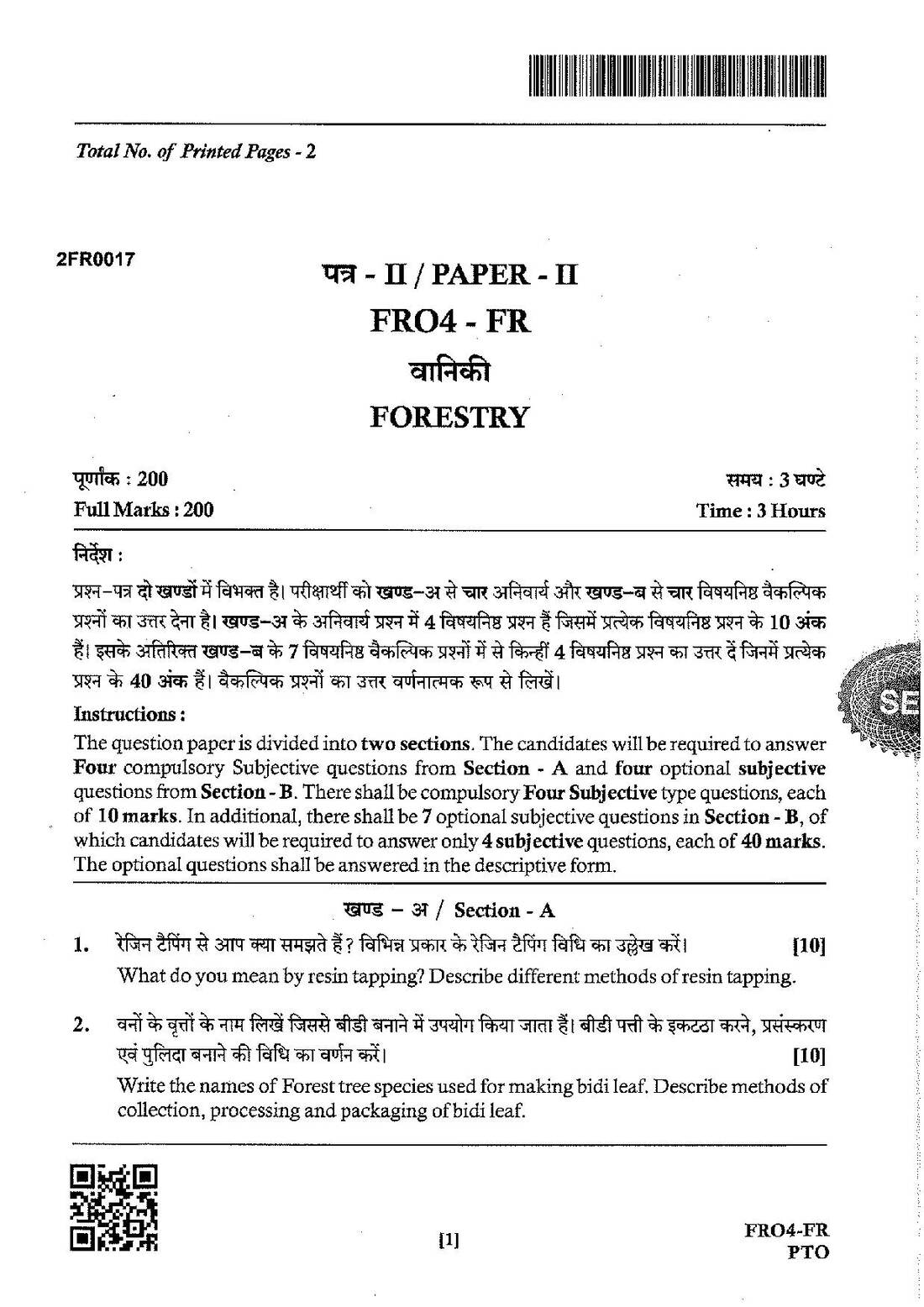
- [10] What do you mean by resin tapping? Describe different methods of resin tapping. वनों के वृत्तों के नाम लिखें जिससे बीडी बनाने में उपयोग किया जाता हैं।
- एवं पुलिदा बनाने की विधि का वर्णन करें। [10] Write the names of Forest tree species used for making bidi leaf. Describe methods of collection, processing and packaging of bidi leaf. FRO4-FR [1] PTO
Questions (page 2)
Section B
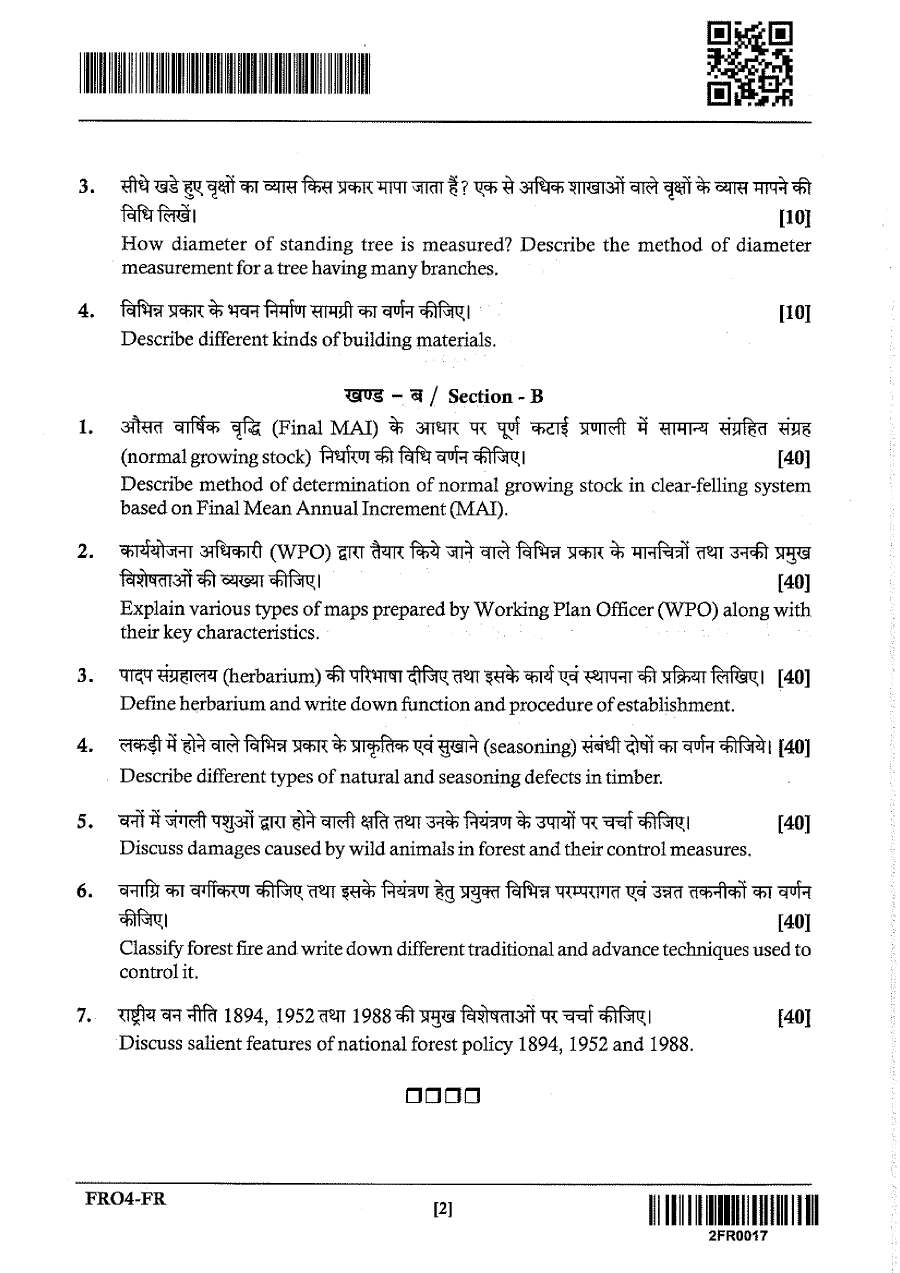
Q2. विशेषताओं की व्यख्या कीजिए। [40] Explain various types of maps prepared by Working Plan Officer (WPO) along with their key characteristics. पादप संग्रहालय (herbarium) की परिभाषा दीजिए तथा इसके कार्य एवं स्थापना की प्रक्रिया लिखिए। [40]
Section B
Q3. Define herbarium and write down function and procedure of establishment. लकड़ी में होने वाले विभिन्न प्रकार के प्राकृतिक एवं सुखाने (seasoning) संबंधी दोषों का वर्णन कीजिये। [40]
Section B
Q4. Describe different types of natural and seasoning defects in timber. वनों में जंगली पशुओं द्वारा होने वाली क्षति तथा उनके नियंत्रण के उपायों पर चर्चा कीजिए।
Section B
Q5. [40] Discuss damages caused by wild animals in forest and their control measures. वनाग्नि का वर्गीकरण कीजिए तथा इसके नियंत्रण हेतु प्रयुक्त विभिन्न परम्परागत एवं उन्नत तकनीकों का वर्णन
Section B
Q6. कीजिए। [40] Classify forest fire and write down different traditional and advance techniques used to control it. राष्ट्रीय वन नीति 1894, 1952 तथा 1988 की प्रमुख विशेषताओं पर चर्चा कीजिए। [40]
Section B
Q7. Discuss salient features of national forest policy 1894, 1952 and 1988. 0000 FRO4-FR [2]
Question paper preview
Scanned pages 1–2 for reference. Download the official PDF for the full paper.
Free question paper download
Download question paper PDF
Your download starts in 10s
Preparing your question paper file…
Frequently asked questions
What is the name of the exam?
The exam is the FOREST RANGE OFFICER, MAIN EXAMINATION.
Which paper is this question paper for?
This is for Forestry Paper-II.
Who conducts the JPSC Forest Range Officer Main Examination?
The examination is conducted by JPSC.
What is the maximum marks for this paper?
The maximum marks for this paper are 200.
What is the time duration allowed for this paper?
The time allowed for this paper is 3 Hours.
What is the question paper structure?
The question paper is divided into two sections: Section A (compulsory subjective questions) and Section B (optional subjective questions).